Get your free personalized podcast brief
We scan new podcasts and send you the top 5 insights daily.
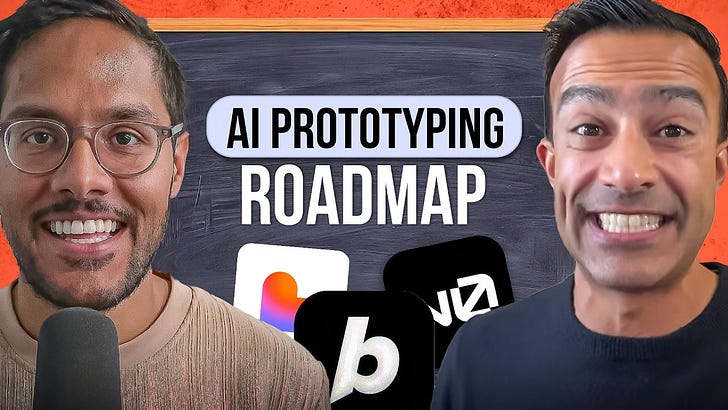
True AI prototyping mastery isn't about a single tool. It involves a structured progression through 15 distinct skills, from basic prompting (Apprentice) to versioning (Journeyman) and creating fully functional prototypes (Master). This ladder turns "AI slop" into high-craft work.
Related Insights
For product managers not yet working on AI, the best way to gain experience is to build simple AI tools for personal use cases, like a parenting advisor or a board game timer. Using no-code prototyping tools, they can learn the entire development lifecycle—from ideation to prompting and user feedback—without needing an official AI project at work.
Capable AI coding assistants allow PMs to build and test functional prototypes or "skills" in a single day. This changes the product development philosophy, prioritizing quick validation with users over creating detailed UI mockups and specifications upfront.

Frame AI agent development like training an intern. Initially, they need clear instructions, access to tools, and your specific systems. They won't be perfect at first, but with iterative feedback and training ('progress over perfection'), they can evolve to handle complex tasks autonomously.
Vercel designer Pranati Perry advises viewing AI models as interns. This mindset shifts the focus from blindly accepting output to actively guiding the AI and reviewing its work. This collaborative approach helps designers build deeper technical understanding rather than just shipping code they don't comprehend.

Instead of asking an AI to directly build something, the more effective approach is to instruct it on *how* to solve the problem: gather references, identify best-in-class libraries, and create a framework before implementation. This means working one level of abstraction higher than the code itself.

Don't ask an AI agent to build an entire product at once. Structure your plan as a series of features. For each step, have the AI build the feature, then immediately write a test for it. The AI should only proceed to the next feature once the current one passes its test.

For PMs struggling to get AI experience at their current job, building a ChatGPT app serves as a powerful portfolio project. The end-to-end process—from prompting an idea to running evals—simulates the full AI product development lifecycle, demonstrating valuable, hands-on skills to potential employers.

A truly effective skill isn't created in one shot. The best practice is to treat the first version as a draft, then iteratively refine it through research, self-critique, and testing to make the AI "think like an expert, not just follow steps."
AI prototyping should be viewed as a fundamental skill for modern PMs, not an extra job responsibility. Just like using Figma to communicate design, AI prototyping tools allow PMs to make abstract AI concepts tangible for stakeholders and customers. This accelerates feedback loops and improves alignment on complex product behaviors.
Non-technical creators using AI coding tools often fail due to unrealistic expectations of instant success. The key is a mindset shift: understanding that building quality software is an iterative process of prompting, testing, and debugging, not a one-shot command that works in five prompts.