Get your free personalized podcast brief
We scan new podcasts and send you the top 5 insights daily.
To ensure AI reliability, Salesforce builds environments that mimic enterprise CRM workflows, not game worlds. They use synthetic data and introduce corner cases like background noise, accents, or conflicting user requests to find and fix agent failure points before deployment, closing the "reality gap."

Related Insights
Contrary to the vision of free-wheeling autonomous agents, most business automation relies on strict Standard Operating Procedures (SOPs). Products like OpenAI's Agent Builder succeed by providing deterministic, node-based workflows that enforce business logic, which is more valuable than pure autonomy.

Instead of replacing top performers, AI should be used to do work humans physically cannot. Salesforce targeted a backlog of 100 million 'orphan leads,' using an AI agent to work through 8,000 dormant leads in three weeks. This generated $500,000 in pipeline that would have otherwise been zero.

Effective enterprise AI deployment involves running human and AI workflows in parallel. When the AI fails, it generates a data point for fine-tuning. When the human fails, it becomes a training moment for the employee. This "tandem system" creates a continuous feedback loop for both the model and the workforce.
The biggest hurdle for enterprise AI adoption is uncertainty. A dedicated "lab" environment allows brands to experiment safely with partners like Microsoft. This lets them pressure-test AI applications, fine-tune models on their data, and build confidence before deploying at scale, addressing fears of losing control over data and brand voice.
Training AI agents to execute multi-step business workflows demands a new data paradigm. Companies create reinforcement learning (RL) environments—mini world models of business processes—where agents learn by attempting tasks, a more advanced method than simple prompt-completion training (SFT/RLHF).
Treating AI evaluation like a final exam is a mistake. For critical enterprise systems, evaluations should be embedded at every step of an agent's workflow (e.g., after planning, before action). This is akin to unit testing in classic software development and is essential for building trustworthy, production-ready agents.
To test complex AI prompts for tasks like customer persona generation without exposing sensitive company data, first ask the AI to create realistic, synthetic data (e.g., fake sales call notes). This allows you to safely develop and refine prompts before applying them to real, proprietary information, overcoming data privacy hurdles in experimentation.

Unlike deterministic SaaS software that works consistently, AI is probabilistic and doesn't work perfectly out of the box. Achieving 'human-grade' performance (e.g., 99.9% reliability) requires continuous tuning and expert guidance, countering the hype that AI is an immediate, hands-off solution.

Developers often test AI systems with well-formed, correctly spelled questions. However, real users submit vague, typo-ridden, and ambiguous prompts. Directly analyzing these raw logs is the most crucial first step to understanding how your product fails in the real world and where to focus quality improvements.

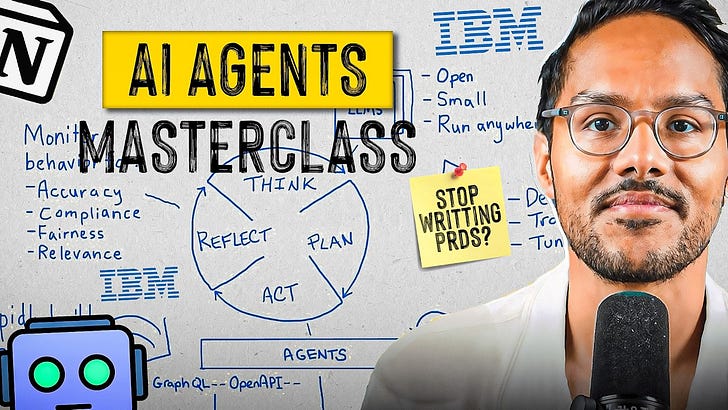
Salesforce's Chief AI Scientist explains that a true enterprise agent comprises four key parts: Memory (RAG), a Brain (reasoning engine), Actuators (API calls), and an Interface. A simple LLM is insufficient for enterprise tasks; the surrounding infrastructure provides the real functionality.