Get your free personalized podcast brief
We scan new podcasts and send you the top 5 insights daily.
By running development and knowledge tools like Claude Code on a home server and accessing them via a secure personal VPN like Tailscale, you can transform a mobile phone into a powerful terminal for deep work, including coding and research, from anywhere.

Related Insights
The power of tools like Claude Code comes from giving the AI access to fundamental command-line tools (e.g., `bash`, `grep`). This allows the AI to compose novel solutions and lets product teams define new features using simple English prompts rather than hard-coded logic.
Monologue's developer treats AI tools like Claude Code and GPT-5 as his engineering team. He credits GPT-5's ability to navigate poorly documented, legacy Mac code from the 1980s as a "biggest unlock," enabling him to build a production-grade app without hiring specialist developers.
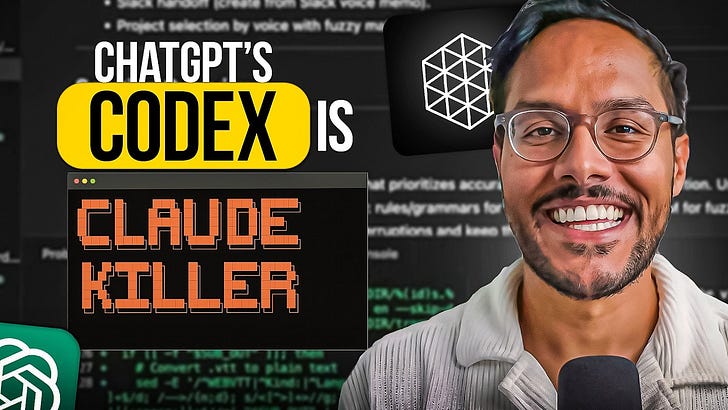
Browser-based ChatGPT cannot execute code or connect to external APIs, limiting its power. The Codex CLI unlocks these agentic capabilities, allowing it to interact with local files, run scripts, and connect to databases, making it a far more powerful tool for real-world tasks.
A repeatable workflow exists for non-technical builders: research ideas with Perplexity, formalize a Product Requirements Document with Claude, generate a frontend prototype with Magic Patterns, and then deploy the code in Replit with a Supabase backend.

Tim McLear used AI coding assistants to build custom apps for niche workflows, like partial document transcription and field research photo logging. He emphasizes that "no one was going to make me this app." The ability for non-specialists to quickly create such hyper-specific internal tools is a key, empowering benefit of AI-assisted development.
Claude Code's terminal-based interaction within a specific folder allows it to automatically read and reference local files. This makes "context engineering" drastically faster and more powerful than manually pasting information into a traditional chat interface, as the context is implicitly understood.

The terminal-first interface of Claude Code wasn't a deliberate design choice. It emerged organically from prototyping an API client in the terminal, which unexpectedly revealed the power of giving an AI model direct access to the same tools (like bash) that a developer uses.
The future of AI isn't just in the cloud. Personal devices, like Apple's future Macs, will run sophisticated LLMs locally. This enables hyper-personalized, private AI that can index and interact with your local files, photos, and emails without sending sensitive data to third-party servers, fundamentally changing the user experience.
Don't pay for Claude's most expensive tier just for coding. A hybrid approach uses the cheaper Claude Pro plan for its superior file-handling and writing. For heavy coding, switch to the terminal inside Cursor, which provides access to top models like Opus for only $20/month, creating a powerful stack for under $40.
The new Spiral app, with its complex UI and multiple features, was built almost entirely by one person. This was made possible by leveraging AI coding agents like Droid and Claude, which dramatically accelerates the development process from idea to a beautiful, functional product.