Get your free personalized podcast brief
We scan new podcasts and send you the top 5 insights daily.
During capital-constrained periods, founders must be ruthless in their focus. Every dollar and hour should go towards "killer experiments"—those that directly accrue value and hit the specific milestones required for the next fundraising round. "Cool science" that doesn't advance these goals is a luxury companies can't afford.

Related Insights
More capital isn't always better. An excess of funding can lead to a lack of focus, wasteful spending, and a reluctance to make tough choices—a form of moral hazard. It's crucial to match the amount of capital to a founder's ability to deploy it effectively without losing discipline.

Contrary to common advice, the founder deliberately raised capital in small increments, never securing more than 12 months of runway. He found this self-imposed pressure was a powerful forcing function that kept him and the team sharp and focused on hitting critical milestones.

While a challenging fundraising market seems negative, it forces startups to operate with discipline. Unlike in frothy markets where companies expand based on hype, the current climate rewards tangible results. This compels a lean structure focused on high-value projects, creating a healthier long-term business model.

Founders face a strategic trade-off depending on the market cycle. In a hot market, capital is abundant but competition for user attention is fierce. In a quiet market, capital is scarce, but it's easier for a quality product to stand out and get noticed.
Since startups lack infinite time and money, an investor's key diligence question is whether the team can learn and iterate fast enough to find a valuable solution before resources run out. This 'learning velocity' is more important than initial traction or a perfect starting plan.

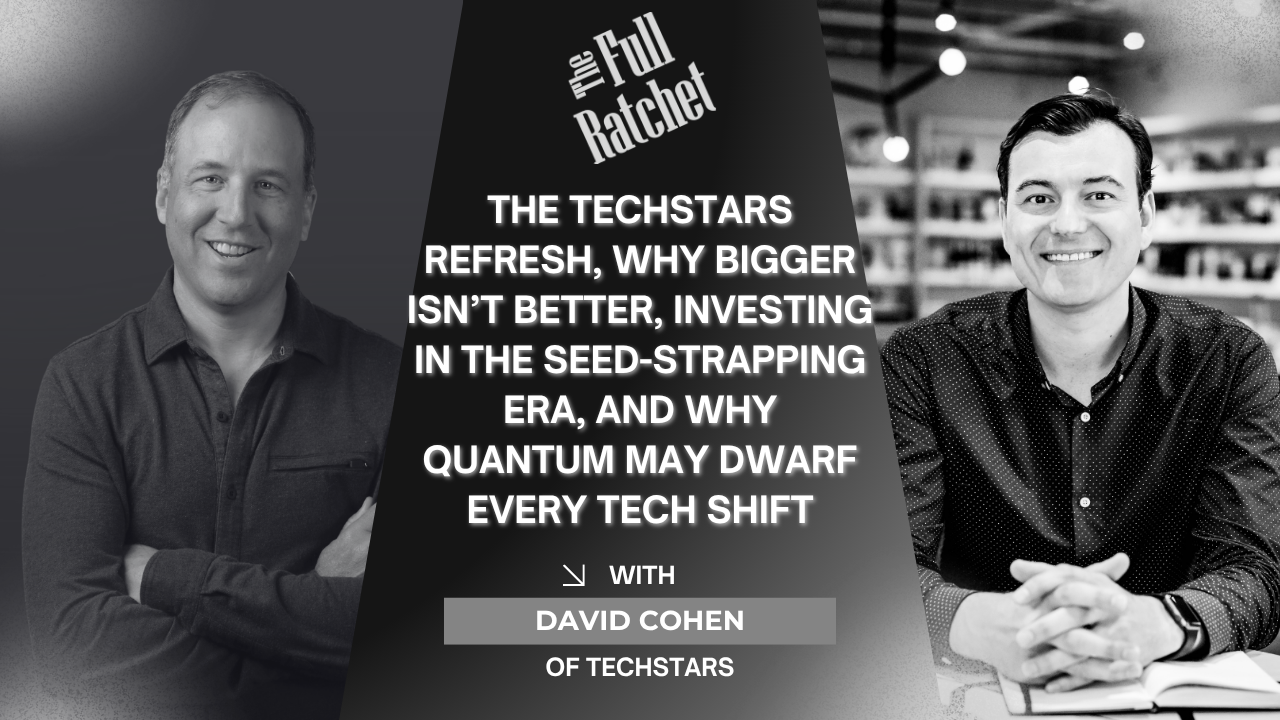
David Cohen observes that founders who are inherently frugal or "stingy" with capital—spending only when absolutely necessary—often achieve better outcomes. This mindset, focused on capital preservation and efficiency, is a more powerful indicator of success than simply raising large rounds to fuel growth, a trait he has seen in his own entrepreneurial career.
The firm distinguishes between speed (magnitude) and velocity (magnitude plus direction). Founders are encouraged to focus on velocity, ensuring the entire team is moving quickly *in the right direction*. This prevents wasted effort where mere motion is mistaken for progress, a common trap in turbulent markets.

Chet Pipkin advises that a lack of cash is not always a bad thing for a new venture. Financial constraints force founders to focus on the essential aspects of their business and identify a genuine, pressing customer problem, which is more critical for success than having abundant capital.

To truly learn from go-to-market experiments, you can't be half-hearted. StackAI's philosophy is to dedicate significant, focused effort for 1-3 months on a single idea. This ensures that if it fails, you know it's the idea, not poor execution, providing a definitive learning.

Faced with a $25k event sponsorship, GoProposal's founder realized he could hire a full-time videographer for the same price. This decision, driven by scarcity, led to a more durable content engine that proved invaluable when the pandemic hit. A lack of resources forces creative, high-leverage thinking.
