Get your free personalized podcast brief
We scan new podcasts and send you the top 5 insights daily.
To enable agents to self-correct, observability tools must be programmatically accessible. This means shifting from UI dashboards to CLI-first access for logs and metrics, allowing agents to 'read' system state and reason about failures on their own.
Related Insights
A cutting-edge pattern involves AI agents using a CLI to pull their own runtime failure traces from monitoring tools like Langsmith. The agent can then analyze these traces to diagnose errors and modify its own codebase or instructions to prevent future failures, creating a powerful, human-supervised self-improvement loop.
The enthusiastic reception for Google's Workspace CLI reveals a counter-intuitive trend: old-school Command-Line Interfaces are becoming the preferred way for AI agents to interact with software. Unlike humans, agents don't need GUIs and benefit from the CLI's deterministic, low-friction nature, avoiding the 'abstraction tax' of newer API layers.

Cursor's "cloud agent diagnosis" command allows a primary agent to spin up specialized sub-agents that use integrations like Datadog to explore logs and diagnose another agent's failure. This creates a multi-agent system where agents act as external debuggers for each other.
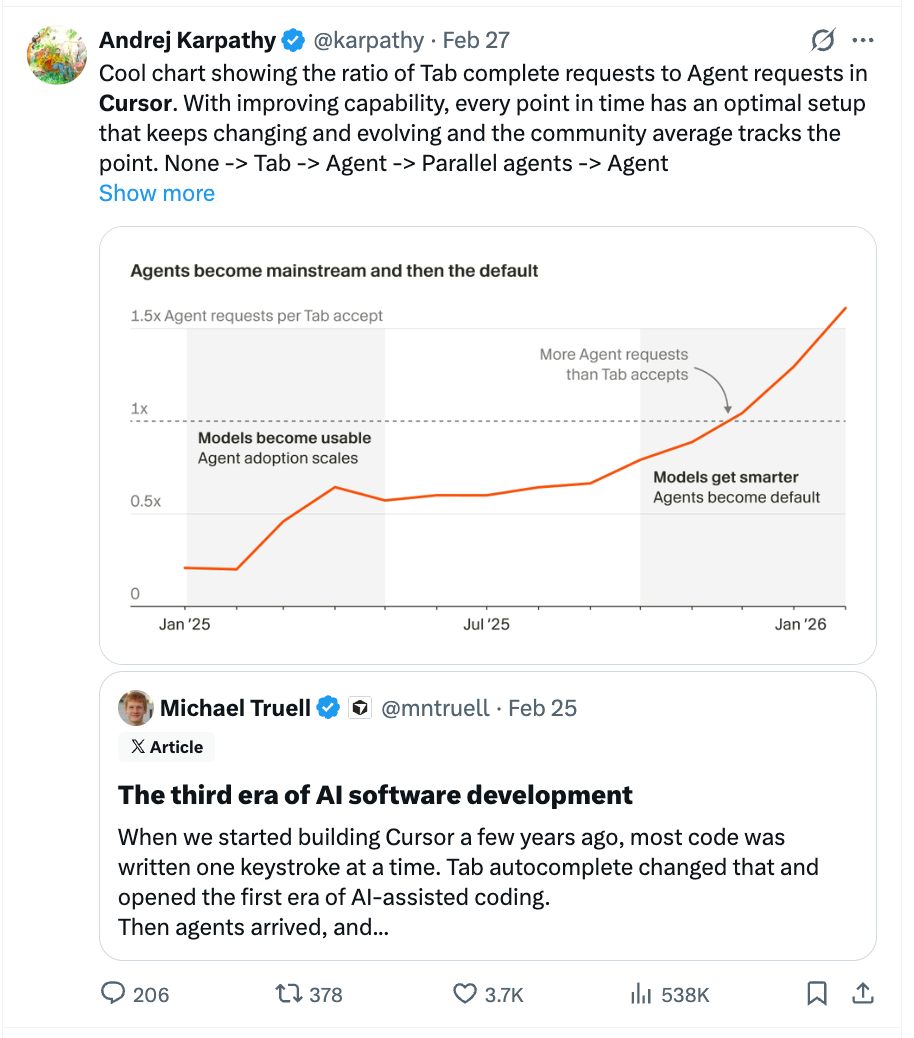
While GUIs were built for humans, the terminal is more "empathetic to the machine." Coding agents are more effective using CLIs because it provides a direct, scriptable, and universal way to interact with a system's tools, leveraging vast amounts of pre-trained shell command data.
AI agents are the fastest-growing users of command-line tools. They have unique behaviors, like running "status" after every command, and struggle with interactive flows. Tools must be designed with this new, non-human persona in mind, not just for human developers.

Eliminate the engineering bottleneck for setting up observability. Use pre-built 'skills' within coding agents like Claude Code. A single command can analyze an agent's code and automatically instrument it to send trace data to platforms like Arize, no engineer required.

As AI agents increasingly interact with software to perform tasks, a new field of "Agent Experience" (AX) is emerging. The same principles of identifying and resolving friction in human user journeys (UX) will need to be applied to optimize the performance and efficiency of these automated agents.

Newman's most critical infrastructure for AI-assisted development is a universal logging service for all his apps (front-end, back-end, mobile). When a bug appears, he can tell an AI agent to "debug this," and it can analyze the comprehensive logs to find the root cause without guesswork.

To automate bug fixing, connect an AI agent to your error reporting (Sentry), database (Supabase), and log drains (Acxiom). When a bug is reported, the agent can autonomously replay events from logs, diagnose the root cause of the failure, and eventually fix it, creating a powerful self-healing loop for your application.
Building a visual debugging tool for trace files is wasted effort when an AI agent can directly analyze the raw data and provide the answer. Optimizing for human legibility in the debugging process is a mistake when the agent, not a human, is doing the fixing.