Get your free personalized podcast brief
We scan new podcasts and send you the top 5 insights daily.
While investors fear "Chipflation" (rapidly rising memory prices) could end the AI investment boom, the reality is more nuanced. Morgan Stanley argues higher costs will primarily reprice and ration access to AI infrastructure, favoring large hyperscalers, rather than halting the overall cycle.

Related Insights
Unlike past cycles driven solely by new demand (e.g., mobile phones), the current AI memory super cycle is different. The new demand driver, HBM, actively constrains the supply of traditional DRAM by competing for the same limited wafer capacity, intensifying and prolonging the shortage.

The bank asserts that the massive wave of AI and data center capital expenditure will proceed regardless of interest rate levels or overall economic growth. This suggests the demand for computing power is a powerful secular trend that transcends typical cyclical business investment patterns.

While AI compute demand seems limitless, its price is not infinitely elastic. As inference becomes a core cost of goods sold (COGS) for AI products, excessively high compute prices will break the business models of infrastructure customers, ultimately limiting demand.

Companies like Microsoft and Meta are significantly raising their capital expenditure guidance. The commentary reveals a key driver is the rising cost of memory components needed for AI infrastructure, highlighting a critical supply chain pressure point beyond just GPUs.

Hyperscalers face a strategic challenge: building massive data centers with current chips (e.g., H100) risks rapid depreciation as far more efficient chips (e.g., GB200) are imminent. This creates a 'pause' as they balance fulfilling current demand against future-proofing their costly infrastructure.

Author Chris Miller explains that the further down the supply chain you go (from hyperscalers to fabs like TSMC to equipment makers like ASML), the more skepticism there is about the true scale of AI demand. This "bullwhip effect" results in cautious capital expenditure, creating a manufacturing bottleneck for the AI industry.

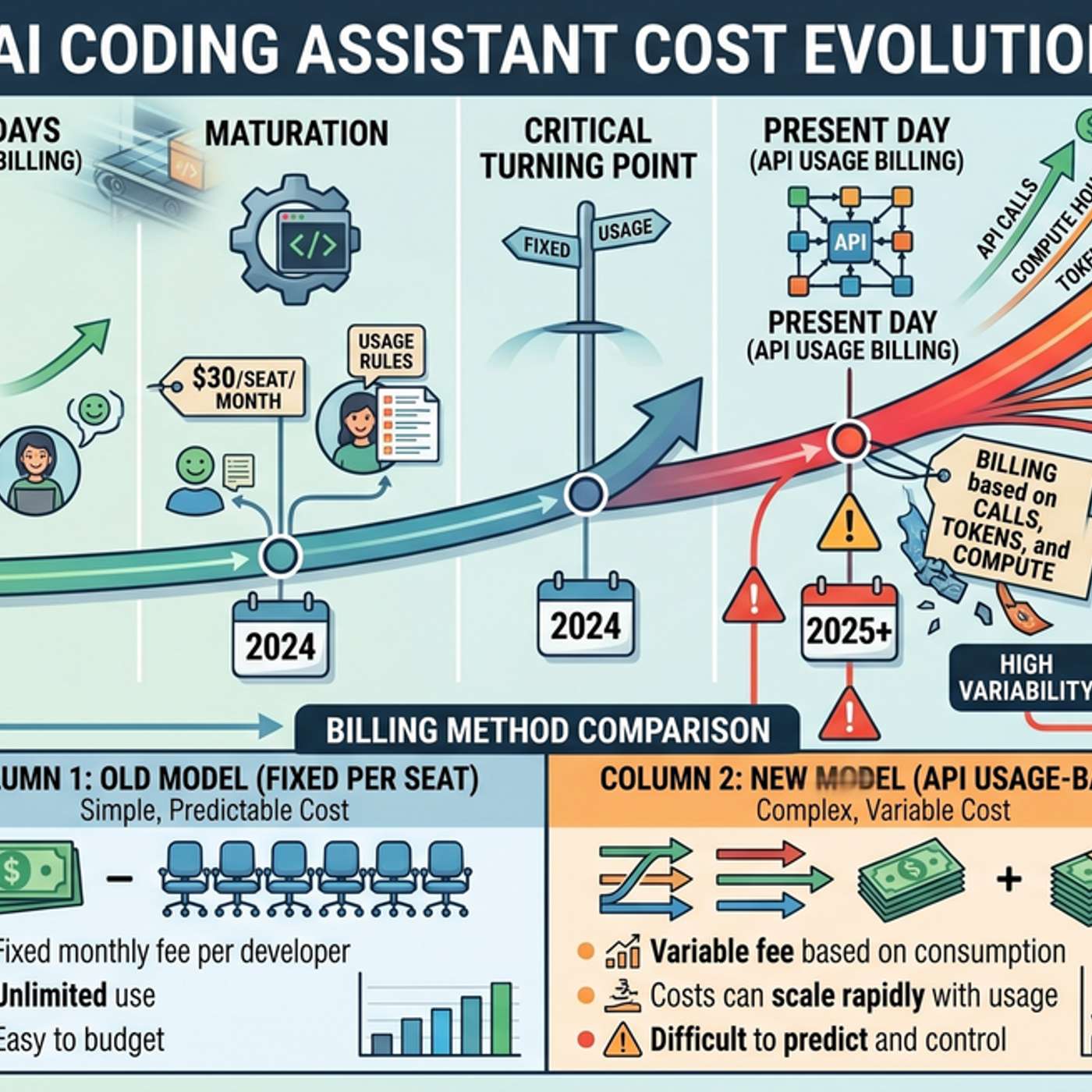
Rising AI API costs are not merely a vendor strategy but a direct result of real-world bottlenecks. These include surging electricity prices for data centers, a structural shortage of high-bandwidth memory (HBM), and constrained hardware supply chains, which are fundamentally altering the cost basis for AI compute.
Unlike railroads or telecom, where infrastructure lasts for decades, the core of AI infrastructure—semiconductor chips—becomes obsolete every 3-4 years. This creates a cycle of massive, recurring capital expenditure to maintain data centers, fundamentally changing the long-term ROI calculation for the AI arms race.

Despite record profits driven by AI demand for High-Bandwidth Memory, chip makers are maintaining a "conservative investment approach" and not rapidly expanding capacity. This strategic restraint keeps prices for critical components high, maximizing their profitability and effectively controlling the pace of the entire AI hardware industry.

The soaring cost of AI memory will not significantly impact headline consumer inflation (CPI). Instead, the economic pressure is absorbed by businesses through higher producer prices, squeezed corporate margins, rising cloud costs, and delayed technology upgrades, representing a hidden tax on the corporate sector.