Get your free personalized podcast brief
We scan new podcasts and send you the top 5 insights daily.
A less accurate LSTM model was deployed over a superior BERT model due to hardware limits (no GPUs), faster retraining needs, and the fact that a minor accuracy boost did not alter the essential human-in-the-loop workflow. Real-world constraints often outweigh marginal performance gains.

Related Insights
While public benchmarks show general model improvement, they are almost orthogonal to enterprise adoption. Enterprises don't care about general capabilities; they need near-perfect precision on highly specific, internal workflows. This requires extensive fine-tuning and validation, not chasing leaderboard scores.

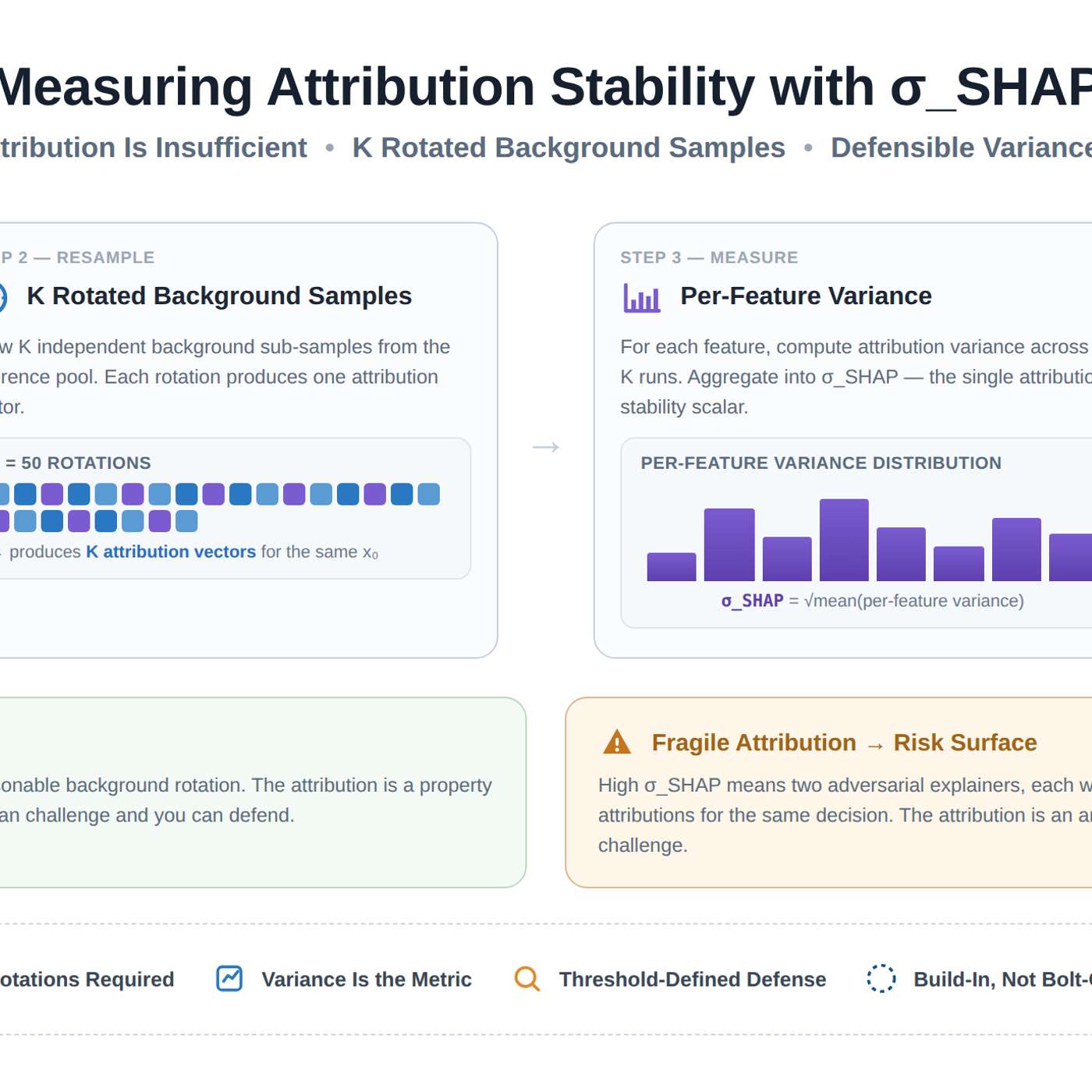
In regulated industries, the best model isn't always the most accurate. A model with slightly lower predictive performance but highly stable and defensible explanations is more valuable operationally. Attribution stability should be a key criterion in model selection, alongside traditional metrics like F1-score.
For most enterprise tasks, massive frontier models are overkill—a "bazooka to kill a fly." Smaller, domain-specific models are often more accurate for targeted use cases, significantly cheaper to run, and more secure. They focus on being the "best-in-class employee" for a specific task, not a generalist.

PMs often default to the most powerful, expensive models. However, comprehensive evaluations can prove that a significantly cheaper or smaller model can achieve the desired quality for a specific task, drastically reducing operational costs. The evals provide the confidence to make this trade-off.

While speed benchmarks are flashy, a model's memory usage is the true determinant of its viability. In real-world applications, AI models must share limited resources with other processes, making a low memory footprint more critical than a marginal speed advantage for successful deployment.
When selecting foundational models, engineering teams often prioritize "taste" and predictable failure patterns over raw performance. A model that fails slightly more often but in a consistent, understandable way is more valuable and easier to build robust systems around than a top-performer with erratic, hard-to-debug errors.

The most compelling business reason for enterprises to adopt custom fine-tuning is the need for low latency. For real-time applications like voice bots, large frontier models are too slow. This practical constraint forces companies to use smaller, specialized open-source models.

Teams often fall into the trap of optimizing for model accuracy, a metric popularized by academic settings like Kaggle. In business, this is misleading. A highly accurate model might be too passive and miss opportunities. The focus must shift from pure accuracy to real-world business outcomes and ROI.

The team over-optimized model inference, which accounted for only 0.3% of the total processing time. The real bottleneck was the multi-minute human review step. Optimizing the user interface to save reviewers seconds would have been far more impactful than improving the model's speed.
The focus on benchmark scores for frontier models is misplaced for most practical use cases. Many applications, especially in physical and embedded AI, rely on smaller, specialized models. The small percentage point differences on abstract benchmarks have little bearing on solving a specific business problem effectively.