Get your free personalized podcast brief
We scan new podcasts and send you the top 5 insights daily.
Traditional grant funding disincentivizes high-risk research because lab work is slow and expensive. Virtual cell models act as a "computational fruit fly," allowing scientists to test radical hypotheses in silico first. This lowers the barrier for exploring unconventional ideas by de-risking the time and resource investment before committing to the wet lab.

Related Insights
The combination of AI reasoning and robotic labs could create a new model for biotech entrepreneurship. It enables individual scientists with strong ideas to test hypotheses and generate data without raising millions for a physical lab and staff, much like cloud computing lowered the barrier for software startups.
Wet lab experiments are slow and expensive, forcing scientists to pursue safer, incremental hypotheses. AI models can computationally test riskier, 'home run' ideas before committing lab resources. This de-risking makes scientists less hesitant to explore breakthrough concepts that could accelerate the field.

The transition to an engineering discipline in drug discovery, analogous to aeronautics, means using powerful in silico models to get much closer to a final product before physical testing. This reduces reliance on iterative, expensive, and time-consuming wet lab experiments.

Scientists constrained by limited grant funding often avoid risky but groundbreaking hypotheses. AI can change this by computationally generating and testing high-risk ideas, de-risking them enough for scientists to confidently pursue ambitious "home runs" that could transform their fields.
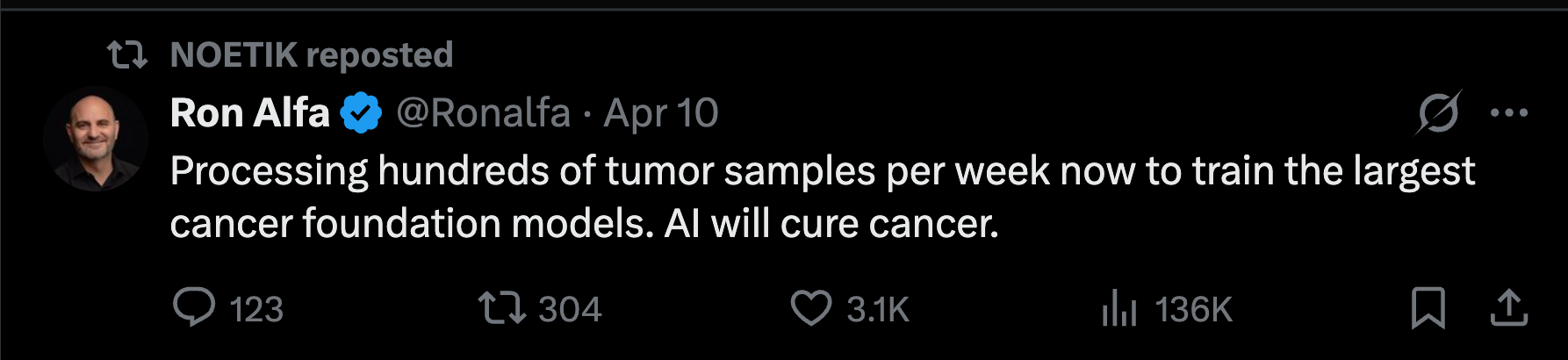
Instead of pursuing a purely academic goal of simulating every biochemical process, Noetik's "virtual cell" models are practical tools. They focus on understanding cell biology through heuristics that are useful for making drugs, like predicting a cell's transcriptome or protein expression in a specific context.
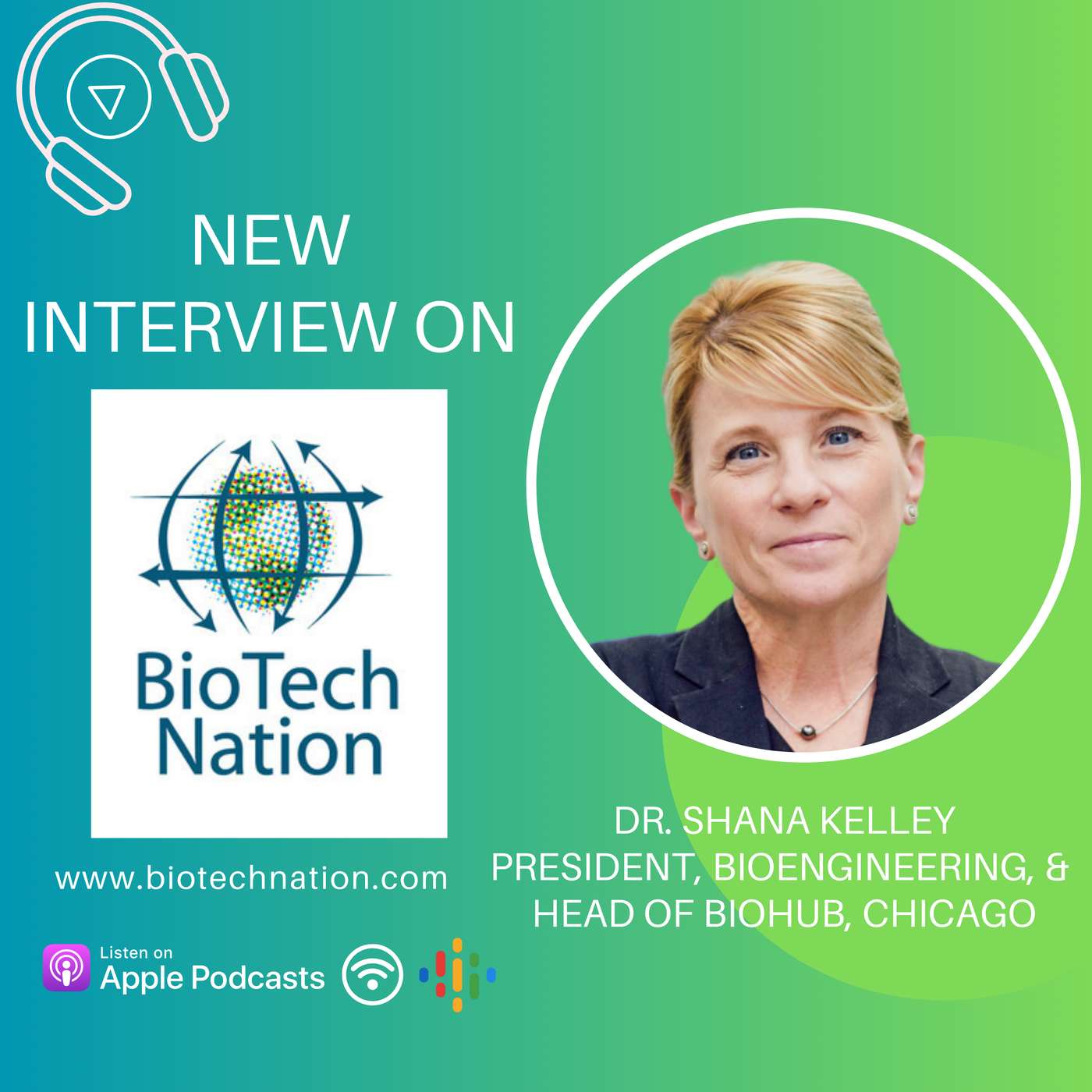
Today's "virtual cell" models represent training data well but cannot predict outcomes for novel interventions. The next frontier is building models that generalize to serve as true predictive oracles for experiments that haven't yet been performed, a key focus for BioHub.

AI models are trained on large lab-generated datasets. The models then simulate biology and make predictions, which are validated back in the lab. This feedback loop accelerates discovery by replacing random experimental "walks" with a more direct computational route, making research faster and more efficient.
CZI's virtual cell models act as a computational "model organism," enabling scientists to run high-risk experiments in silico. This approach dramatically lowers the cost and time required to test novel ideas, encouraging more ambitious research that might otherwise be prohibitive.

Contrary to the idea that AI will make physical experiments obsolete, its real power is predictive. AI can virtually iterate through many potential experiments to identify which ones are most likely to succeed, thus optimizing resource allocation and drastically reducing failure rates in the lab.

A major biotech revolution is underway as AI now enables effective 'in silico' (simulated) experiments. This shift from physical "wet labs" to cheap, infinitely scalable simulations drastically cuts time and cost for drug discovery, making audacious goals like curing cancer scientifically plausible.
