Get your free personalized podcast brief
We scan new podcasts and send you the top 5 insights daily.
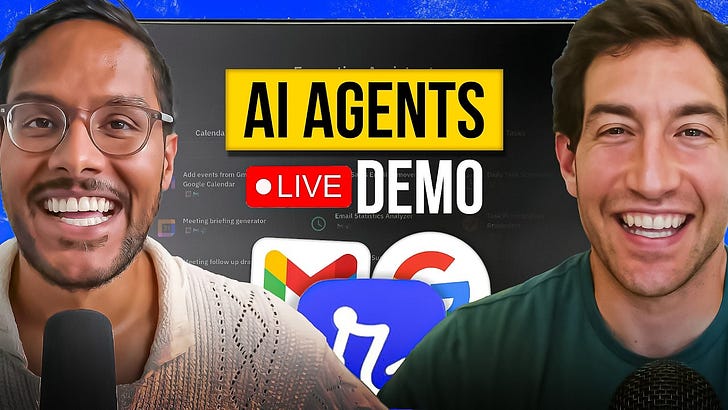
Platforms like Nebula allow founders to move beyond simple automation. By providing a high-level directive and connecting services, AI agents can run entire business functions, like a content blog that researches, writes, and publishes daily with minimal human intervention.

Related Insights
VCs traditionally advise against early product expansion. But with agentic AI, which leverages existing metadata to solve new problems without building new screens, startups can rapidly add capabilities to meet customer demand for a single, unified agent, accelerating the compound startup model.
The evolution of 'agentic AI' extends beyond content generation to automating the connective tissue of business operations. Its future value is in initiating workflows that span departments, such as kickstarting creative briefs for marketing, creating product backlogs from feedback, and generating service tickets, streamlining operational handoffs.

Unlike co-pilots that assist developers, Factory's “droids” are designed to be autonomous. This reframes the developer's job from writing code to mastering delegation—clearly defining tasks and success criteria for an AI agent to execute independently.

The new generation of AI automates workflows, acting as "teammates" for employees. This creates entirely new, greenfield markets focused on productivity gains for every individual, representing a TAM potentially 10x larger than the previous SaaS era, which focused on replacing existing systems of record.

Unlike tools like Zapier where users manually construct logic, advanced AI agent platforms allow users to simply state their goal in natural language. The agent then autonomously determines the steps, writes necessary code, and executes the task, abstracting away the workflow.
Claude Code can take a high-level goal, ask clarifying questions, and then independently work for over an hour to generate code and deploy a working website. This signals a shift from AI as a simple tool to AI as an autonomous agent capable of complex, multi-step projects.

The strategy for a one-person AI-powered business isn't a single 'do-everything' agent. Instead, it's creating a team of specialized agents in different 'channels'—one for lead gen, one for blog content, one for analytics—mirroring a company's departmental structure.
The future of software isn't just AI-powered features. It's a fundamental shift from tools that assist humans to autonomous agents that perform tasks. Human roles will evolve from *doing* the work to *orchestrating* thousands of these agents.
The next evolution of enterprise AI isn't conversational chatbots but "agentic" systems that act as augmented digital labor. These agents perform complex, multi-step tasks from natural language commands, such as creating a training quiz from a 700-page technical document.

The paradigm shift with AI agents is from "tools to click buttons in" (like CRMs) to autonomous systems that work for you in the background. This is a new form of productivity, akin to delegating tasks to a team member rather than just using a better tool yourself.