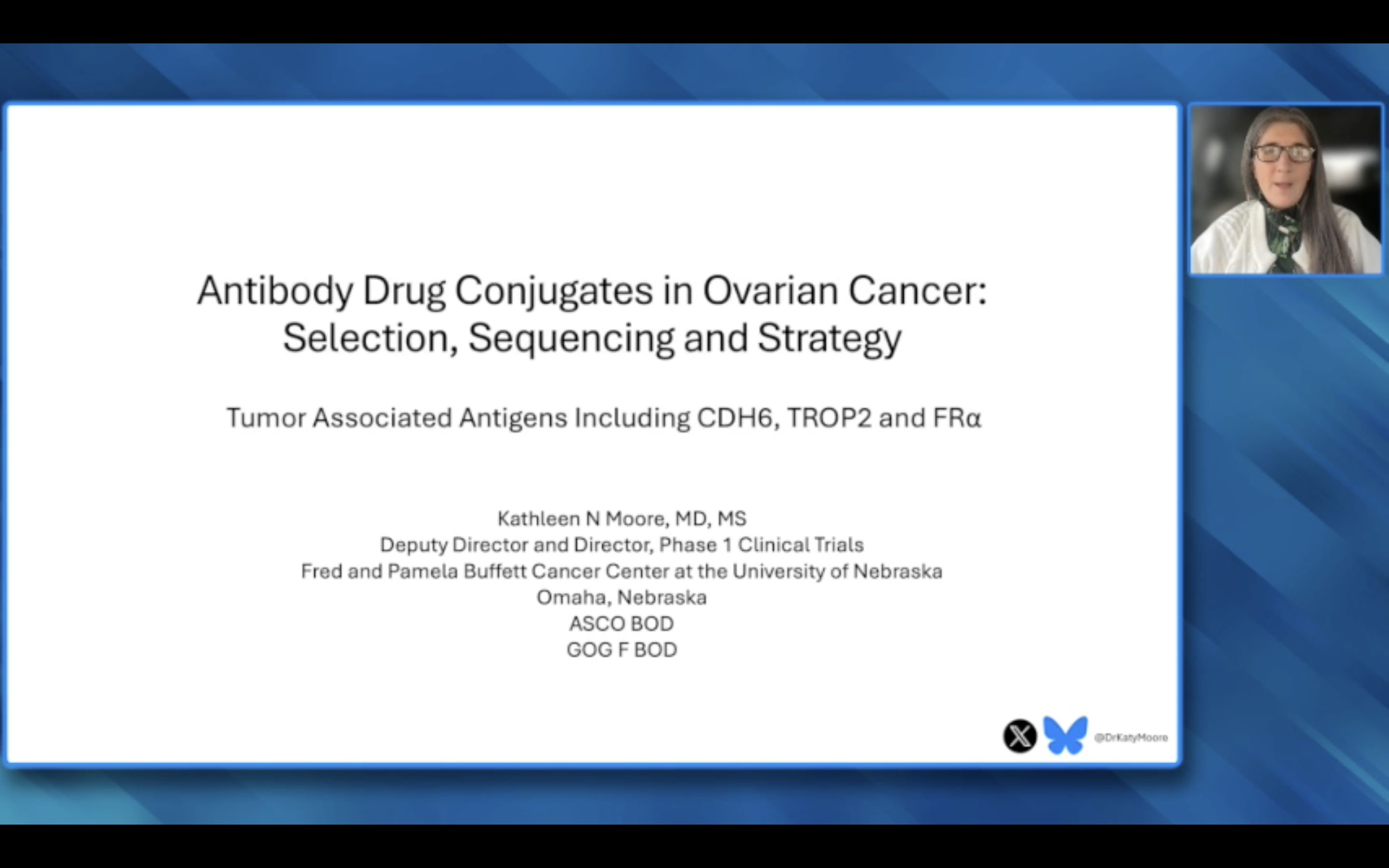
Get your free personalized podcast brief
We scan new podcasts and send you the top 5 insights daily.
Despite cervical cancer being virally driven—a characteristic that theoretically makes it highly susceptible to immunotherapy—treatments have shown durable but limited responses. This surprising gap between scientific expectation and clinical reality is driving research into novel combinations, such as immunotherapy plus antibody-drug conjugates (ADCs), to improve efficacy.

Related Insights
Recent trials have created a clinical dilemma. The A18 study supports adding immunotherapy to chemoradiation, while the INTERLACE study supports induction chemotherapy before chemoradiation. With both showing survival benefits, clinicians must now choose between two new, distinct, and unreconciled standards of care.
The future of advanced prostate cancer treatment may involve combining ADCs with bispecific T-cell engagers. This strategy could use ADCs for a short duration to deliver a potent hit, followed by immunotherapy to achieve durable remission, potentially reducing toxicity and enabling earlier use.

The future of GYN oncology immunotherapy is diverging. For responsive cancers like endometrial, the focus is on refining biomarkers and overcoming resistance. For historically resistant cancers like ovarian, the strategy shifts to using combinatorial approaches (e.g., CAR-NKs, vaccines) to fundamentally alter the tumor microenvironment itself, making it more receptive to an immune response.
The primary reason Antibody-Drug Conjugates (ADCs) stop working is payload resistance, a shift from the traditional belief that failure stems from tumors losing the target antigen. This insight drives development of multi-payload ADCs to overcome this resistance mechanism.

When planning treatment for patients who will receive multiple antibody-drug conjugates (ADCs), the prevailing clinical strategy is to focus on alternating the drug's payload (e.g., a tubulin inhibitor vs. a topoisomerase I inhibitor). This approach is believed to be more effective at overcoming resistance than alternating the cell-surface target.

The next frontier in CSCC isn't just about new drugs, but about optimizing existing ones. A key research area is determining the minimum number of immunotherapy doses required for an optimal response—potentially just one or two—to limit toxicity, reduce treatment burden, and personalize care for high-risk patients.
A significant clinical challenge is the sequencing of antibody-drug conjugates (ADCs). Retrospective data from large databases indicates that using a second TROP2-targeted ADC after a first one provides very limited efficacy, highlighting an urgent need for prospective trials to define optimal sequencing strategies and overcome resistance.
Although HER2 expression is rare in cervical cancer, it is a crucial biomarker to test for. In these uncommon cases, patients who have progressed on standard immunotherapy can achieve "wonderful responses" with trastuzumab deruxtecan (T-DXd), highlighting a powerful, targeted option for a population with high unmet need.
While immunotherapy was a massive leap forward, Dr. Saav Solanki states the next innovation frontier is combining it with newer modalities. Antibody-drug conjugates (ADCs) and T-cell engagers are being used to recruit the immune system into the tumor microenvironment, helping patients who don't respond to current immunotherapies.

As multiple effective Antibody-Drug Conjugates (ADCs) become available, the primary clinical challenge is no longer *if* they work, but *how* to use them best. Key unanswered questions involve optimal sequencing, dosing for treatment versus maintenance, and overall length of therapy, mirroring issues already seen in breast cancer.