Get your free personalized podcast brief
We scan new podcasts and send you the top 5 insights daily.
Alex Rives frames cell-state transitions as a probabilistic transition function: a model takes a cell or tissue state and inputs, then predicts a distribution of possible next states. This makes virtual cells harder than deterministic predictors, but better matched to biology's noisy, branching real outcomes.

Related Insights
Alex Rives argues current virtual cell models fail because biology's measuring tools cannot observe the fine-grained causal structure models need. He says better architectures help, but Biohub is investing heavily in new measurement modalities and data generation because observation limits are the deeper bottleneck first.
While AI excels at protein modeling thanks to direct data, "virtual cell" models are underperforming simple baselines. The core issue is their reliance on single-cell RNA-seq data, which acts as a poor, compressed representation of the cell's true, complex state, unlike the direct data available for proteins.

To create a predictive "virtual cell," data collection must shift from passive observation to active intervention. The strategy is to massively scale perturbation experiments (like Perturb-seq) across countless contexts and measure multi-modal responses, teaching the model cause and effect.

Today's "virtual cell" models represent training data well but cannot predict outcomes for novel interventions. The next frontier is building models that generalize to serve as true predictive oracles for experiments that haven't yet been performed, a key focus for BioHub.
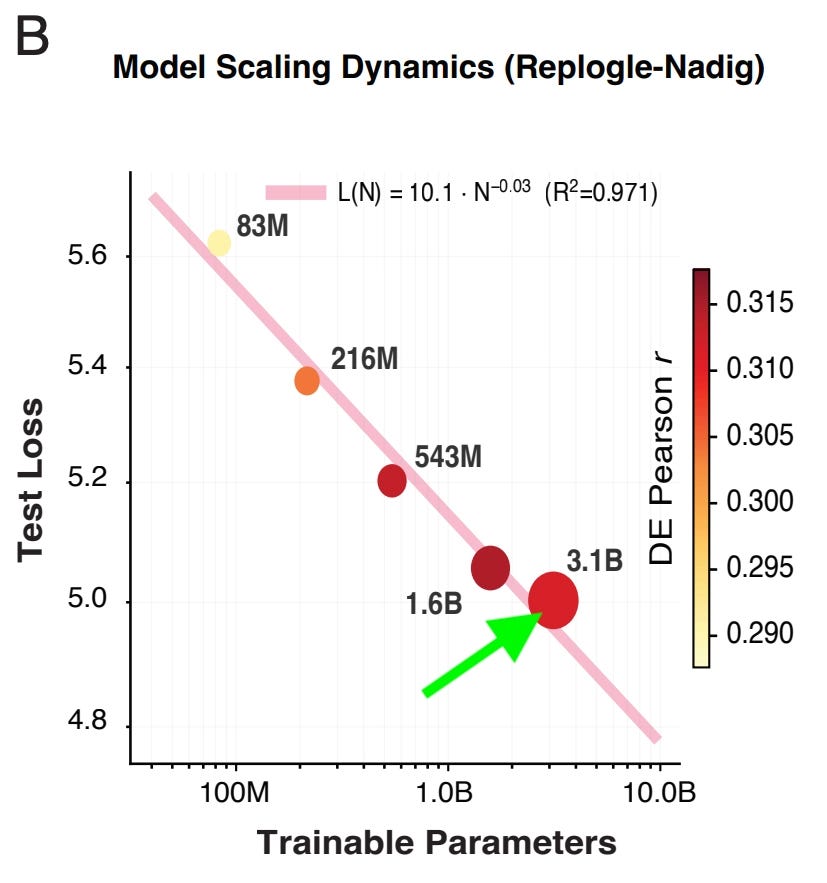
Beyond its core architecture, X-Cell integrates five types of biological priors, including text embeddings from scientific literature, protein interaction networks, and morphology information. This diverse context allows the model to make more accurate predictions and provides interpretability by showing which priors are most important for specific cell types.
To build truly dynamic "virtual cells," two key technological hurdles must be overcome. First, developing high-throughput methods for measuring proteins, the cell's functional units. Second, inventing a sequencing technology that can measure the state of the *same cell* at multiple time points without destroying it.
AI models trained on descriptive data (e.g., RNA-seq) can classify cell states but fail to predict how to transition a diseased cell to a healthy one. True progress requires generating massive "causal" datasets that show the effects of specific genetic perturbations.

Simple linear models fail to generalize to new cell types because gene functions are highly context-dependent. Some "housekeeping" genes have universal effects, but many others behave differently in various cellular environments. A sophisticated, nonlinear AI model is required to capture these context-specific interactions.
The key utility of a "virtual cell" model isn't just predicting outcomes within its training data. Its power is the ability to generalize and make accurate causal predictions in entirely new contexts, such as different cell types or primary cells from donors, where large-scale experiments are difficult or impossible.
Unlike text, gene expression levels lack inherent order. Autoregressive models (like GPT) force an artificial sequence, limiting performance. Diffusion models, which operate on sets and iteratively refine predictions, are a more natural and effective architecture for modeling cellular responses to perturbations.