Get your free personalized podcast brief
We scan new podcasts and send you the top 5 insights daily.
For niche tasks, leverage an AI model with deep domain knowledge (like Claude for its own 'Skills' feature) to create highly specific prompts. Then, feed these optimized prompts into a powerful, generalist coding assistant (like Google's) to achieve a more accurate and robust final product.

Related Insights
An effective AI development workflow involves treating models as a team of specialists. Use Claude as the reliable 'workhorse' for building an application from the ground up, while leveraging models like Gemini or GPT-4 as 'advisory models' for creative input and alternative problem-solving perspectives.

While Claude's built-in 'create skill' tool is clunky, its output reveals a highly structured template for effective prompts. It includes decision trees, clarifying questions for the user, and keywords for invocation, serving as an invaluable guide for building robust skills without starting from scratch.

Instead of prompting a specialized AI tool directly, experts employ a meta-workflow. They first use a general LLM like ChatGPT or Claude to generate a detailed, context-rich 'master prompt' based on a PRD or user story, which they then paste into the specialized tool for superior results.
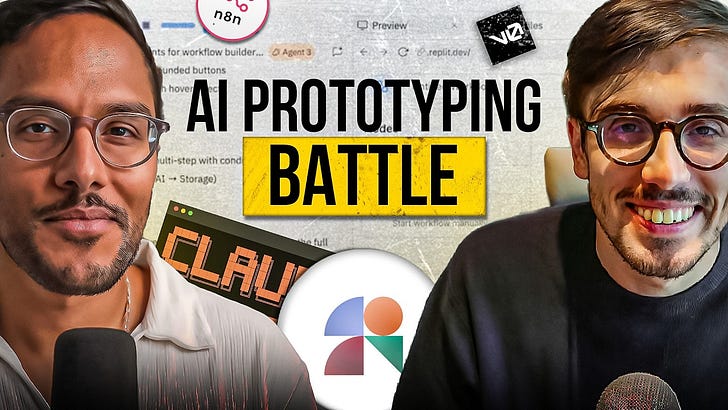
The paradigm is shifting from using AI as a general chatbot to building a team of 'digital employees.' Claude Skills allow users to encapsulate a specific, repeatable workflow—like drafting a newsletter from tweets—into a tool that can be executed on demand, creating a specialized agent for that job.
Before delegating a complex task, use a simple prompt to have a context-aware system generate a more detailed and effective prompt. This "prompt-for-a-prompt" workflow adds necessary detail and structure, significantly improving the agent's success rate and saving rework.
Building an AI application is becoming trivial and fast ("under 10 minutes"). The true differentiator and the most difficult part is embedding deep domain knowledge into the prompts. The AI needs to be taught *what* to look for, which requires human expertise in that specific field.
Use the Claude chat application for deep research on technical architecture and best practices *before* coding. It can research topics for over 10 minutes, providing a well-summarized plan that you can then feed into a dedicated coding tool like Cursor or Claude Code for implementation.
Instead of guessing which skills to create, describe your business to Claude and ask it to recommend the 10 most valuable, custom skills you should build. This leverages the AI's understanding to bootstrap your own AI-powered workflow.
Instead of manually writing prompts for a video AI like Sora 2, delegate the task to a language model like Claude. Instruct it to first research Sora's specific capabilities and then generate prompts that are explicitly optimized for that platform's strengths, leading to higher-quality, more effective outputs.
The most leveraged engineering activity is creating a 'meta-prompt' that takes a simple feature request and automatically generates a detailed technical specification. This spec then serves as a high-quality prompt for an AI coding agent, making all future development faster.
