Get your free personalized podcast brief
We scan new podcasts and send you the top 5 insights daily.
One of the most significant ways AI accelerates research is by dramatically shortening the time scientists spend stuck or confused. Instead of wrestling with a conceptual block for days, a researcher can query the AI and get an immediate clarification, allowing for much faster progress.

Related Insights
Mathematician Terence Tao finds AI doesn't speed up his core problem-solving but makes his papers "richer" by adding complex plots and deeper literature searches. Tasks that were previously infeasible are now easy. AI expands the scope and quality of work rather than just shortening the timeline for existing tasks.
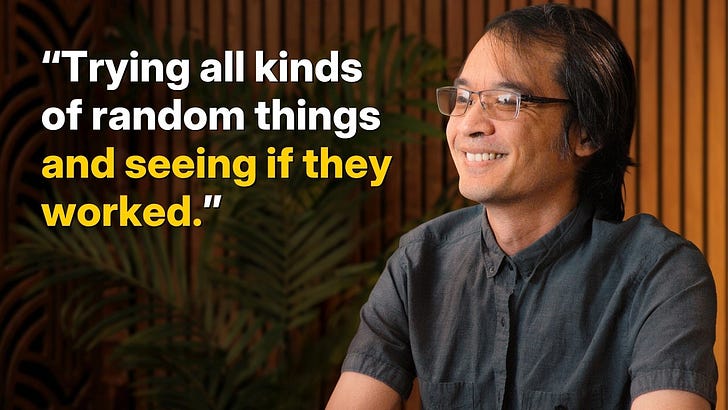
Historically, curiosity was hampered by the effort required to find answers. By closing the gap between question and answer to mere seconds, AI removes this friction and can potentially trigger an explosion in learning and exploration for a broad population.

Beyond productivity gains, AI's most transformative impact may be automating R&D to accelerate scientific discovery. This could lead to breakthroughs in health and wellness, solving problems that might otherwise take decades and fundamentally improving quality of life, not just GDP.

AI's true power in science isn't autonomous discovery, but process compression. It acts as an expert guide, allowing motivated individuals to navigate complex fields like drug discovery and assemble workflows that once required multiple specialized teams, blurring the line between professional research and individual effort.

AI's primary value in early-stage drug discovery is not eliminating experimental validation, but drastically compressing the ideation-to-testing cycle. It reduces the in-silico (computer-based) validation of ideas from a multi-month process to a matter of days, massively accelerating the pace of research.

The ultimate goal isn't just modeling specific systems (like protein folding), but automating the entire scientific method. This involves AI generating hypotheses, choosing experiments, analyzing results, and updating a 'world model' of a domain, creating a continuous loop of discovery.

AI's key advantage isn't superior intelligence but the ability to brute-force enumerate and then rapidly filter a vast number of hypotheses against existing literature and data. This systematic, high-volume approach uncovers novel insights that intuition-driven human processes might miss.
AI now generates complex scientific derivations faster than humans can validate them. For a recent quantum gravity paper, the AI produced the core results in days, but human collaborators spent three weeks just checking the work, shifting the research bottleneck from discovery to verification.
With AI generating complex formulas and proofs, the most challenging part of scientific research is no longer solving the core problem. Instead, the primary human task becomes verifying the AI-generated results and writing them up, fundamentally changing the research workflow.

Contrary to fears of displacement, AI tools like 'AI co-scientists' amplify human ingenuity. By solving foundational problems (like protein folding) and automating tedious tasks, AI enables more researchers, even junior ones, to tackle more complex, high-level scientific challenges, accelerating discovery.
