Get your free personalized podcast brief
We scan new podcasts and send you the top 5 insights daily.
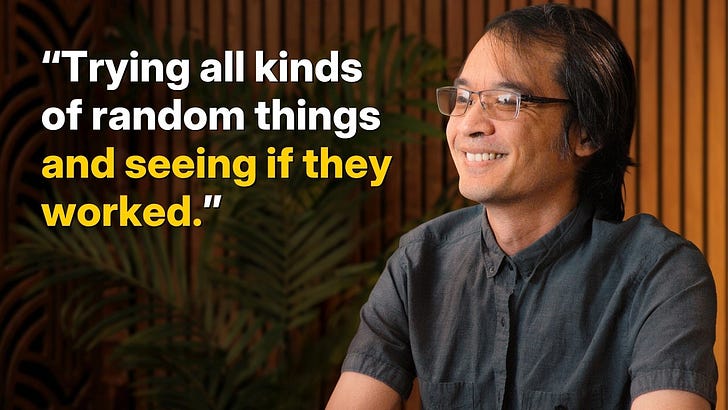
Mathematician Terence Tao finds AI doesn't speed up his core problem-solving but makes his papers "richer" by adding complex plots and deeper literature searches. Tasks that were previously infeasible are now easy. AI expands the scope and quality of work rather than just shortening the timeline for existing tasks.
Related Insights
AI tools don't lead to more leisure time; they intensify work by providing massive leverage. Users can execute ideas more easily and tackle more ambitious projects. The net result is an increase in output and project scope, allowing individuals to accomplish more in a day, often with less fatigue because tedious tasks are automated.

Contrary to the narrative of AI reducing work, heavy users find it intensifies their workload. The immense leverage from AI makes it easier to get ideas off the ground and produce more in-depth output. This shifts the productivity gain from "working less" to "achieving more," leading to more complex projects, not more free time.

A Berkeley Haas study finds AI doesn't reduce work but intensifies it through 'task expansion.' Professionals use AI to venture into adjacent roles—like product managers writing code—widening their job scope and increasing total output, rather than simply doing their old job faster.

Users who treat AI as a collaborator—debating with it, challenging its outputs, and engaging in back-and-forth dialogue—see superior outcomes. This mindset shift produces not just efficiency gains, but also higher quality, more innovative results compared to simply delegating discrete tasks to the AI.
According to OpenAI co-founder Andrej Karpathy, the true impact of AI code generation is less about a linear speedup on existing tasks. Instead, it expands the scope of what's feasible, allowing engineers to attempt projects they would have previously deemed not worth the effort or beyond their skillset.

Human intuition is a poor gauge of AI's actual productivity benefits. A study found developers felt significantly sped up by AI coding tools even when objective measurements showed no speed increase. The real value may come from enabling tasks that otherwise wouldn't be attempted, rather than simply accelerating existing workflows.

AI's true productivity leverage is not just speed but enabling more attempts. A human might get one shot at a complex task, whereas an AI-assisted workflow allows for three or more "turns at the wheel." The critical human skill shifts from initial creation to rapid review and refinement of these iterations.

AI's primary impact will be augmenting and increasing productivity across entire organizations, not just automating lower-level tasks. The technology can handle a fraction of almost everyone's job, freeing up humans to focus on strategic, creative, and interpersonal work that models cannot perform.

A UC Berkeley study found employees using AI worked faster and took on broader tasks, leading to more hours worked, not fewer. AI offloads menial labor, making jobs more purpose-driven and motivating employees to do more, which increases stress and burnout.
For creative work like design, AI's true value isn't just accelerating tasks. It's enabling designers to explore a much wider option space, test more possibilities, and apply more craft to the final choice. Since design is non-deterministic, AI serves creative exploration more than simple speed.