Get your free personalized podcast brief
We scan new podcasts and send you the top 5 insights daily.
While costly, advanced AI models provide a return on investment by enabling teams to tackle previously unsolvable or prohibitively complex problems. The value isn't just in accelerating existing workflows but in fundamentally increasing the ambition and scope of what's technically achievable.

Related Insights
A 10x increase in compute may only yield a one-tier improvement in model performance. This appears inefficient but can be the difference between a useless "6-year-old" intelligence and a highly valuable "16-year-old" intelligence, unlocking entirely new economic applications.
![Dylan Patel - Inside the Trillion-Dollar AI Buildout - [Invest Like the Best, EP.442] thumbnail](https://megaphone.imgix.net/podcasts/799253cc-9de9-11f0-8661-ab7b8e3cb4c1/image/d41d3a6f422989dc957ef10da7ad4551.jpg?ixlib=rails-4.3.1&max-w=3000&max-h=3000&fit=crop&auto=format,compress)
To properly evaluate the cost of advanced AI tools, shift your mental framework. Don't compare a $200/month plan to a $20/month entertainment subscription. Compare it to the cost of a human employee, which could be thousands per month. The AI is a productive asset, making its price a high-leverage investment.

Focusing on AI for cost savings yields incremental gains. The transformative value comes from rethinking entire workflows to drive top-line growth. This is achieved by either delivering a service much faster or by expanding a high-touch service to a vastly larger audience ("do more").

The high price point for professional AI tools is justified by their ability to tackle complex, high-value business tasks, not just minor productivity gains. The return on investment comes from replacing expensive and time-consuming work, like developing a data-driven growth strategy, in minutes.

Most view AI for efficiency, but its true power lies in handling routine tasks to free up human talent. This unlocks capacity for strategic, creative, and relationship-driven work that fuels innovation and growth, shifting the question from cost savings to new capabilities.

To optimize AI costs in development, use powerful, expensive models for creative and strategic tasks like architecture and research. Once a solid plan is established, delegate the step-by-step code execution to less powerful, more affordable models that excel at following instructions.

The most significant value from AI is not in automating existing tasks, but in performing work that was previously too costly or complex for an organization to attempt. This creates entirely new capabilities, like analyzing every single purchase order for hidden patterns, thereby unlocking new enterprise value.

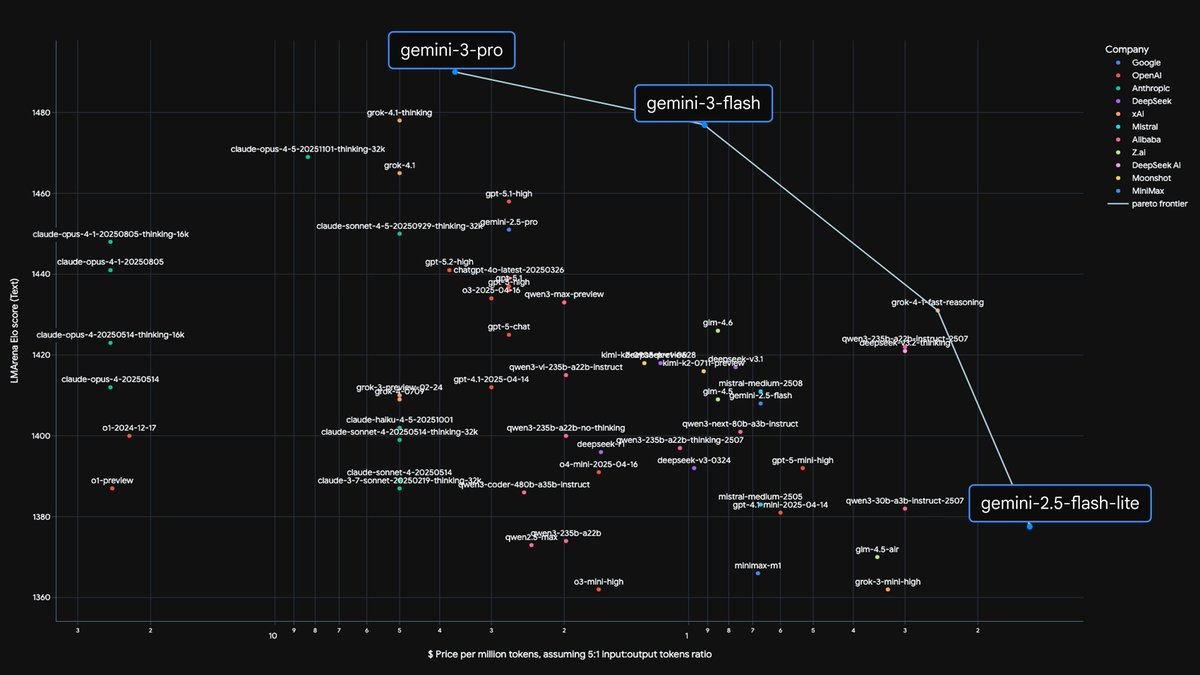
While the cost for GPT-4 level intelligence has dropped over 100x, total enterprise AI spend is rising. This is driven by multipliers: using larger frontier models for harder tasks, reasoning-heavy workflows that consume more tokens, and complex, multi-turn agentic systems.

Don't assume that a "good enough" cheap model will satisfy all future needs. Jeff Dean argues that as AI models become more capable, users' expectations and the complexity of their requests grow in tandem. This creates a perpetual need for pushing the performance frontier, as today's complex tasks become tomorrow's standard expectations.
While AI provides operational efficiency, its most profound value lies in enabling tasks that were previously impossible due to scale, like instantly rewriting 10 million pages of web content after a terminology change. This capability transcends traditional ROI calculations.