Get your free personalized podcast brief
We scan new podcasts and send you the top 5 insights daily.
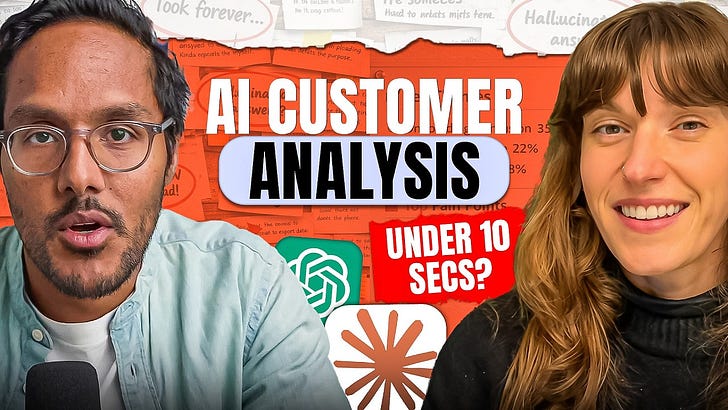
Instead of running analyses sequentially, set up AI agents (e.g., in Claude Code) with pre-programmed workflows for different data types. You can then trigger both a survey analysis and an interview analysis simultaneously, effectively cutting your total analysis time in half.
Related Insights
Knowledge workers are using AI agents like Claude Code to create multi-layered research. The AI first generates several deep-dive reports on individual topics, then creates a meta-analysis by synthesizing those initial AI-generated reports, enabling a powerful, iterative research cycle managed locally.
While AI handles quantitative analysis, its greatest strength is synthesizing unstructured qualitative data like open-ended survey responses. It excels at coding and theming this feedback, automating a process that was historically a painful manual bottleneck for researchers and analysts.

After running a survey, feed the raw results file and your original list of hypotheses into an AI model. It can perform an initial pass to validate or disprove each hypothesis, providing a confidence score and flagging the most interesting findings, which massively accelerates the analysis phase.
Instead of sending massive text blocks, feed unstructured data like user survey responses or Slack community introductions into a presentation AI. This quickly generates digestible, visual reports with synthesized personas, key takeaways, and charts, a task that would previously take a team weeks to complete.
Structure your development workflow to leverage the AI agent as a parallel processor. While you focus on a hands-on coding task in the main editor window, delegate a separate, non-blocking task (like scaffolding a new route) to the agent in a side panel, allowing it to "cook in the background."
Instead of manual survey design, provide an AI with a list of hypotheses and context documents. It can generate a complete questionnaire, the platform-specific code file for deployment (e.g., for Qualtrics), and an analysis plan, compressing the user research setup process from days to minutes.
The agent development process can be significantly sped up by running multiple tasks concurrently. While one agent is engineering a prompt, other processes can be simultaneously scraping websites for a RAG database and conducting deep research on separate platforms. This parallel workflow is key to building complex systems quickly.
Don't ask an AI to immediately find themes in open-ended survey responses. First, instruct it to perform "inductive coding"—creating and applying labels to each response based on the data itself. This structured first step ensures a more rigorous and accurate final analysis.
When developing AI capabilities, focus on creating agents that each perform one task exceptionally well, like call analysis or objection identification. These specialized agents can then be connected in a platform like Microsoft's Copilot Studio to create powerful, automated workflows.

Waiting for a single AI assistant to process requests creates constant start-stop interruptions. Using a tool like Conductor to run multiple AI coding agents in parallel on different tasks eliminates this downtime, helping developers and designers maintain a state of deep focus and productivity.