Get your free personalized podcast brief
We scan new podcasts and send you the top 5 insights daily.
Comma AI's architecture is "end-to-end," meaning its model takes raw video and directly outputs driving commands like acceleration and steering angle. This avoids the traditional, more brittle pipeline of separately detecting lanes, traffic lights, and other objects as intermediate steps before planning a path.
Related Insights
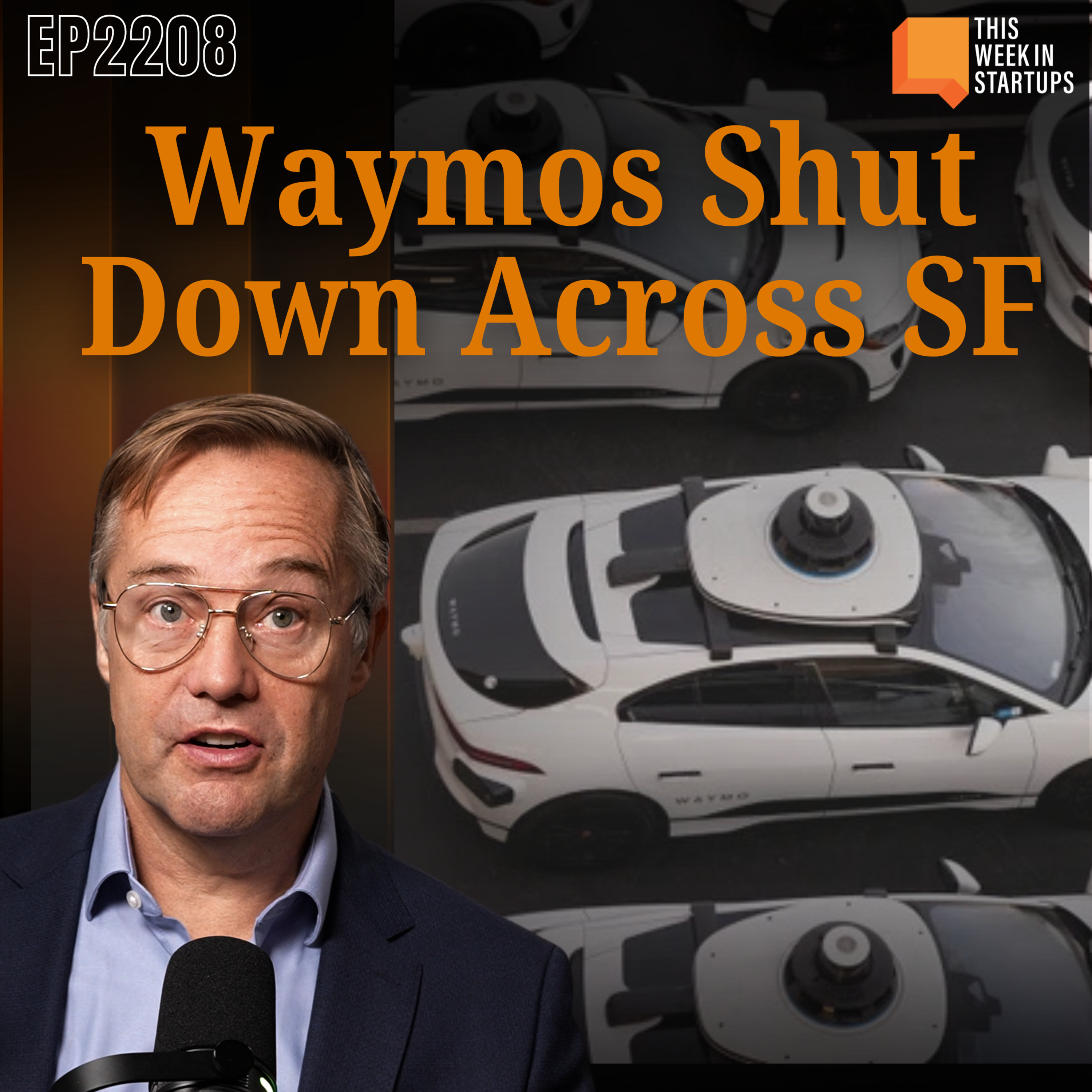
During a San Francisco power outage, Waymo's map-based cars failed while Teslas were reportedly unaffected. This suggests that end-to-end AI systems are less brittle and better at handling novel "edge cases" than more rigid, heuristic-based autonomous driving models.
Comma AI's OpenPilot software is open source not just for philosophical reasons, but as a core business strategy. It enables a community of developers to add support for new vehicle models, massively expanding the product's addressable market without requiring a large in-house team.
Rivian's CEO explains that early autonomous systems, which were based on rigid rules-based "planners," have been superseded by end-to-end AI. This new approach uses a large "foundation model for driving" that can improve continuously with more data, breaking through the performance plateau of the older method.

Comma AI's CTO reveals their commitment to an end-to-end ML architecture was a necessity, not just a preference. Lacking the capital of Waymo or Tesla for vast human data labeling teams, they were forced to develop a more efficient, less human-intensive approach to leverage their driving data.
A pure "pixels-in, actions-out" model is insufficient for full autonomy. While easy to start, this approach is extremely inefficient to simulate and validate for safety-critical edge cases. Waymo augments its end-to-end system with intermediate representations (like objects and road signs) to make simulation and validation tractable.
The key difference between AV 1.0 and AV 2.0 isn't just using deep learning. Many legacy systems use DL for individual components like perception. The revolutionary AV 2.0 approach replaces the entire modular stack and its hand-coded interfaces with one unified, data-driven neural network.

Initially criticized for forgoing expensive LIDAR, Tesla's vision-based self-driving system compelled it to solve the harder, more scalable problem of AI-based reasoning. This long-term bet on foundation models for driving is now converging with the direction competitors are also taking.

Instead of using traditional, rule-based simulators, Comma AI trains its driving agent inside a learned "world model." This generative model creates photorealistic, diverse driving scenarios and, crucially, responds accurately to the agent's simulated actions—a key requirement for effective robotics training.
The winning vehicle in the 2005 DARPA self-driving challenge, led by future Waymo founder Sebastian Thrun, used a clever machine learning approach. It overlaid precise laser sensor data onto a regular video camera feed, teaching the system to recognize the color and texture of "safe" terrain and extrapolate a drivable path far ahead.
Comma AI's strategy is to incrementally solve the grand challenge of self-driving by shipping products that are useful today. This iterative approach allows them to generate revenue, gather real-world data, and fund development, contrasting with competitors who operate in a more research-focused, "all-or-nothing" mode.