Get your free personalized podcast brief
We scan new podcasts and send you the top 5 insights daily.
In an agentic world where AI decision-making is commoditized, a strong business framework is Trigger, Decision, Action, Feedback. The most defensible companies will own the workflow components surrounding the AI: the initial trigger (e.g., an invoice is due), the resulting action, and the feedback loop (e.g., payment confirmed).

Related Insights
As AI gets embedded in core workflows, the key strategic question becomes who owns the resulting intelligence. Enterprises are wary of outsourcing their core logic to model providers who have explicitly stated they will compete in their customers' industries, making ownership of these learnings paramount.

Customers are hesitant to trust a black-box AI with critical operations. The winning business model is to sell a complete outcome or service, using AI internally for a massive efficiency advantage while keeping humans in the loop for quality and trust.

For long-term defensibility, AI companies must control the entire stack: the model, the middleware, and the end-user work product. While some can start with the model layer, others can successfully start with the user interface and vertically integrate downwards over time to build a durable business.

As foundational AI models become commoditized, the competitive advantage is no longer raw intelligence. Lasting value comes from building a reliable ecosystem around the AI, focusing on deep workflow integration, governance, user trust, and flawless operational execution. This is the true defensible moat.
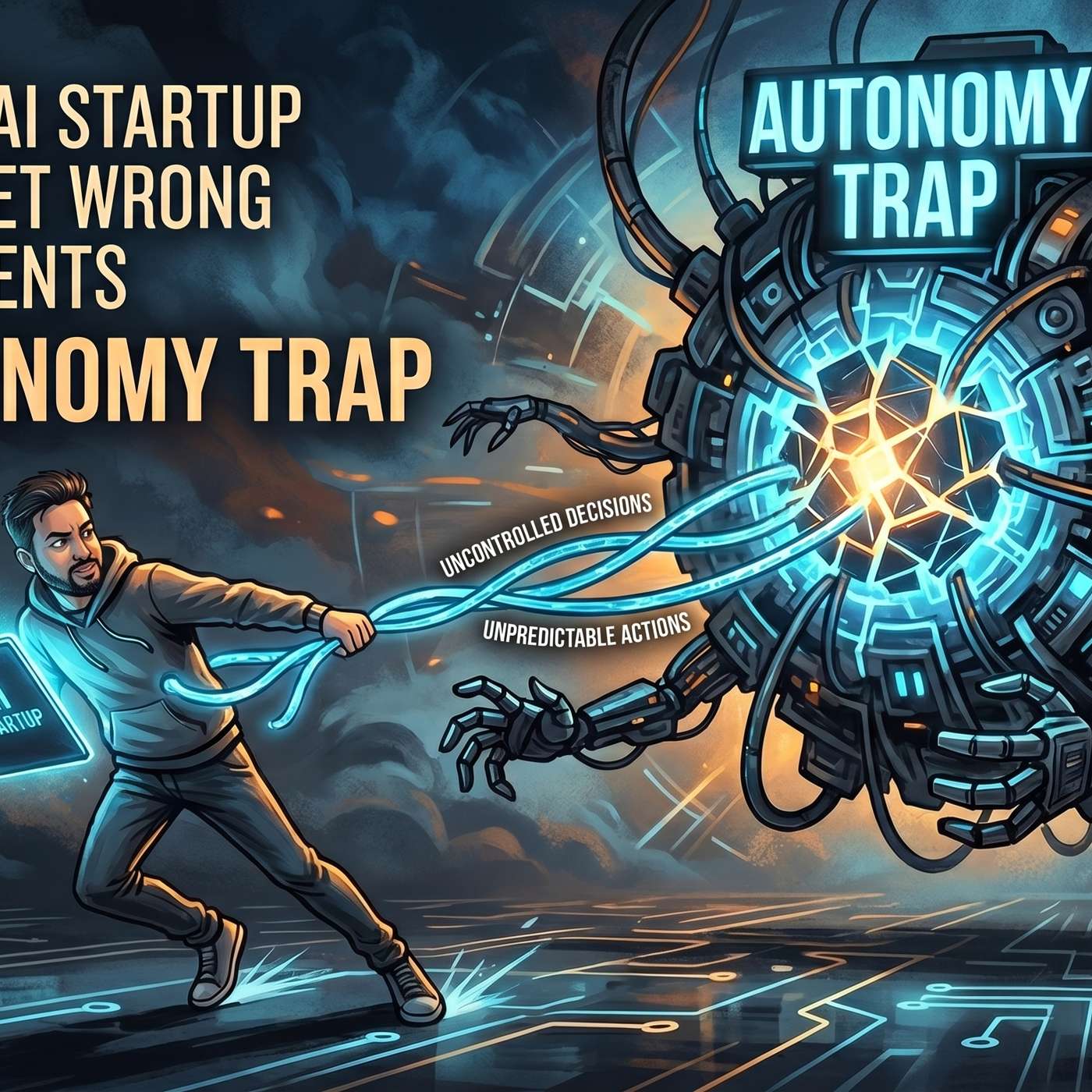
Counter to fears that foundation models will obsolete all apps, AI startups can build defensible businesses by embedding AI into unique workflows, owning the customer relationship, and creating network effects. This mirrors how top App Store apps succeeded despite Apple's platform dominance.
An impressive AI capability, like a multi-language voice agent, is a differentiator that can be copied. Lasting defensibility is achieved not by the AI feature itself, but by embedding it within an end-to-end workflow that becomes the system of record for the user.

An AI agent that only automates a small, horizontal slice of a business process is "virtually useless." To deliver real business outcomes, the agent must be capable of handling the entire end-to-end workflow, from initial contact to final revenue generation.

Capturing the critical 'why' behind decisions for a context graph cannot be done after the fact by analyzing data. Companies must be directly in the flow of work where decisions are made to build this defensible data layer, giving workflow-native tools a structural advantage over external data aggregators.

As AI models become commoditized, the new competitive frontier lies in mapping valuable, real-world events ('triggers') to automated AI workflows. The analysis suggests massive companies will be built by identifying industry-specific triggers—like a competitor's feature launch or a drop in customer usage—and selling the automated outcome.

An AI app that is merely a wrapper around a foundation model is at high risk of being absorbed by the model provider. True defensibility comes from integrating AI with proprietary data and workflows to become an indispensable enterprise system of record, like an HR or CRM system.
