Get your free personalized podcast brief
We scan new podcasts and send you the top 5 insights daily.
Tasklet completely re-architected its agent, moving from feeding chat history into the LLM to treating the file system as the primary context. The agent now receives hints and pointers to relevant files, enabling it to handle infinitely long histories and larger contexts beyond the token window.

Related Insights
According to Harrison Chase, providing agents with file system access is critical for long-horizon tasks. It serves as a powerful context management tool, allowing the agent to save large tool outputs or conversation histories to files, then retrieve them as needed, effectively bypassing context window limitations.
To prevent an AI agent from repeating mistakes across coding sessions, create 'agents.md' files in your codebase. These act as a persistent memory, providing context and instructions specific to a folder or the entire repo. The agent reads these files before working, allowing it to learn from past iterations and improve over time.

To manage context costs, Tasklet summarizes agent history with decreasing granularity over time. Recent interactions are sent verbatim, while older conversations have tool calls, thinking steps, and messages truncated or summarized. This is done in cache-aware buckets to minimize cost.
To prevent performance degradation from overly large prompts ("context rot"), recursive language models offload context to an external environment. For a coding agent, this is the file system; for Marimo Pair, it's the live Python runtime. The agent can then access this information on-demand, keeping its primary context clean and focused.

A key challenge for AI agents is their limited context window, which leads to performance degradation over long tasks. The 'Ralph Wiggum' technique solves this by externalizing memory. It deliberately terminates an agent and starts a new one, forcing it to read the current state from files (code, commit history, requirement docs), creating a self-healing and persistent system.

In architectures like OpenClaw, an agent's state and memory are stored in a file system, not the model itself. This means your agent is its files. You can swap the underlying LLM and the agent retains its identity and capabilities, much like recompiling code for a new chip.
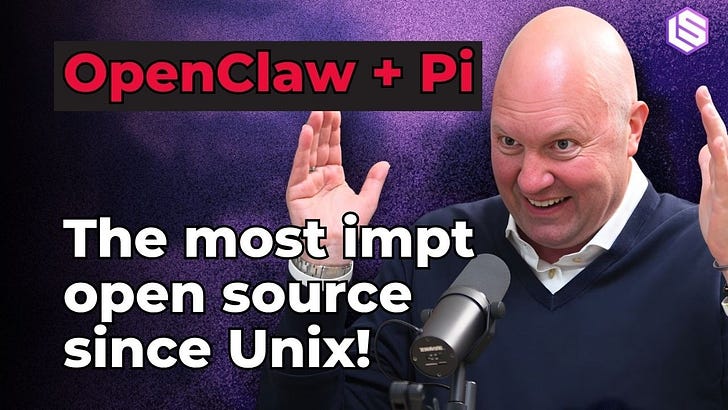
The architectural breakthrough of AI agents is the fusion of LLMs with the classic UNIX mindset. It uses a shell, file system, and cron jobs, making the agent's state (its files) independent of the specific LLM. This allows for model-swapping, migration, and self-modification.
Contrary to the trend toward multi-agent systems, Tasklet finds that one powerful agent with access to all context and tools is superior for a single user's goals. Splitting tasks among specialized agents is less effective than giving one generalist agent all information, as foundation models are already experts at everything.

AI agents have limited context windows and "forget" earlier instructions. To solve this, generate PRDs (e.g., master plan, design guidelines) and a task list. Then, instruct the agent to reference these documents before every action, effectively creating a persistent, dynamic source of truth for the project.

To make agents useful over long periods, Tasklet engineers an "illusion" of infinite memory. Instead of feeding a long chat history, they use advanced context engineering: LLM-based compaction, scoping context for sub-agents, and having the LLM manage its own state in a SQL database to recall relevant information efficiently.