Get your free personalized podcast brief
We scan new podcasts and send you the top 5 insights daily.
The industry's critical need is for engineers who can build the entire support system for an LLM: contracts, validation, observability, cost controls, and failure handling. This "AI systems" skill set is more valuable than simply being able to craft a clever prompt for a single input.

Related Insights
Top AI labs struggle to find people skilled in both ML research and systems engineering. Progress is often bottlenecked by one or the other, requiring individuals who can seamlessly switch between optimizing algorithms and building the underlying infrastructure, a hybrid skillset rarely taught in academia.
![[State of Post-Training] From GPT-4.1 to 5.1: RLVR, Agent & Token Efficiency — Josh McGrath, OpenAI thumbnail](https://assets.flightcast.com/V2Uploads/nvaja2542wefzb8rjg5f519m/01K4D8FB4MNA071BM5ZDSMH34N/square.jpg)
While prompts are easy to copy, the complex engineering work to ensure reliability—validation, versioning, cost controls, and error handling—creates a true competitive moat. This "AI systems engineering" layer is where a product's long-term value and defensibility are built.
As AI automates more day-to-day coding, the critical skill for engineers is becoming 'systems thinking'—understanding the entire workflow and how components interact. This was once a senior-level trait but is now essential for everyone in engineering.

As AI automates narrow skills like writing code snippets, the ability to think at a system level becomes paramount. Designing how different components—including classical ML models, LLMs, and traditional software—fit together is a skill that is harder to automate and increasingly valuable.

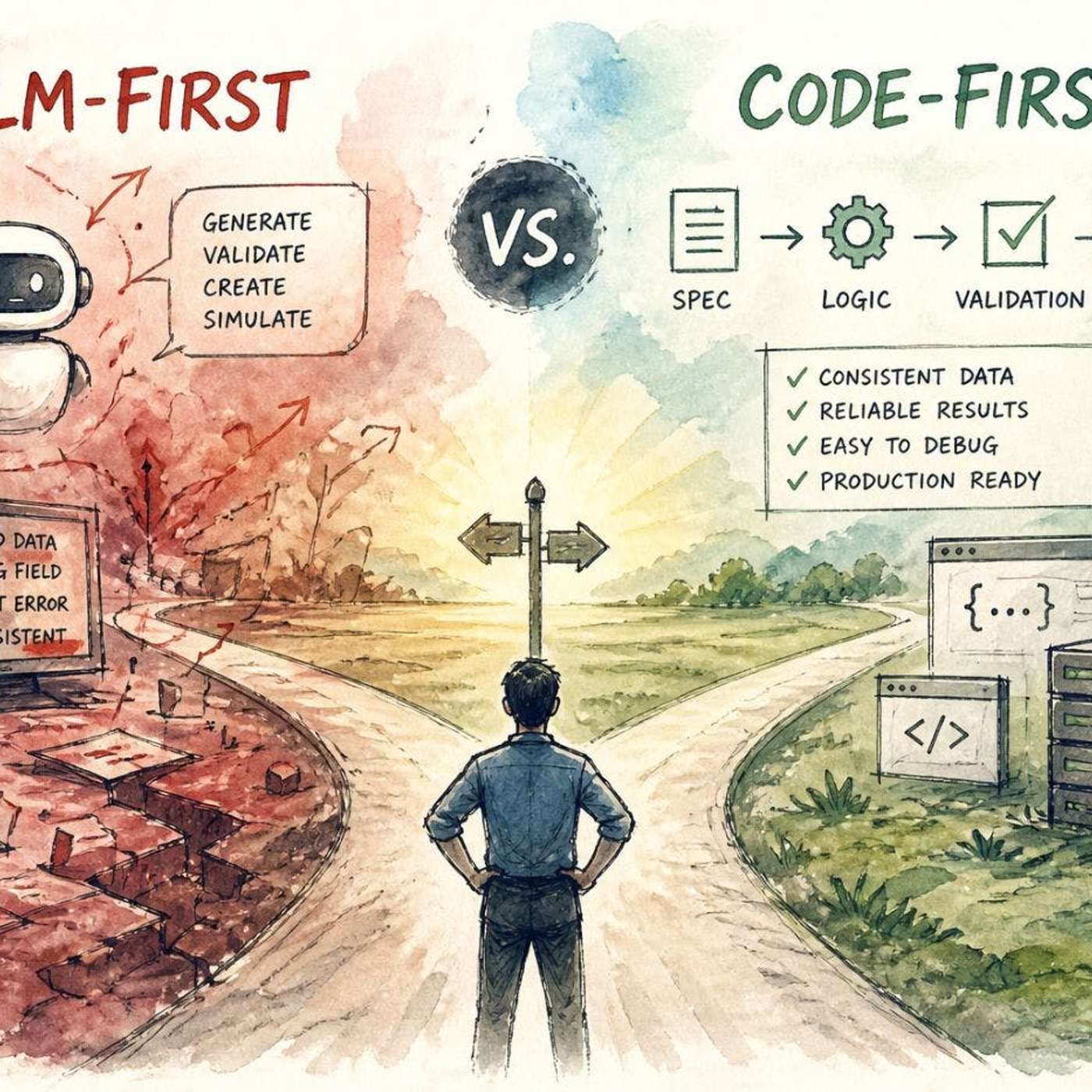
Don't give LLMs full control. Use deterministic code for core logic, validation, and enforcing rules. Delegate only tasks requiring flexibility or understanding of unstructured input to the LLM, treating it as a specialized component, not the entire system.
Theoretical knowledge is now just a prerequisite, not the key to getting hired in AI. Companies demand candidates who can demonstrate practical, day-one skills in building, deploying, and maintaining real, scalable AI systems. The ability to build is the new currency.

As AI handles routine coding, the most valuable engineers are either "dreamers" with strong product sense who can own features end-to-end, or deep subject matter experts who can verify and handle the complex, trust-critical parts of the system where human verification is still essential.

As LLMs excel at producing functional code, human value is shifting to higher-level skills. Graduates must now demonstrate proficiency in system design, architectural decision-making, and identifying business needs, rather than just raw coding output.
In an AI-first world, an engineer's role shifts from writing feature code to building leverage. They become akin to staff engineers for AI agents, creating the systems, documentation, and automated tests (the "harness") that empower AI to produce high-quality work autonomously.

AI excels at generating code, making that task a commodity. The new high-value work for engineers is "verification”—ensuring the AI's output is not just bug-free, but also valuable to customers, aligned with business goals, and strategically sound.
