Get your free personalized podcast brief
We scan new podcasts and send you the top 5 insights daily.
Purely abstract mathematical concepts, developed with no real-world application, are later found to be the precise language needed to describe physical reality. For example, Riemann's geometry for curved space sat unused for 60 years until Einstein required it for general relativity, proving the universe's 'code' was discoverable before its function was known.

Related Insights
Beyond physics, string theory's mathematical toolkit has proven powerful. A string theorist used its methods to solve a complex counting problem, producing an answer that mathematicians initially disputed. They later found a bug in their own code, proving the string theory result correct.

The main reason string theory excites physicists is not because it's been proven by experiments, but because it is mathematically consistent. It successfully combines quantum mechanics and gravity without generating the nonsensical infinities that doom simpler approaches.
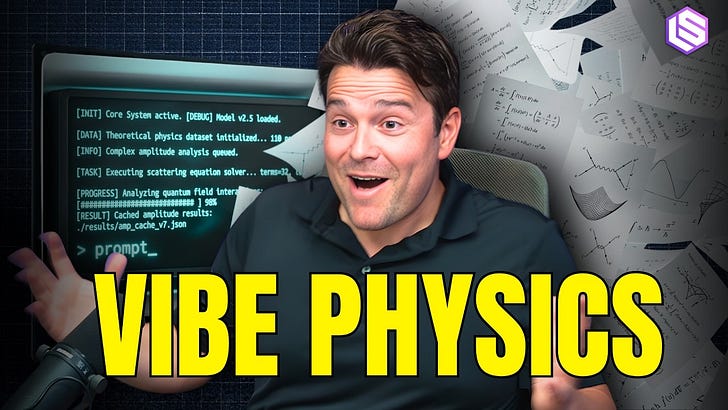
Physicists were stuck on a problem because manual calculations grew with factorial complexity, creating a messy, unmanageable formula. ChatGPT discovered an underlying elegant formula where complexity grows linearly, a simplification human researchers had missed for a year.
A radical implication of string theory is the concept of "emergent spacetime." Our familiar four dimensions may not be the fundamental building blocks of reality. Instead, they could be an emergent property derived from a deeper quantum phenomenon, specifically entanglement.
Pure, curiosity-driven research into quantum physics over a century ago, with no immediate application in sight, became the foundation for today's multi-billion dollar industries like lasers, computer chips, and medical imaging. This shows the immense, unpredictable ROI of basic science.
String theory wasn't created to unify gravity and quantum mechanics. It was an unsuccessful attempt to describe hadron particles. Its potential for quantum gravity was an accidental discovery, showcasing how scientific theories can find new life in unexpected domains.
The history of mathematics is filled with examples, like Newton and Leibniz independently discovering calculus, where different people in isolation uncover the exact same mathematical systems. This suggests they are not inventing a language but discovering a pre-existing computational structure inherent to the universe itself.
Physicists are finding structures beyond spacetime (e.g., amplituhedra) defined by permutations. Hoffman's theory posits these structures are the statistical, long-term behavior of a vast network of conscious agents. Physics and consciousness research are unknowingly meeting in the middle, describing the same underlying reality from opposite directions.

Traditional science failed to create equations for complex biological systems because biology is too "bespoke." AI succeeds by discerning patterns from vast datasets, effectively serving as the "language" for modeling biology, much like mathematics is the language of physics.

Turning intuition into precise mathematics is vital because the math can reveal consequences the theory's creator never anticipated. Einstein himself didn't foresee and initially rejected the existence of black holes, a direct prediction from his own equations.
