Get your free personalized podcast brief
We scan new podcasts and send you the top 5 insights daily.
By combining a Medicare Advantage plan, a proprietary tech platform, and a primary care network, Devoted Health created a defensible moat. This vertical integration allows AI to drive dramatic efficiency gains, tripling company size while halving operating ratio.

Related Insights
By acquiring Torch, a startup that unifies medical records for AI, OpenAI is moving beyond a general-purpose platform. This purchase provides crucial domain expertise and a solution for structured data, revealing a strategy to build specialized, industry-specific AI products for high-value sectors like healthcare.

Contrary to the belief that startups will dominate, large, vertically integrated managed care companies are best suited to adapt to consumerism. Their existing scale across insurance, provider arms, technology, and pharmacy assets allows them to invest in and deliver the transparency and access consumers demand.

AI's impact on healthcare will be a bifurcation. One end will be hyper-efficient, low-cost, AI-driven telehealth. The other will be high-touch, relationship-based advanced primary care. The traditional, inefficient fee-for-service model in the middle will become obsolete, much like Amazon and luxury retail hollowed out department stores.

Doctronic's AI-native care platform dramatically increases physician productivity. By using AI to handle initial intake and summarization, doctors can see 15 or more patients an hour, compared to the traditional telehealth rate of four. This demonstrates AI's potential to address the supply-demand mismatch in healthcare.

While LLMs can provide medical intelligence, they cannot perform physical tasks like drawing blood. The winning model uses AI for a disruptive cost structure internally while delivering a service with a real-world, regulated, or hardware-based moat that cannot be commoditized by a general AI.

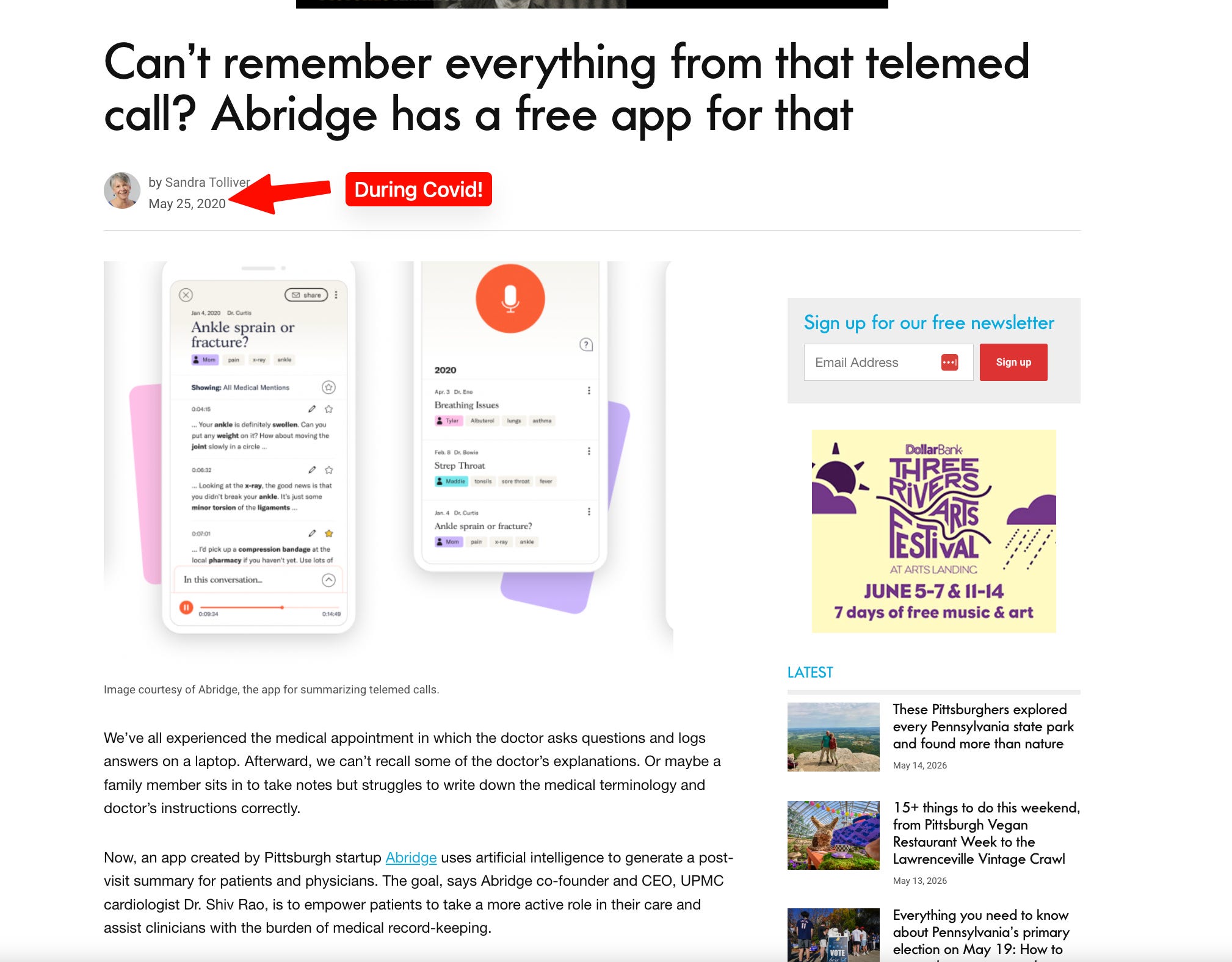
While proprietary data and high-quality models are important, Abridge's true moat lies in its deep integration into the clinical workflow. By solving problems like prior authorization in real-time while the patient is still in the room, it collapses weeks of administrative latency into minutes, creating value that is hard to replicate.
The vague concept of a 'data network effect' is now a real defensibility strategy in AI. The key is having a *live*, constantly updating proprietary dataset (e.g., real-time health data). This allows a commodity model to deliver superior results compared to a state-of-the-art model without access to that live data.

The founder of Medvy built a massive telehealth business by using a "telehealth in a box" platform for doctors, pharmacies, and compliance. This allowed him to focus exclusively on AI-driven branding and marketing to acquire customers at scale.

Initially adopted for clinician retention, AI tools are now proving hard financial ROI. By unlocking new operating margin, AI allows health systems to reinvest in talent and technology. This creates a compounding flywheel that separates top organizations from those at risk of consolidation.

The $1.8B telehealth company MedV is described as an "AI-enabled wrapper" not for a foundation model, but for the GLP-1 drug industry. This insight reframes the "wrapper" concept: AI's greatest immediate impact may be creating hyper-efficient operational layers over existing industries like telehealth, not just building on top of LLMs.