Get your free personalized podcast brief
We scan new podcasts and send you the top 5 insights daily.
Previously, maintainers invested time mentoring new contributors, betting they'd become long-term assets. With AI, contributors can apply feedback without learning from it, breaking the compounding feedback loop and fundamentally changing the maintainer-contributor dynamic.

Related Insights
The ease of creating PRs with AI agents shifts the developer bottleneck from code generation to code validation. The new challenge is not writing the code, but gaining the confidence to merge it, elevating the importance of review, testing, and CI/CD pipelines.
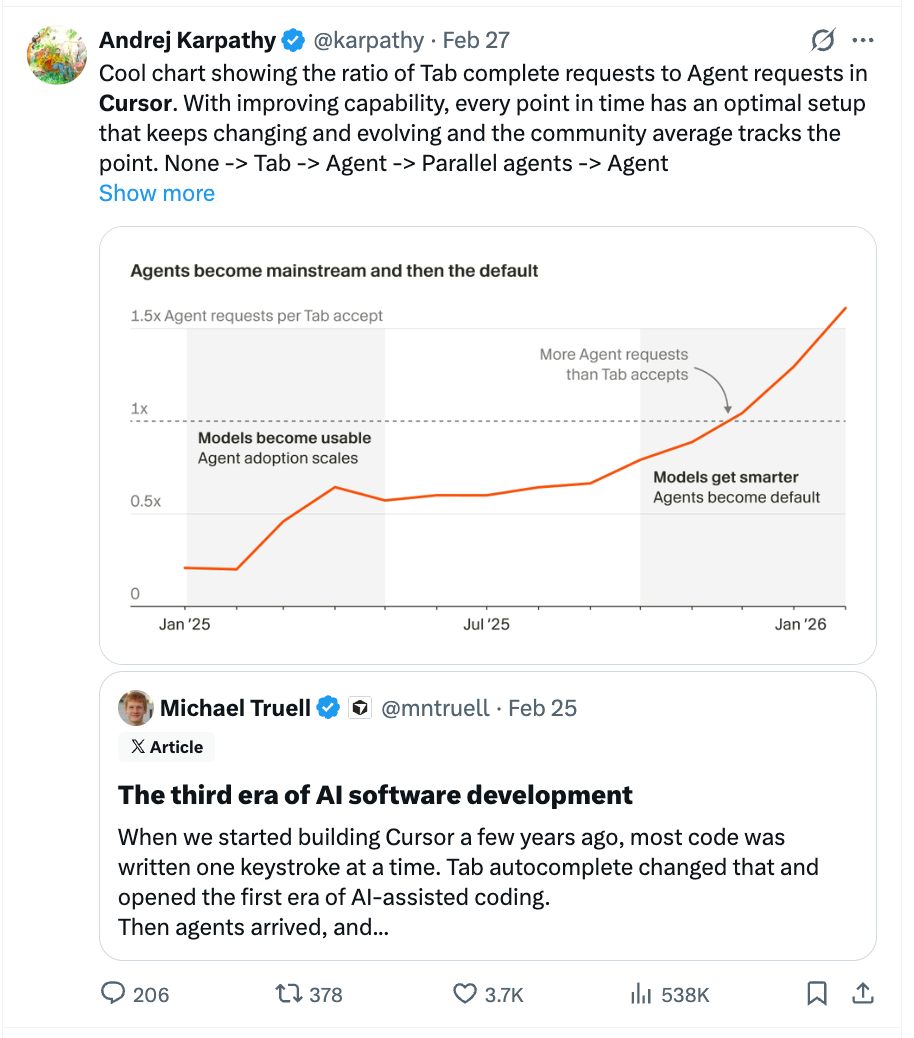
A teammate of Charlie Marsh admitted they now review his pull requests more carefully, saying, 'you're not writing it anymore, it's the agent.' This highlights a hidden cost of AI adoption: it can break down the earned trust and review shortcuts that senior engineers typically benefit from.
New AI-driven code review processes haven't replaced the pull request because they miss the core point. The PR isn't just a technical workflow; it's a social protocol for codifying trust. We trust a change because a specific senior human reviewed it. Agent-driven reviews diffuse this trust, making them harder to adopt.
When an AI model generates code, the focus of a pull request review changes. It's no longer just about whether the code works. The engineer must now explain and defend the architectural choices the model made, demonstrating they understand the implications and haven't just accepted a default, suboptimal solution.

Traditional software development processes, like peer code reviews, were built for a cadence of 10-15 PRs per month. When AI agents enable a 10x increase in output, the human team becomes the bottleneck, forcing a shift towards AI-driven review and validation.

A surprising side effect of using AI at OpenAI is improved code review quality. Engineers now use AI to write pull request summaries, which are consistently more thorough and better at explaining the 'what' and 'why' of a change. This improved context helps human reviewers get up to speed faster.
AI agents can generate plausible-looking code contributions instantly, flooding maintainers with pull requests. Since the human cost to review and validate the code remains high, this creates a significant imbalance and a new bottleneck in open source development.
AI tools automate library selection, reducing developer interaction with open-source projects. This diminishes the non-monetary incentives (attention, feedback, recognition) that motivate maintainers, potentially leading to the ecosystem's decline.
As AI writes most of the code, the highest-leverage human activity will shift from reviewing pull requests to reviewing the AI's research and implementation plans. Collaborating on the plan provides a narrative journey of the upcoming changes, allowing for high-level course correction before hundreds of lines of bad code are ever generated.

With AI agents autonomously generating pull requests, the primary constraint in software development is no longer writing code but the human capacity to review it. Companies like Block are seeing PRs per engineer increase massively, creating a new challenge for engineering managers to solve.
