Get your free personalized podcast brief
We scan new podcasts and send you the top 5 insights daily.
A surprising side effect of using AI at OpenAI is improved code review quality. Engineers now use AI to write pull request summaries, which are consistently more thorough and better at explaining the 'what' and 'why' of a change. This improved context helps human reviewers get up to speed faster.

Related Insights
The focus of "code review" is shifting from line-by-line checks to validating an AI's initial architectural plan. After plan approval, AI agents like OpenAI's Codex can effectively review their own generated code, a capability they have been explicitly trained for, making human code review obsolete.
As AI coding agents generate vast amounts of code, the most tedious part of a developer's job shifts from writing code to reviewing it. This creates a new product opportunity: building tools that help developers validate and build confidence in AI-written code, making the review process less of a chore.

An internal OpenAI team maintains a codebase written entirely by AI. By removing the "escape hatch" of manual coding, they are forced to solve fundamental problems in providing better context and documentation to the AI, thus uncovering best practices for agent interaction.

AI tools are automating code generation, reducing the time developers spend writing it. Consequently, the primary skill shifts to carefully reviewing and verifying the AI-generated code for correctness and security. This means a developer's time is now spent more on review and architecture than on implementation.

To combat the bottleneck of reviewing massive, AI-generated pull requests, Cursor's agents create video demos of the features they build. This provides a much more accessible entry point for human review than a giant diff, helping to quickly align on the direction.
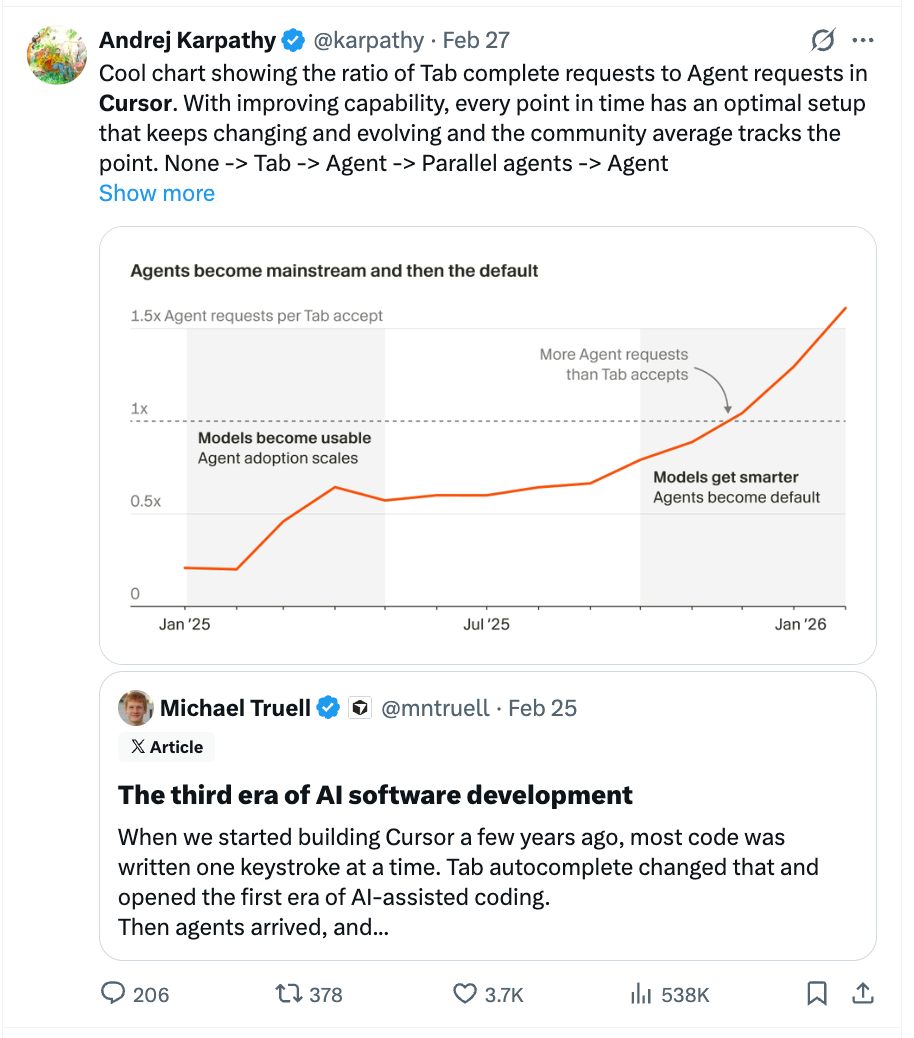
As AI writes most of the code, the highest-leverage human activity will shift from reviewing pull requests to reviewing the AI's research and implementation plans. Collaborating on the plan provides a narrative journey of the upcoming changes, allowing for high-level course correction before hundreds of lines of bad code are ever generated.

Data from OpenAI reveals a massive and growing productivity gap. Engineers who actively use the AI coding assistant Codex are opening 70% more pull requests than their peers, indicating a significant boost in efficiency and a widening skill divide.
It's infeasible for humans to manually review thousands of lines of AI-generated code. The abstraction of review is moving up the stack. Instead of checking syntax, developers will validate high-level plans, two-sentence summaries, and behavioral outcomes in a testing environment.

As AI generates more code, the core engineering task evolves from writing to reviewing. Developers will spend significantly more time evaluating AI-generated code for correctness, style, and reliability, fundamentally changing daily workflows and skill requirements.

AI agents can generate code far faster than humans can meaningfully review it. The primary challenge is no longer creation but comprehension. Developers spend most of their time trying to understand and validate AI output, a task for which current tools like standard PR interfaces are inadequate.