Get your free personalized podcast brief
We scan new podcasts and send you the top 5 insights daily.
Contrary to fears of disintermediation, the rise of AI agents increases the value of enterprise systems of record like Box. With thousands of employees and tens of thousands of agents accessing data, a centralized platform for managing security, access controls, and data governance becomes more critical than ever.

Related Insights
Agents don't operate in a vacuum; they need to act on structured, secure data stored in a durable system of record like a CRM or billing platform. Instead of replacing SaaS, agents will increase demand for platforms with robust APIs, making the future about agents *on top of* SaaS, not *instead of* SaaS.

Complex platforms have vast functionality that most human users never discover. AI agents can act as perfect power users, programmatically accessing the full suite of features to solve problems. This unlocks the "trapped value" of the software, increasing its utility and solidifying its role as a system of record.

Established SaaS companies can defend against AI disruption by leaning into their role as secure, compliant systems of record. While AI can replicate features, it cannot easily replace the years of trust, security protocols, and enterprise-grade support that large companies pay for. Their value shifts from UI to being a trusted database.

The future of work involves potentially millions of AI agents operating within a company. This requires a new governance layer, including agent inventories, inspectable reasoning traces, identity management, and sandboxed execution environments to maintain security and control.

As AI moves from answering questions to executing actions, governance becomes paramount. Previously a backend IT concern, robust governance for permissions, auditing, and accountability is now an essential prerequisite for deploying production-ready AI agents safely.

As autonomous agents become prevalent, they'll need a sandboxed environment to access, store, and collaborate on enterprise data. This core infrastructure must manage permissions, security, and governance, creating a new market opportunity for platforms that can serve as this trusted container.
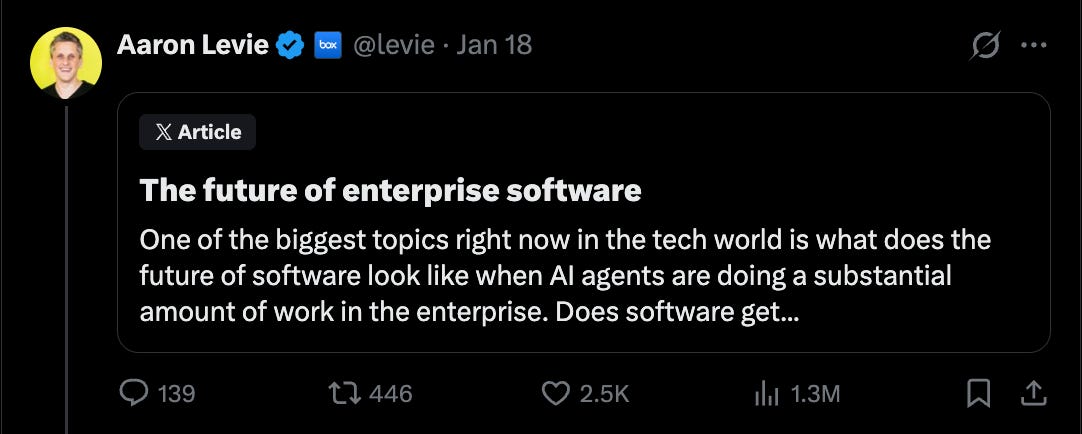
Box CEO Aaron Levy predicts that as AI agents become the biggest users of software, the traditional graphical user interface will become secondary. Software must be available in a "headless" fashion, as agents will interact directly with APIs, not click buttons, fundamentally changing how enterprise software is built.

Countering the idea of a zero-sum SaaS market, Box CEO Aaron Levie argues that AI agents create net-new value. By performing complex knowledge work on existing data (like analyzing contracts), agents allow software platforms to capture budget previously allocated to human labor, thus expanding the total addressable market.

According to Box CEO Aaron Levy, the biggest barrier to deploying AI agents isn't technology but corporate structure. Agents deliver the most value on processes that cross departments, but data fragmentation and a lack of central ownership across these silos prevent effective implementation.

Aaron Levie states that the rapid advancement of AI agent capabilities over the past year has convinced him that being a "headless" platform is no longer optional. SaaS companies must prioritize their API strategy above all else, as agents become the primary users of their systems.
