Get your free personalized podcast brief
We scan new podcasts and send you the top 5 insights daily.
Implementing agentic workflows doesn't eliminate challenges; it transforms them. For example, tripling code output creates a new code review bottleneck. The goal is to solve these emergent problems in service of a clearly superior way of operating, rather than expecting a problem-free state.

Related Insights
OpenAI's team found that as code generation speed approaches real-time, the new constraint is the human capacity to verify correctness. The challenge shifts from creating code to reviewing and testing the massive output to ensure it's bug-free and meets requirements.

The conventional, sequential stages of software development (design, code, test, review) are becoming obsolete. AI agents merge these steps into a single, iterative loop driven by user intent. This isn't a 10x improvement on the existing workflow; it's a fundamental paradigm shift that makes the entire traditional process a relic.
The ease of creating PRs with AI agents shifts the developer bottleneck from code generation to code validation. The new challenge is not writing the code, but gaining the confidence to merge it, elevating the importance of review, testing, and CI/CD pipelines.
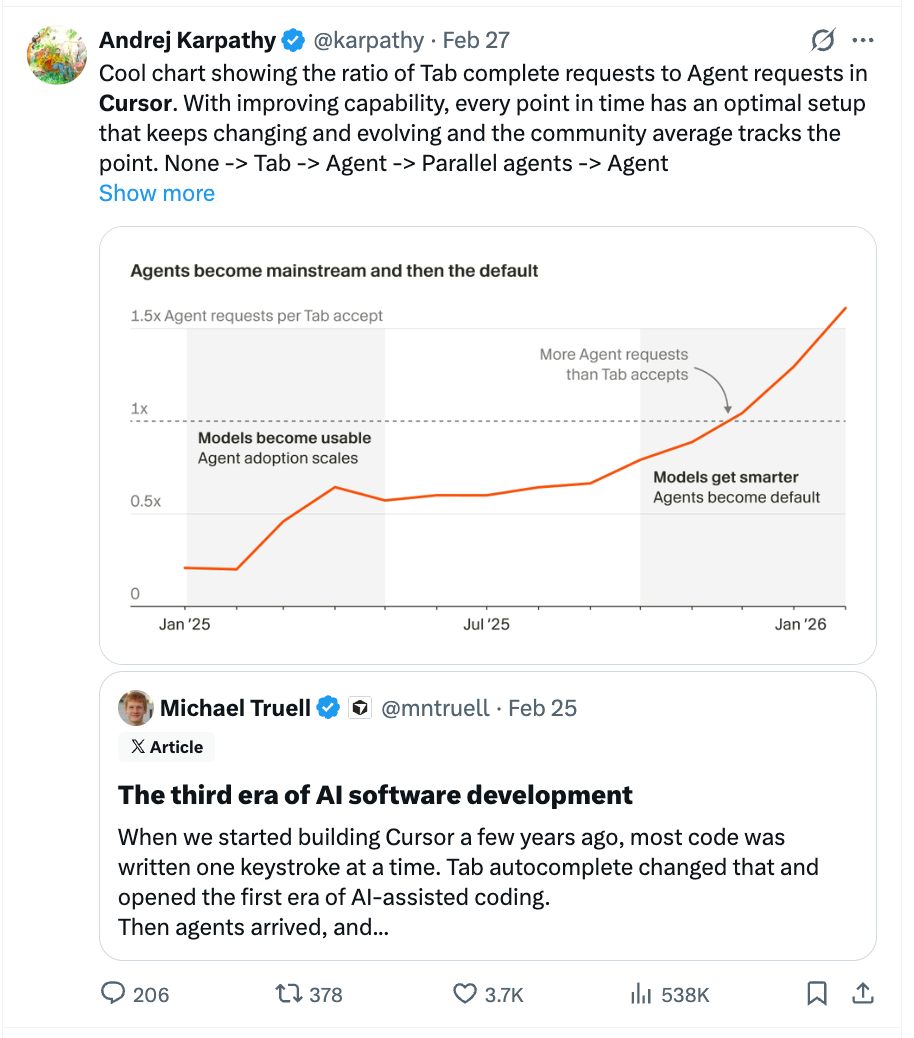
As AI agents handle the mechanics of code generation, the primary role of a developer is elevated. The new bottlenecks are not typing speed or syntax, but higher-level cognitive tasks: deciding what to build, designing system architecture, and curating the AI's work.
With AI agents capable of generating code and designs at an unprecedented rate, the new chokepoint in workflows is human review. The primary challenge is no longer production but scaling the evaluation process to ensure AI-generated output aligns with quality standards and company values.

AI doesn't just make engineers faster code writers; it shifts their accountability. Instead of being responsible for the code line-by-line, the engineer becomes responsible for the system of agents that generates the code. This requires new skills like defining agent boundaries and reviewing large AI-generated diffs to catch drift from intent.
AI agents can generate and merge code at a rate that far outstrips human review. While this offers unprecedented velocity, it creates a critical challenge: ensuring quality, security, and correctness. Developing trust and automated validation for this new paradigm is the industry's next major hurdle.

The most significant gains from AI will not come from automating existing human tasks. Instead, value is unlocked by allowing AI agents to develop entirely new, non-human processes to achieve goals. This requires a shift from process mapping to goal-oriented process invention.
Hyper-productive AI agents can generate a constant stream of ideas, code, and tasks, overwhelming human operators. The key constraint is no longer the ability to build, but the capacity to manage, operate, and direct the output of these agents, creating a new risk of 'agent-induced burnout'.

After achieving broad adoption of agentic coding, the new challenge becomes managing the downsides. Increased code generation leads to lower quality, rushed reviews, and a knowledge gap as team members struggle to keep up with the rapidly changing codebase.
