Get your free personalized podcast brief
We scan new podcasts and send you the top 5 insights daily.
AI agents can generate and merge code at a rate that far outstrips human review. While this offers unprecedented velocity, it creates a critical challenge: ensuring quality, security, and correctness. Developing trust and automated validation for this new paradigm is the industry's next major hurdle.

Related Insights
OpenAI's team found that as code generation speed approaches real-time, the new constraint is the human capacity to verify correctness. The challenge shifts from creating code to reviewing and testing the massive output to ensure it's bug-free and meets requirements.

As AI generates vast quantities of code, the primary engineering challenge shifts from production to quality assurance. The new bottleneck is the limited human attention available to review, understand, and manage the quality of the codebase, leading to increased fragility and "slop" in production.

As AI coding agents generate vast amounts of code, the most tedious part of a developer's job shifts from writing code to reviewing it. This creates a new product opportunity: building tools that help developers validate and build confidence in AI-written code, making the review process less of a chore.

The ease of creating PRs with AI agents shifts the developer bottleneck from code generation to code validation. The new challenge is not writing the code, but gaining the confidence to merge it, elevating the importance of review, testing, and CI/CD pipelines.
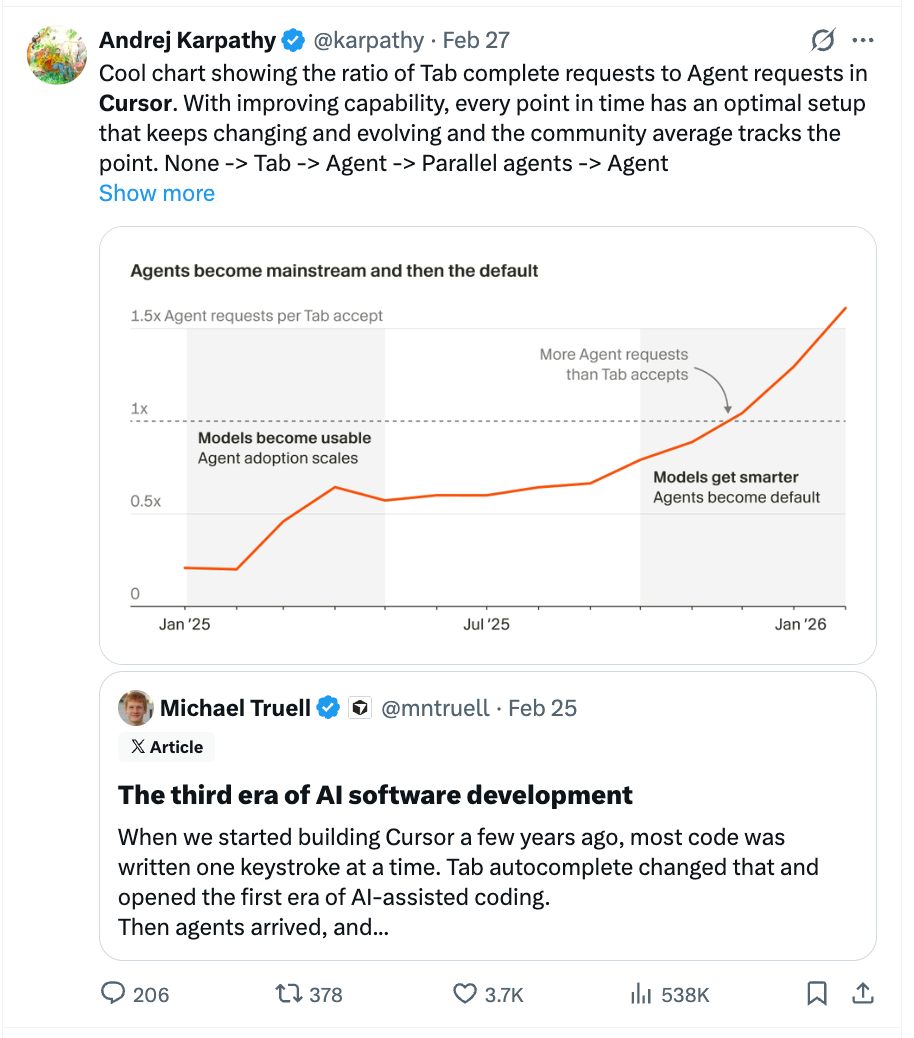
As AI generates more code than humans can review, the validation bottleneck emerges. The solution is providing agents with dedicated, sandboxed environments to run tests and verify functionality before a human sees the code, shifting review from process to outcome.

Simply deploying AI to write code faster doesn't increase end-to-end velocity. It creates a new bottleneck where human engineers are overwhelmed with reviewing a flood of AI-generated code. To truly benefit, companies must also automate verification and validation processes.

With AI agents autonomously generating pull requests, the primary constraint in software development is no longer writing code but the human capacity to review it. Companies like Block are seeing PRs per engineer increase massively, creating a new challenge for engineering managers to solve.

An agent's effectiveness is limited by its ability to validate its own output. By building in rigorous, continuous validation—using linters, tests, and even visual QA via browser dev tools—the agent follows a 'measure twice, cut once' principle, leading to much higher quality results than agents that simply generate and iterate.

A new paradigm for AI-driven development is emerging where developers shift from meticulously reviewing every line of generated code to trusting robust systems they've built. By focusing on automated testing and review loops, they manage outcomes rather than micromanaging implementation.
As AI generates more code, the core engineering task evolves from writing to reviewing. Developers will spend significantly more time evaluating AI-generated code for correctness, style, and reliability, fundamentally changing daily workflows and skill requirements.