Get your free personalized podcast brief
We scan new podcasts and send you the top 5 insights daily.
Erik Bernhardsson treats mandatory pull request reviews as an organizational crutch where developers dodge accountability for production deploys. Instead of stalling safe code changes, teams should make reviews optional and enforce system resilience through rigorous automated tests, decoupled architectures, and continuous deployment.

Related Insights
The ease of creating PRs with AI agents shifts the developer bottleneck from code generation to code validation. The new challenge is not writing the code, but gaining the confidence to merge it, elevating the importance of review, testing, and CI/CD pipelines.
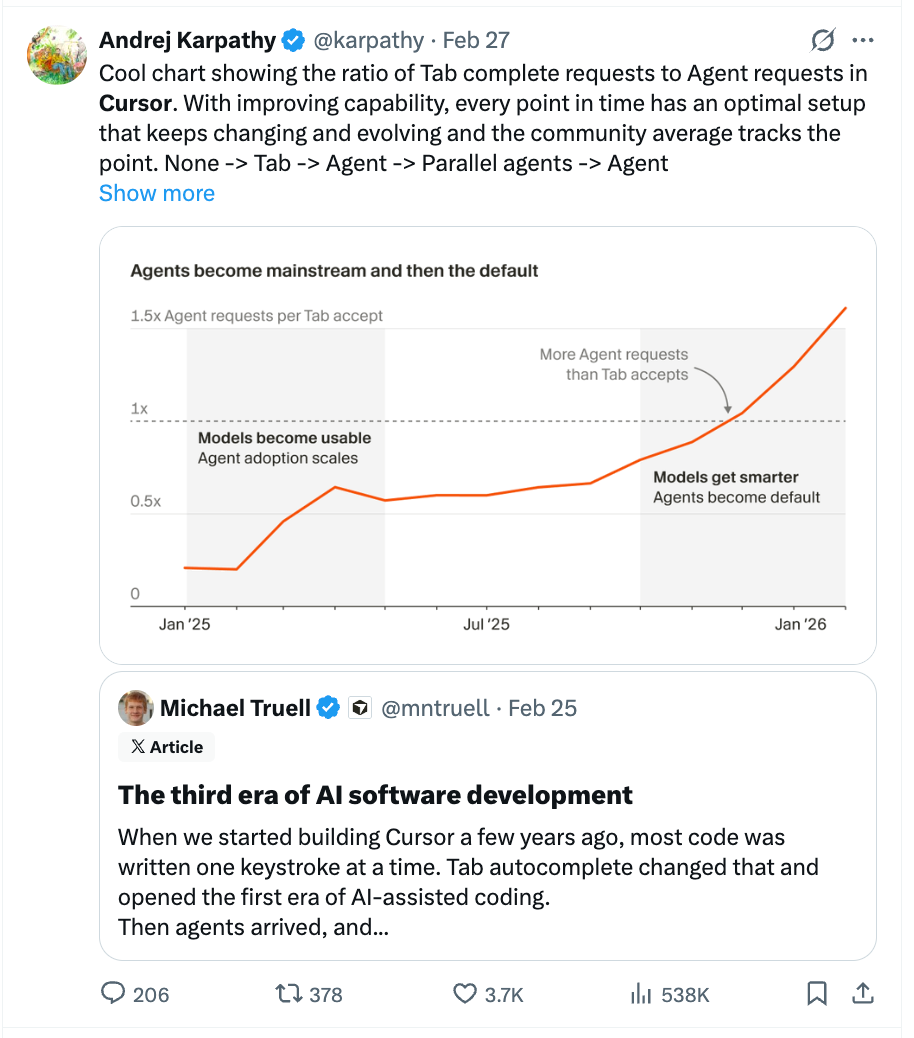
Create an agent that automatically reviews pull requests after CI checks pass. The agent scores PRs on risk factors like blast radius and security. Low-risk PRs are auto-approved and merged, while high-risk ones are flagged for human review, dramatically speeding up deployment velocity.
Chaining an automated code review loop forces agents to iteratively address feedback until achieving a perfect review score. This automated cycle prevents developers from wasting time on half-baked pull requests by guaranteeing baseline code standards prior to human testing.

To scale code review with 8x output, teams should codify and check-in their standards—specs, design systems, style guides—into the repository. AI reviewers can then automatically validate new code against this explicit "statement of what good looks like," reducing the burden on human reviewers.

With AI generating 1,300 pull requests weekly at Stripe, the critical path is shifting. When coding becomes a commodity, the bottleneck moves to human review and validation. Engineering teams must refocus from pure creation to oversight and quality assurance at scale.
While the goal is autonomous improvement, deploying these systems safely in production requires human oversight. Implement mandatory human-in-the-loop steps, specifically code reviews for any proposed changes to the agent or its evaluation logic, before shipping to users.

To maintain high velocity with AI coding assistants, Chris Fregly has stopped line-by-line code reviews and traditional unit testing. He now focuses on high-level evaluations and 'correctness harnesses' that continuously run in the background, shifting quality control from process (review) to outcome (performance).
To avoid shipping "slop" from AI coding assistants, the solution is building robust infrastructure. Automated checks and security guardrails prevent bad code from reaching production, acting as a programmatic senior engineer for the non-technical builder.
Chris Fregley argues that manually reviewing AI-generated code is slow and ineffective. He has replaced traditional code reviews and unit tests with a focus on robust, continuous evaluation frameworks ("evals") and correctness checks that run in the background, allowing for faster and safer code deployment.
In an agent-driven workflow, human review becomes the primary bottleneck. By moving reviews to after the merge, the team prioritizes agent throughput and treats human attention as a scarce resource for high-level guidance, not gatekeeping individual pull requests.