Get your free personalized podcast brief
We scan new podcasts and send you the top 5 insights daily.
Chaining an automated code review loop forces agents to iteratively address feedback until achieving a perfect review score. This automated cycle prevents developers from wasting time on half-baked pull requests by guaranteeing baseline code standards prior to human testing.

Related Insights
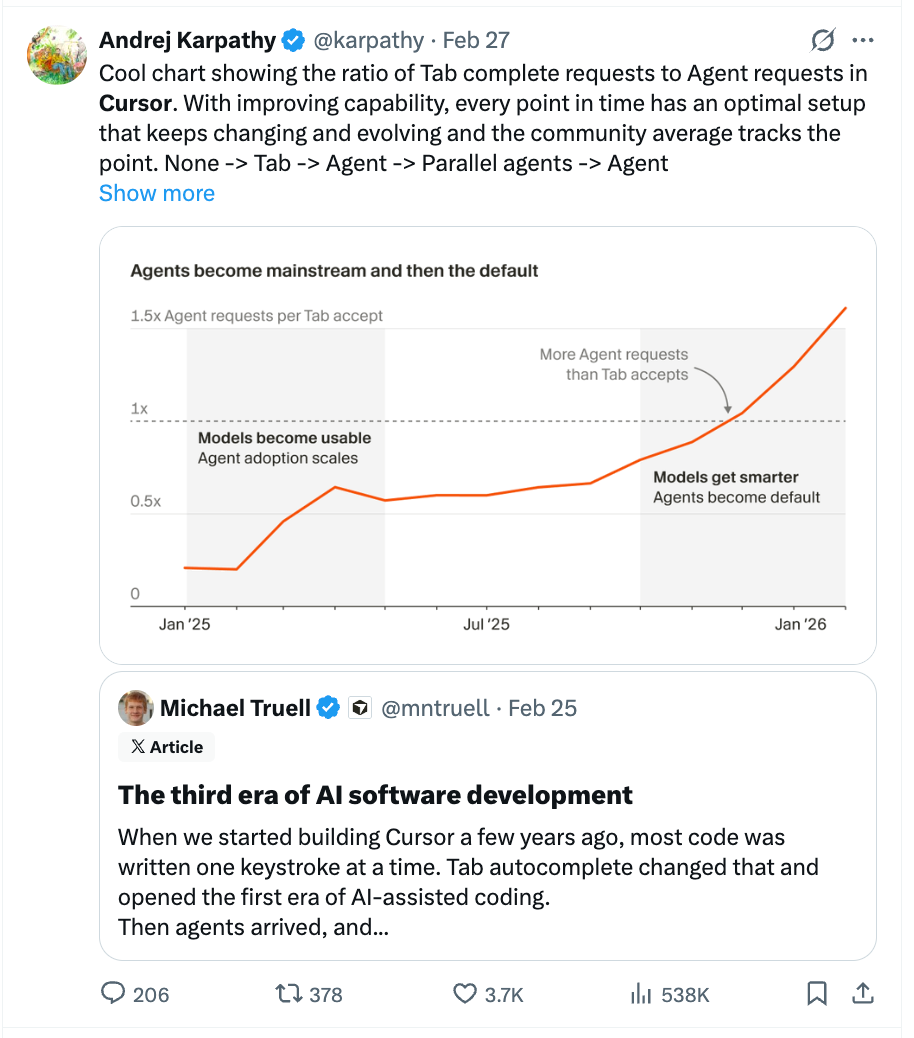
The ease of creating PRs with AI agents shifts the developer bottleneck from code generation to code validation. The new challenge is not writing the code, but gaining the confidence to merge it, elevating the importance of review, testing, and CI/CD pipelines.
For designers who code but aren't senior engineers, submitting pull requests can be daunting. Using an integrated AI code review agent provides an extra layer of validation. It catches potential issues and suggests improvements, boosting confidence before the code undergoes human review.

Most developers admit to giving pull requests only a cursory glance rather than pulling down the code, testing it, and reviewing every line. AI agents are perfectly suited for this meticulous, time-consuming task, promising a new level of rigor in the code review process.

To automate feedback and improve agent work from 50% to 90% completion, create a QA process where you instruct one agent to have its work reviewed by a 'panel' of other agents. This adversarial review loop identifies flaws and refines the output before human intervention.

To scale code review with 8x output, teams should codify and check-in their standards—specs, design systems, style guides—into the repository. AI reviewers can then automatically validate new code against this explicit "statement of what good looks like," reducing the burden on human reviewers.

Move beyond manual agent improvement by creating an automated loop. In this process, an agent runs, its performance is evaluated, failures are identified, and another process suggests and implements code fixes. This creates a foundation for self-improving systems.

Contrary to the belief that AI introduces risk, Intercom's AI code review agent led to a lower revert rate for AI-approved code. This demonstrates that AI can enhance safety and quality, not just speed, by systematically enforcing standards on every pull request.
Integrate a third-party code review agent (e.g., Greptile) to score the AI's work. The workflow instructs the agent to automatically re-enter the "build" phase and address feedback until it achieves a perfect score. This creates a self-correcting system requiring minimal human intervention.
As AI agents generate vast amounts of output, human review becomes an impossible bottleneck. The solution emerging is multi-agent systems where a separate 'grading agent' automatically scores and requests revisions on an agent's work against a predefined rubric, as seen in Anthropic's 'Outcomes' feature, enabling scalable quality assurance.

Don't just automate tasks; automate quality control. Create an agent that reviews a core part of your app daily, grades it against a rubric you define, and automatically spins up a new "child" agent to fix anything that scores below a certain threshold, creating a virtuous cycle of improvement.