Get your free personalized podcast brief
We scan new podcasts and send you the top 5 insights daily.
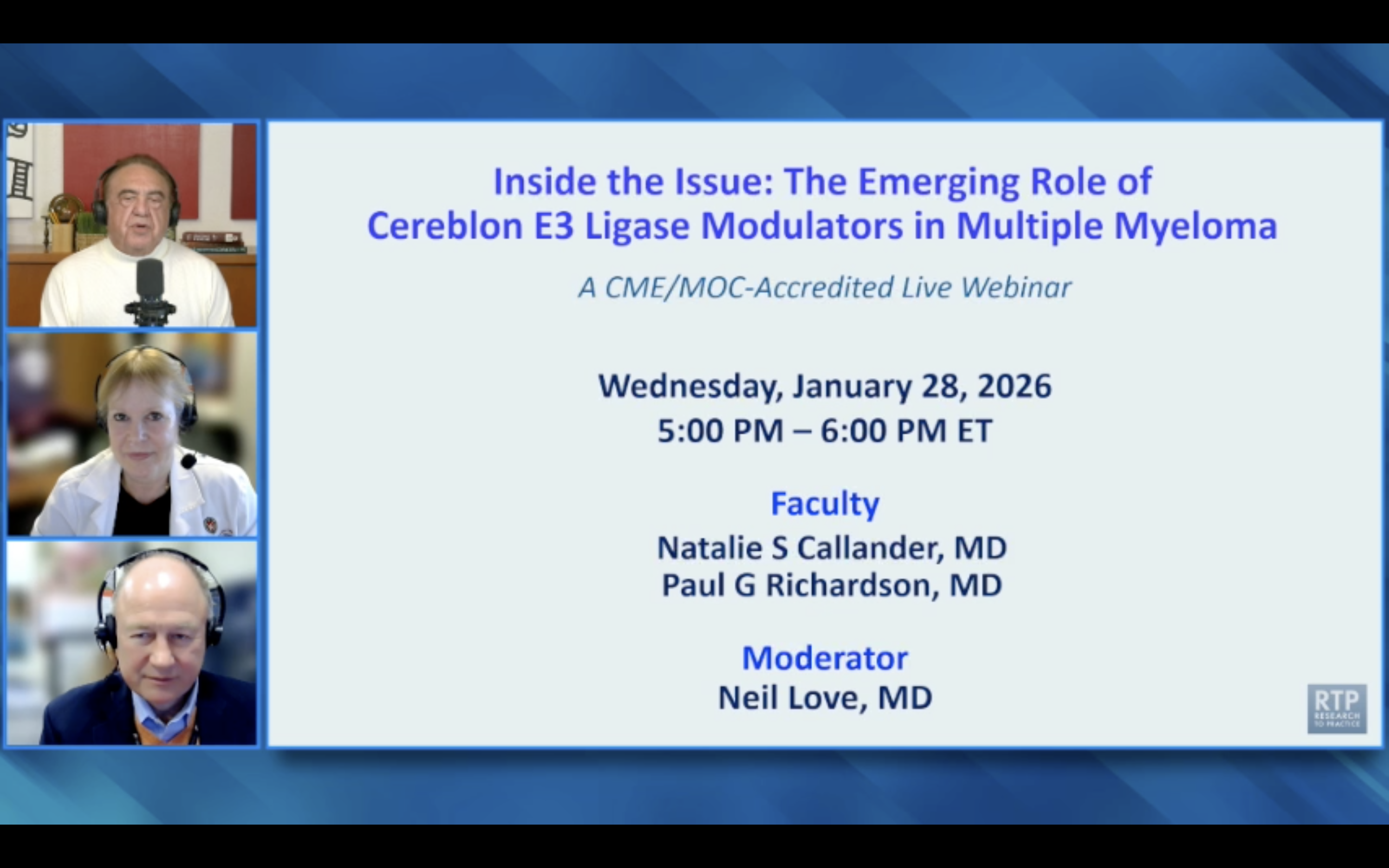
Mezigdomide is considered one of the most active oral agents against extramedullary disease (EMD). Its molecular structure was specifically engineered to optimize tissue penetration, addressing a significant clinical challenge where myeloma grows outside the bone marrow in heavily pretreated patients.
Related Insights
The field of multiple myeloma has transformed from having few treatments to an abundance of effective drugs. The primary clinical challenge is no longer finding a therapy that works, but rather determining the optimal sequence and combination of available options, highlighting a unique form of market maturity.

The company focuses on disease-specific 3D protein conformations, which exposes new binding sites (epitopes) not present on the same protein in healthy cells. This allows for highly selective drugs that avoid the toxicity common with targets defined by genetic sequence alone.

Lenalidomide has a unique off-target effect on C1K alpha which clonally selects for p53 mutated cells, increasing second cancer risk. Preclinical data clearly show that CELMoDs like iberdomide and mezigdomide do not share this mechanism, offering a significant potential safety advantage over the older IMiD.
When treating extramedullary disease (EMD), intravenous (IV) bortezomib should be used over the more common subcutaneous formulation. The higher peak drug concentration (Cmax) achieved with IV administration is critical for efficacy against these difficult-to-penetrate sanctuary sites.
Unlike older IMiDs where T-cell effects are secondary, CELMoDs have a powerful, independent pro-T-cell mechanism. This dual action is so significant that in the future, CELMoDs will be prescribed not just for their direct anti-myeloma effects, but specifically to enhance the efficacy of T-cell therapies like CAR-T and bispecific antibodies.

An expert who initially viewed CELMoDs as incremental improvements now considers them fundamentally different. The new litmus test for future myeloma trials will be tracking prior patient exposure to CELMoDs like iberdomide, just as they track prior IMiD exposure today, cementing their status as a distinct therapeutic category.
Actuate’s drug was designed to be highly lipophilic (fat-soluble) to cross the blood-brain barrier for CNS treatment. This same property proved crucial for its success in oncology, as it allows the drug to easily penetrate cancer cell membranes and reach the nucleus.

Unlike IMiDs, which only partially engage the target, CELMoDs like iberdomide are larger molecules that fully close the cereblon E3 ligase pocket. This maximizes degradation of target proteins Ikaros and Aiolos, leading to greater potency and what is described as "hitting the death star" of the myeloma cell.
Unlike older antibody-drug conjugates (ADCs), newer agents are designed so their chemotherapy payload can diffuse out of the target cell and kill nearby tumor cells that may not even express the target antigen. This "bystander effect" significantly enhances their anti-tumor activity.
During the pandemic, a multicenter mezigdomide trial had zero COVID-19 deaths. This contrasts sharply with bispecific antibody trials in similar populations, which reported significant COVID mortality. This suggests CELMoDs have a more favorable immune profile for managing viral infections in immunocompromised patients.