Get your free personalized podcast brief
We scan new podcasts and send you the top 5 insights daily.
AI coding agents like Amazon Q are most effective when paired with senior developers. Their primary skill shifts from writing original code to reviewing AI-generated output. This leverage turns already high-performing developers into significantly more productive leaders, as their expertise in code review becomes the new bottleneck.

Related Insights
As AI coding agents generate vast amounts of code, the most tedious part of a developer's job shifts from writing code to reviewing it. This creates a new product opportunity: building tools that help developers validate and build confidence in AI-written code, making the review process less of a chore.

The ease of creating PRs with AI agents shifts the developer bottleneck from code generation to code validation. The new challenge is not writing the code, but gaining the confidence to merge it, elevating the importance of review, testing, and CI/CD pipelines.
AI agents function like junior engineers, capable of generating code that introduces bugs, security flaws, or maintenance debt. This increases the demand for senior engineers who can provide architectural oversight, review code, and prevent system degradation, making their expertise more critical than ever.

Contrary to the belief that AI levels the playing field, senior engineers extract more value from it. They leverage their experience to guide the AI, critically review its output as they would a junior hire's code, and correct its mistakes. This allows them to accelerate their workflow without blindly shipping low-quality code.

AI tools are automating code generation, reducing the time developers spend writing it. Consequently, the primary skill shifts to carefully reviewing and verifying the AI-generated code for correctness and security. This means a developer's time is now spent more on review and architecture than on implementation.

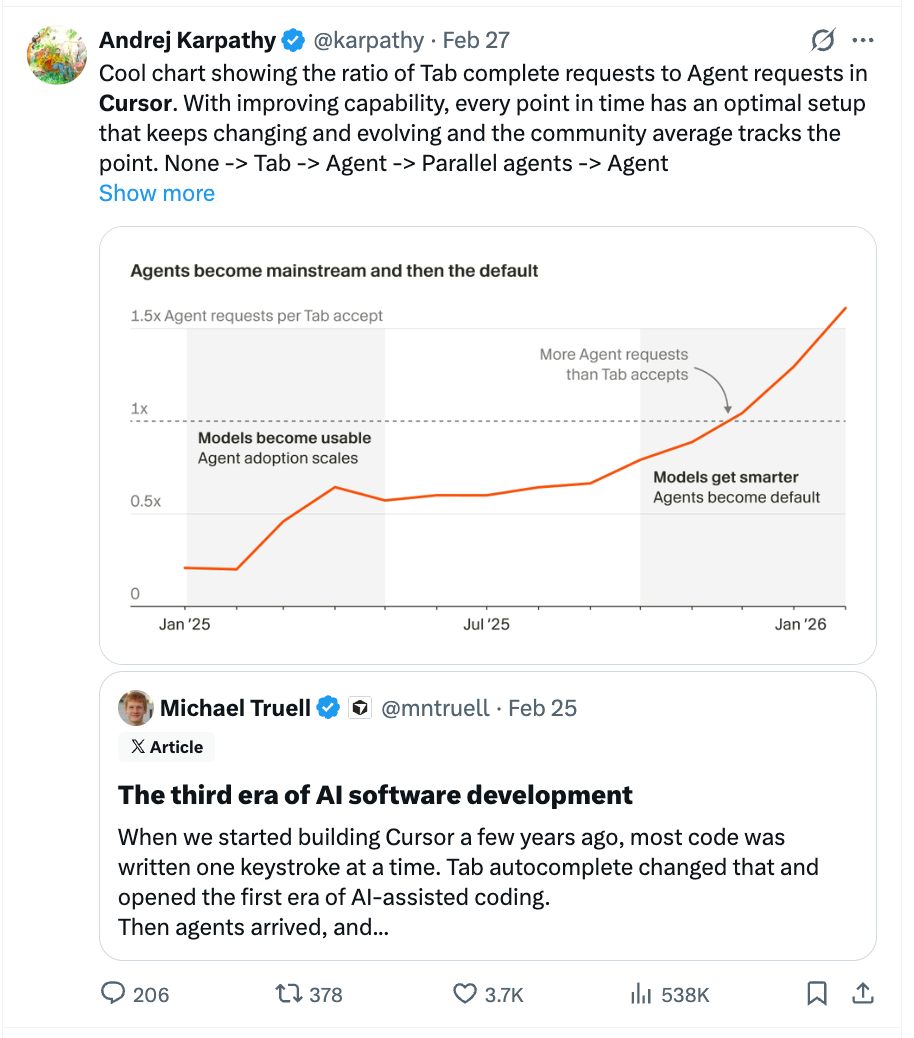
The developer workflow is evolving with tools like Gastown that orchestrate multiple AI agents. This leads to a scenario where the IDE "melts away," and developers' core skills atrophy in code writing but must improve in code reading, reviewing, and prompting.

AI coding tools are a massive force multiplier for senior engineers, acting like a team of capable-but-naive graduates. The engineer's role shifts to high-level architecture and course-correction, enabling them to build, ship, and maintain entire products without hiring a team.

Experienced engineers using tools like Claude Code are no longer writing significant amounts of code. Their primary role shifts to designing systems, defining tasks, and managing a team of AI agents that perform the actual implementation, fundamentally changing the software development workflow.

AI coding tools disproportionately amplify the productivity of senior, sophisticated engineers who can effectively guide them and validate their output. For junior developers, these tools can be a liability, producing code they don't understand, which can introduce security bugs or fail code reviews. Success requires experience.

As AI generates more code, the core engineering task evolves from writing to reviewing. Developers will spend significantly more time evaluating AI-generated code for correctness, style, and reliability, fundamentally changing daily workflows and skill requirements.