Get your free personalized podcast brief
We scan new podcasts and send you the top 5 insights daily.
Google's new Workspace Studio allows non-technical users to build powerful, code-free AI agents for tasks like email summaries. However, a buggy launch with constant "at capacity" errors prevents users from actually deploying these agents, highlighting the gap between powerful new tools and their real-world reliability.
Related Insights
Contrary to the vision of free-wheeling autonomous agents, most business automation relies on strict Standard Operating Procedures (SOPs). Products like OpenAI's Agent Builder succeed by providing deterministic, node-based workflows that enforce business logic, which is more valuable than pure autonomy.

When deploying AI tools, especially in sales, users exhibit no patience for mistakes. While a human making an error receives coaching and a second chance, an AI's single failure can cause users to abandon the tool permanently due to a complete loss of trust.

Despite the hype, LinkedIn found that third-party AI tools for coding and design don't work out-of-the-box on their complex, legacy stack. Success requires deep customization, re-architecting internal platforms for AI reasoning, and working in "alpha mode" with vendors to adapt their tools.

The primary obstacle for tools like OpenAI's Atlas isn't technical capability but the user's workload. The time, effort, and security risk required to verify an AI agent's autonomous actions often exceed the time it would take for a human to perform the task themselves, limiting practical use cases.
Tools like Git were designed for human-paced development. AI agents, which can make thousands of changes in parallel, require a new infrastructure layer—real-time repositories, coordination mechanisms, and shared memory—that traditional systems cannot support.

As AI generates more code than humans can review, the validation bottleneck emerges. The solution is providing agents with dedicated, sandboxed environments to run tests and verify functionality before a human sees the code, shifting review from process to outcome.
Building features like custom commands and sub-agents can look like reliable, deterministic workflows. However, because they are built on non-deterministic LLMs, they fail unpredictably. This misleads users into trusting a fragile abstraction and ultimately results in a poor experience.

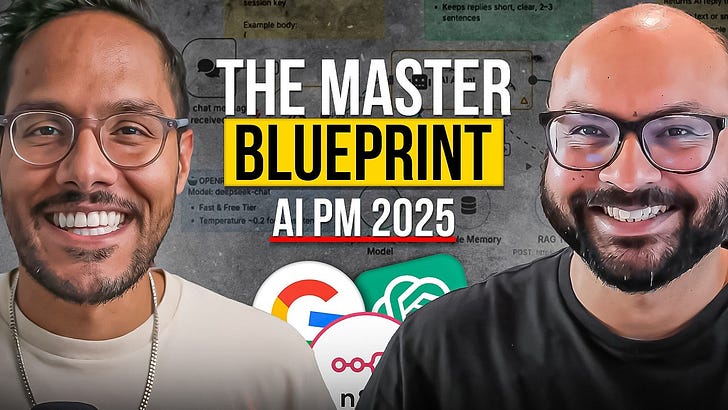
Prototyping and even shipping complex AI applications is now possible without writing code. By combining a no-code front-end (Lovable), a workflow automation back-end (N8N), and LLM APIs, non-technical builders can create functional AI products quickly.
Jason Fried argues that while AI dramatically accelerates building tools for yourself, it falls short when creating products for a wider audience. The art of product development for others lies in handling countless edge cases and conditions that a solo user can overlook, a complexity AI doesn't yet master.

While N8N is powerful for building complex AI agent workflows, its steep learning curve is geared towards engineers. Product Managers will find Lindy.ai more effective because it allows for agent creation through simple AI prompts, removing the technical barrier and speeding up prototyping.