Get your free personalized podcast brief
We scan new podcasts and send you the top 5 insights daily.
Vinod Khosla highlights "auto-formalization" as a critical AI frontier. This technology converts ambiguous, human-written rules (e.g., legal code) into precise, machine-verifiable logic. This eliminates hallucinations, making AI reliable for mission-critical applications like tax law and medical diagnostics.

Related Insights
The purpose of creating a superhuman mathematician is not just to solve proofs, but to establish a system of verifiable reasoning. This formal verification capability will be essential to ensure the safety, reliability, and collaborative potential of all future AI code and superintelligence.

Current AI coding assistants still require engineers to verify correctness. The future involves moving from this 'vibe coding' to a system where developers specify requirements in natural language. An AI, likely an EBM, would then generate formally verified code that is guaranteed to be logically compatible with the existing codebase.

For applications in banking, insurance, or healthcare, reliability is paramount. Startups that architect their systems from the ground up to prevent hallucinations will have a fundamental advantage over those trying to incrementally reduce errors in general-purpose models.
The firm made a strategic decision to invest in AI that fully automates professional roles (e.g., an AI oncologist, an AI chip designer) rather than building "co-pilot" tools that merely assist humans. They believe the larger opportunity lies in completely doing the work, not aiding it.
AI and formal methods have been separate fields with opposing traits: AI is flexible but untrustworthy, while formal methods offer guarantees but are rigid. The next frontier is combining them into neurosymbolic systems, creating a "peanut butter and chocolate" moment that captures the best of both worlds.
Formal verification, the process of mathematically proving software correctness, has been too complex for widespread use. New AI models can now automate this, allowing developers to build systems with mathematical guarantees against certain bugs—a huge step for creating trust in high-stakes financial software.

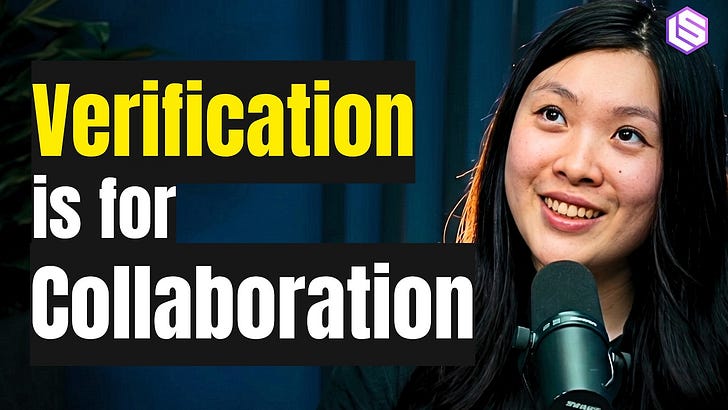
Verification isn't just a compliance tax or a fix for hallucinations. It's a tool to amplify genius, much like mathematical proofs enabled Ramanujan to scale his intuitive brilliance into theorems that future generations could build upon. Its purpose is to compound superintelligence.
The once-critical problem of AI hallucinations has been dramatically reduced. Current frontier models are now more reliable in this regard than human junior associates, making them viable for professional legal work, contrary to popular belief.

Simply generating a mathematical proof in natural language is useless because it could be thousands of pages long and contain subtle errors. The pivotal innovation was combining AI reasoning with formal verification. This ensures the output is provably correct and usable, solving the critical problems of trust and utility for complex, AI-generated work.

The business model for mathematical superintelligence extends beyond solving theorems. Its core technology, formal verification, can be applied to software and hardware to prove correctness and eliminate bugs. This is a massive commercial opportunity in mission-critical industries like cloud computing, aerospace, and crypto, fulfilling a long-standing goal of computer science.