Get your free personalized podcast brief
We scan new podcasts and send you the top 5 insights daily.
The business model for mathematical superintelligence extends beyond solving theorems. Its core technology, formal verification, can be applied to software and hardware to prove correctness and eliminate bugs. This is a massive commercial opportunity in mission-critical industries like cloud computing, aerospace, and crypto, fulfilling a long-standing goal of computer science.

Related Insights
Generative AI can produce the "miraculous" insights needed for formal proofs, like finding an inductive invariant, which traditionally required a PhD. It achieves this by training on vast libraries of existing mathematical proofs and generalizing their underlying patterns, effectively automating the creative leap needed for verification.
The standard for mathematical proofs is shifting from peer-reviewed papers to formally verified code. This makes math more like a large open-source project, where anyone in the world can contribute. Because the contributions can be computationally certified for correctness, collaboration becomes easier and the field becomes more accessible to amateurs.
Languages like Lean allow mathematical proofs to be automatically verified. This provides a perfect, binary reward signal (correct/incorrect) for a reinforcement learning agent. It transforms the abstract art of mathematics into a well-defined environment, much like a game of Go, that an AI can be trained to master.

The same AI technology amplifying cyber threats can also generate highly secure, formally verified code. This presents a historic opportunity for a society-wide effort to replace vulnerable legacy software in critical infrastructure, leading to a durable reduction in cyber risk. The main challenge is creating the motivation for this massive undertaking.
The purpose of creating a superhuman mathematician is not just to solve proofs, but to establish a system of verifiable reasoning. This formal verification capability will be essential to ensure the safety, reliability, and collaborative potential of all future AI code and superintelligence.

While AI can generate code, the stakes on blockchain are too high for bugs, as they lead to direct financial loss. The solution is formal verification, using mathematical proofs to guarantee smart contract correctness. This provides a safety net, enabling users and AI to confidently build and interact with financial applications.

Formal verification, the process of mathematically proving software correctness, has been too complex for widespread use. New AI models can now automate this, allowing developers to build systems with mathematical guarantees against certain bugs—a huge step for creating trust in high-stakes financial software.

AI excels at generating code, making that task a commodity. The new high-value work for engineers is "verification”—ensuring the AI's output is not just bug-free, but also valuable to customers, aligned with business goals, and strategically sound.

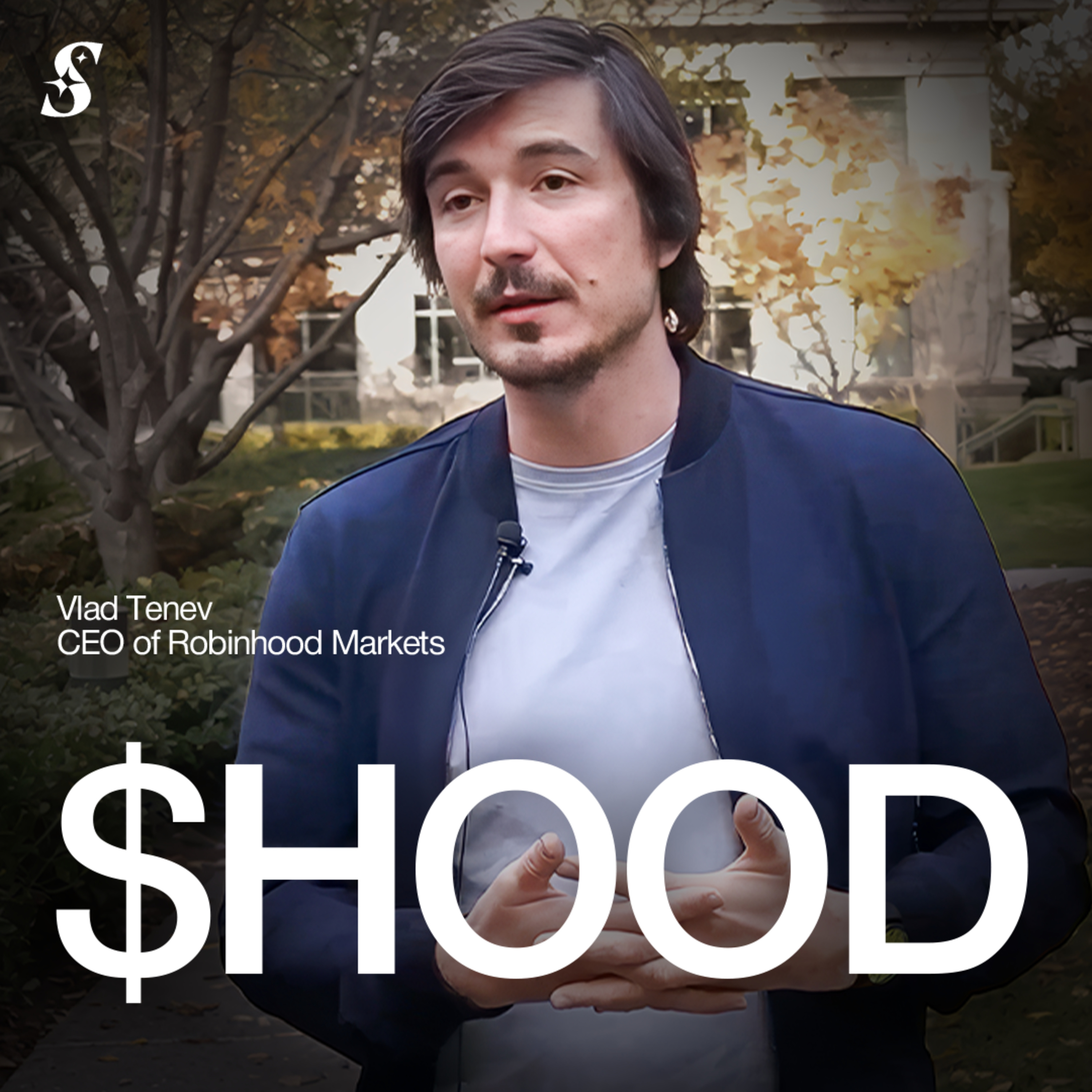
Harmonic, co-founded by Vlad Tenev to build mathematical superintelligence, has seen its model 'Aristotle' advance faster than anticipated. Initially targeting competition-level math, Aristotle is already assisting with or solving previously unsolved 'Erdős problems,' accelerating the timeline towards tackling foundational scientific challenges.
Simply generating a mathematical proof in natural language is useless because it could be thousands of pages long and contain subtle errors. The pivotal innovation was combining AI reasoning with formal verification. This ensures the output is provably correct and usable, solving the critical problems of trust and utility for complex, AI-generated work.