Get your free personalized podcast brief
We scan new podcasts and send you the top 5 insights daily.
Jennifer cites a retrospective glofitamab analysis where dexamethasone was associated with lower CRS or less need for additional support than other steroids. Its longer half-life and greater potency made dexamethasone the preferred steroid at Dana-Farber, although she notes the evidence is only retrospective for this drug class.

Related Insights
The LOTUS-7 trial (loncastuximab + glofitimab) illustrates a key principle for using bispecific antibodies safely: combining them with another active, tumor-debulking drug mitigates Cytokine Release Syndrome (CRS). The speaker identifies this as a "thematic" finding, where reducing tumor bulk directly lowers the risk of this major toxicity, making potent combinations more tolerable.

The efficacy of relacorilant, a glucocorticoid antagonist, has raised concerns that routine steroid use with chemotherapy may induce resistance. This has led clinicians to reduce steroid doses, questioning a long-standing practice and its potential to blunt the therapeutic effects of chemotherapy.

The new agent relicorolant works by blocking the glucocorticoid receptor, which is linked to chemotherapy resistance. This raises the critical question of whether the standard practice of giving steroids before paclitaxel infusion to prevent side effects could be unintentionally hampering treatment efficacy.
Jennifer shows CRS timing differs by drug: glofitamab peaks at the first 2.5 mg step-up, epcoritamab at its first full dose, and mosunetuzumab at the third dose. Follicular lymphoma's extra epcoritamab step-up lowered high-grade CRS. Outpatient monitoring must match the exact agent and dose in practice.
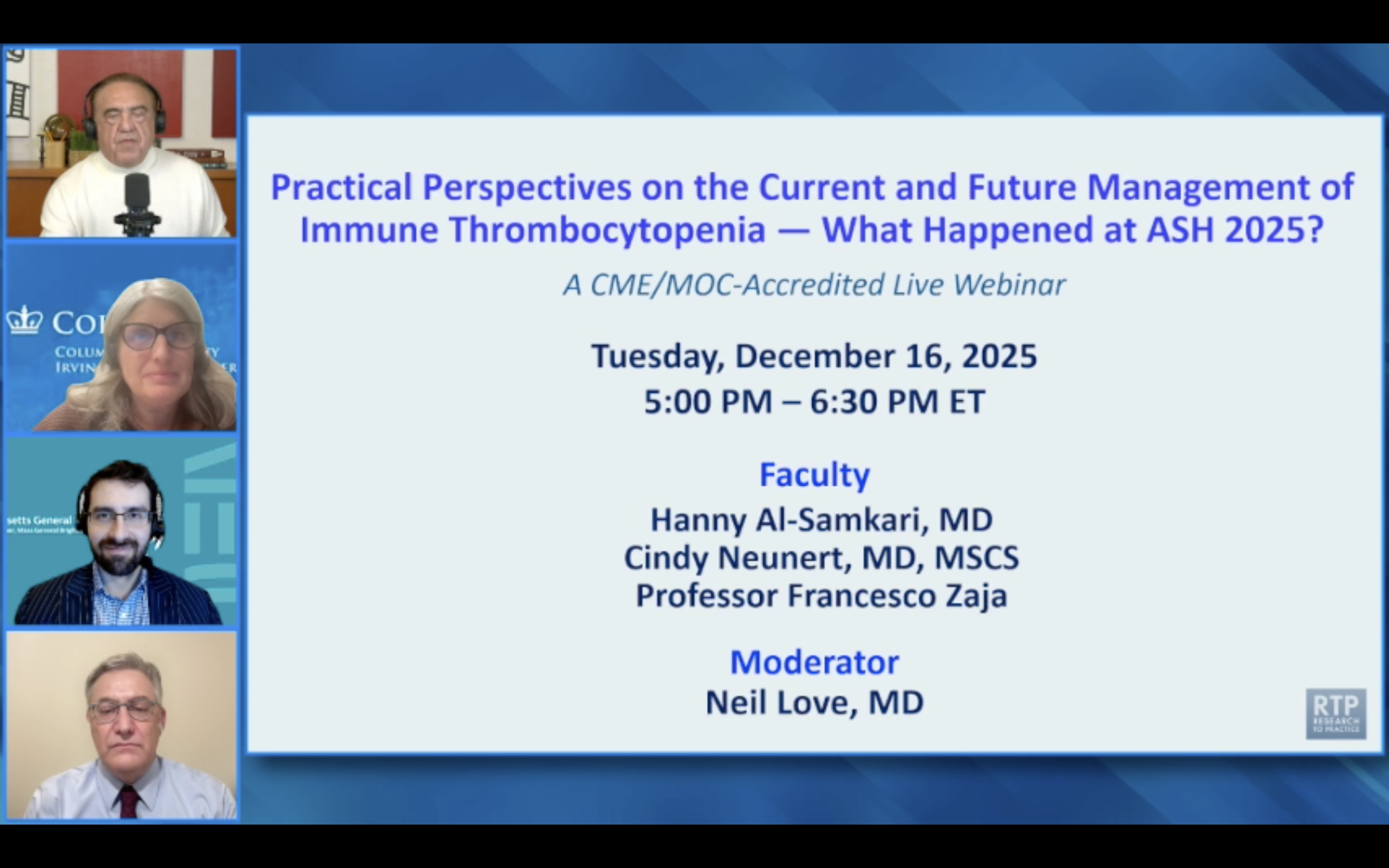
Pulsed dexamethasone provides no overall response rate benefit compared to a standard prednisone taper in first-line ITP treatment. It may offer a slightly faster response (by about one day) but carries a higher risk of acute steroid complications, particularly psychosis in older adults.

The ROSELLA trial's success in boosting chemotherapy with a glucocorticoid receptor antagonist is thought-provoking. It suggests that routinely used steroids for managing side effects like nausea might inadvertently be diminishing chemotherapy's effectiveness across various cancers.
The treatment paradigm for ITP is shifting towards early combination therapy. Recent clinical trials are investigating augmented first- and second-line regimens, such as combining dexamethasone with rituximab or romiplostim, to achieve more durable, treatment-free responses than monotherapy.
To manage infection risk and improve quality of life, experts are quickly reducing bispecific antibody dosing frequency (e.g., to monthly) once a response is achieved. This real-world practice deviates from rigid trial schedules to optimize patient outcomes.

Clinicians often worry that steroid premedication or mitigation blunts the cytotoxic efficacy of bispecific antibodies. Dr. Budde points out that once T cells or CAR-T cells are fully activated, they become remarkably resistant to the immunosuppressive effects of steroids in both laboratory models and clinical practice, validating the safe use of steroids for toxicity management without compromising anti-tumor activity.
In clinical practice for relapsed large cell lymphoma, glofitumab is a preferred bispecific antibody. Clinicians favor it over epcoritamab because it is time-limited (vs. indefinite treatment) and has a more patient-friendly every-three-week schedule, while also being more active than mosunetuzumab.