Get your free personalized podcast brief
We scan new podcasts and send you the top 5 insights daily.
Patients whose endometrial cancer progresses after frontline platinum-based chemotherapy and checkpoint inhibition face a major treatment gap. Data from the Blue Star study showed the ADC PuxiSAM achieved confirmed overall response rates above 60% across cohorts, specifically including this previously treated post-IO population.

Related Insights
While platinum chemotherapy is considered the standard treatment after a patient progresses on a first-line ADC-IO combination, experts admit this is a standard "based on nothing." There is no clinical trial data to prove its efficacy in this specific setting; it serves only as a placeholder for new clinical trials.

Unprecedented response rates (up to 72% in HER2 3+) for new ADCs in Phase 1/2 endometrial cancer trials are challenging the historical view of early trials as having low success. This shift encourages earlier patient enrollment in targeted therapy studies.
Real-world data shows that in platinum-sensitive ovarian cancer patients who have progressed on PARP inhibitors, subsequent platinum-based chemotherapy has a surprisingly low response rate of only 20%. This quantifies a significant opportunity for highly active ADCs to potentially replace platinum in this growing patient population.
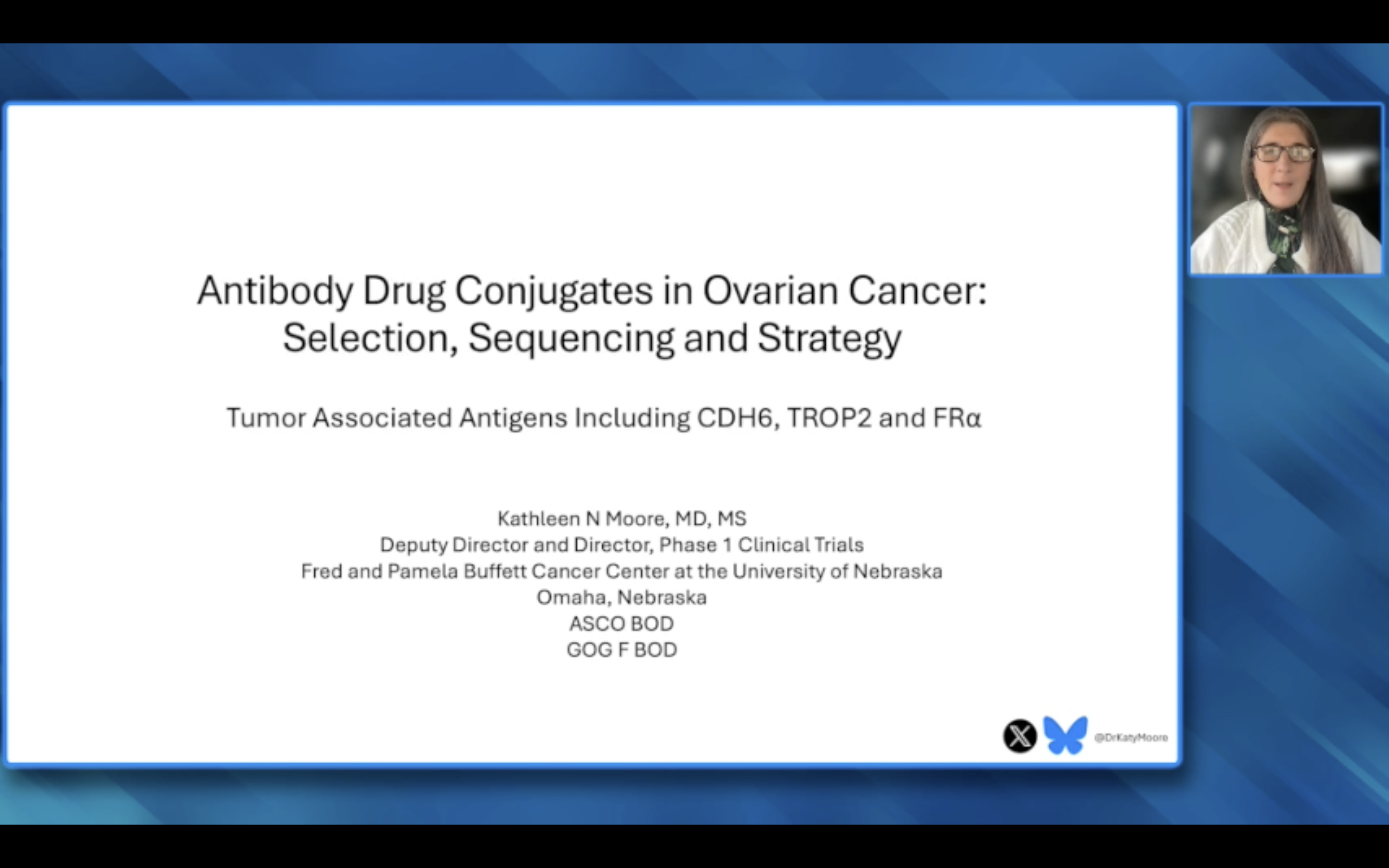
A new wave of antibody-drug conjugates (ADCs) is transforming ovarian cancer treatment. These 'heat-seeking missiles' deliver potent chemotherapy payloads directly to tumor cells, achieving response rates from 23% to over 60% in biomarker-selected populations. This far surpasses the efficacy of conventional chemotherapy in resistant settings.

The EV302 trial update established a new, robust benchmark for second-line therapy. Platinum chemotherapy after EV/Pembrolizumab progression showed only a 21% response rate, which is lower than prior retrospective estimates and highlights the need for better sequencing options.
For endometrial or cervical cancer patients who progress after receiving a checkpoint inhibitor, re-challenging with a single-agent immunotherapy is a less desirable approach. Emerging data suggests that a combination therapy—such as an ICI paired with a TKI like lenvatinib or a bispecific antibody—offers a more promising chance of response.

Despite enthusiasm for chemo-free regimens, experts are skeptical that ADCs can replace platinum-taxane combinations in the first-line setting for ovarian or endometrial cancer. The standard chemotherapy backbone has a response rate exceeding 50%, a high bar for any new agent to clear. ADCs are therefore being developed more as maintenance or add-on therapies.

Even in elderly or frail patients with MSI-high endometrial cancer, the rapid and effective tumor response from combination chemotherapy and immunotherapy often improves quality of life so significantly that it's the preferred approach over single-agent IO.

Disparate clinical trial results in endometrial cancer suggest a mechanistic difference between immunotherapy targets. PD-1 inhibitors (dostarlimab, pembrolizumab) have shown pronounced responses, whereas the PD-L1 inhibitor atezolizumab did not, indicating that targeting the PD-1 receptor may be a more robust strategy in GYN cancers.

While direct comparative trials are lacking, experts note that single-agent activity appears higher for PD-1 inhibitors (pembrolizumab, dostarlimab) than PD-L1 inhibitors (avelumab, durvalumab) in endometrial cancer, leading to a clinical preference for the PD-1 class.
