Get your free personalized podcast brief
We scan new podcasts and send you the top 5 insights daily.
A speaker highlights that the Destiny-Breast05 trial (with a survival endpoint) was published in the prestigious New England Journal of Medicine, while the Destiny-Breast11 trial (with a tumor response endpoint) was rejected. This reveals an academic bias where top-tier journals prioritize hard outcomes like survival over surrogate endpoints.

Related Insights
Despite the ASCENT-07 trial failing its primary progression-free survival (PFS) endpoint, an early overall survival (OS) signal emerged. This divergence suggests the drug may confer a survival advantage not captured by the initial endpoint, complicating the definition of a "negative" trial and warranting further follow-up.

The Destiny Breast 11 trial compared a new drug to a chemotherapy regimen (ACTHP) that many US oncologists no longer use. This choice of a less common control arm makes it difficult for them to directly compare the new treatment's efficacy against their own current standard (TCHP), complicating adoption.
While regulators are open to using Patient-Reported Outcomes (PROs) for drug approval, the oncology community reflexively prioritizes survival data. This cultural bias sees PROs as "softer" endpoints, hindering the approval of drugs based on how patients feel and function.

In trials like ASCENT-4, where over 80% of the control arm received sacituzumab govitecan upon progression, the true overall survival (OS) benefit is obscured. This makes progression-free survival (PFS) a more reliable endpoint for evaluating the drug's first-line efficacy.
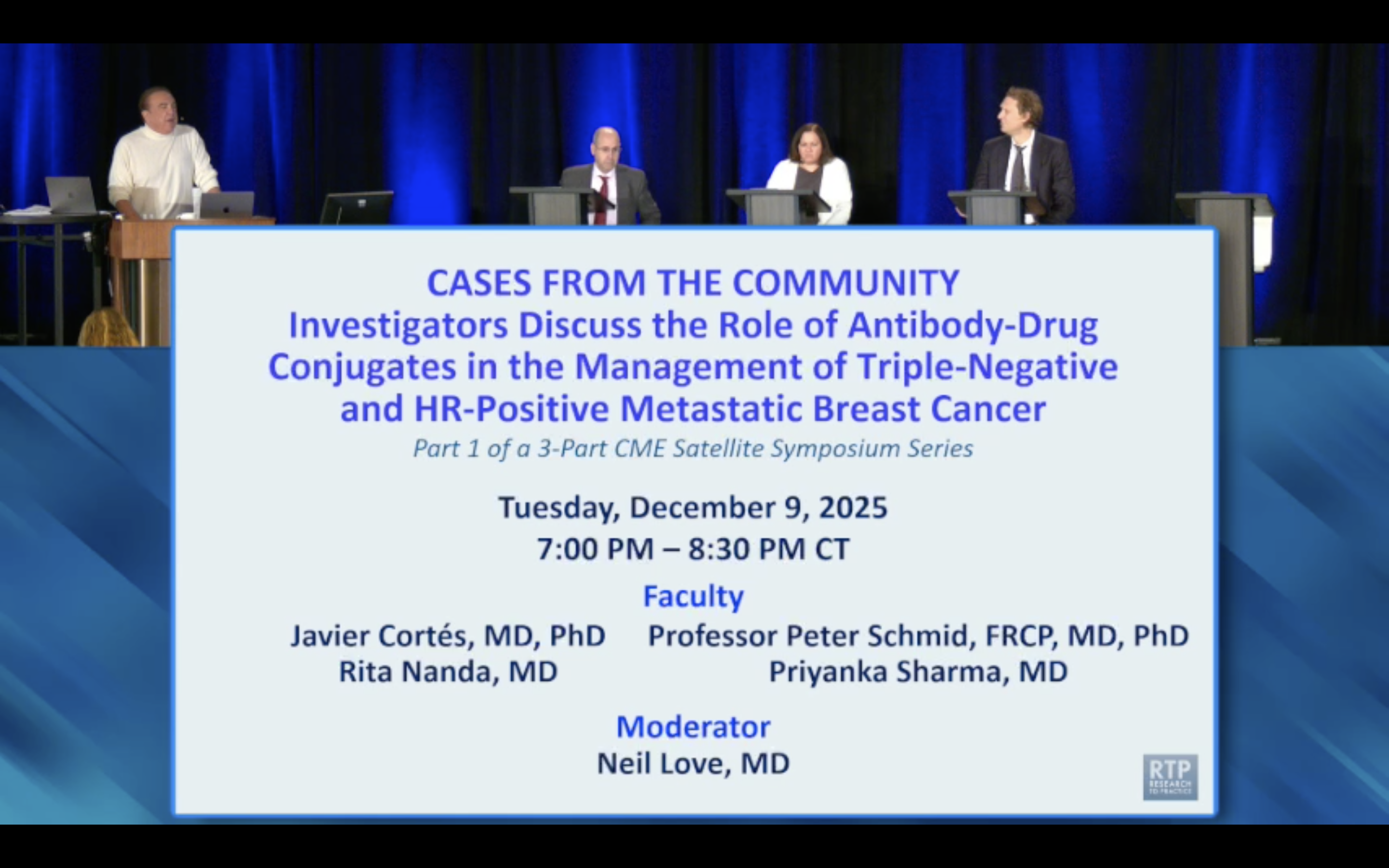
The core conflict in choosing breast cancer therapy is whether to prioritize immediate tumor shrinkage (pathological complete response) or long-term cure (event-free survival). One trial (DB11) excels at shrinkage but isn't designed to prove survival, while another (DB05) proves survival, crystallizing a fundamental debate about clinical trial endpoints and treatment goals.
Traditional endpoints like progression-free survival (PFS) incentivize continuous treatment. The NCI group proposes "treatment-free survival," a novel metric that quantifies time spent *off* therapy. This endpoint better captures the patient experience and rewards treatments that provide durable responses after a finite course.

The PEACE-3 steering committee felt its initial positive OS signal was unreliable due to non-proportional curves, despite meeting the statistical goal. This suggests a high level of self-imposed rigor, as early curve crossing can be due to statistical chance when event numbers are low, rather than a true lack of benefit.
In the CREST trial, the FDA's critique heavily emphasized an overall survival hazard ratio above one. Though statistically insignificant and based on immature data, this single figure created a powerful suggestion of potential harm that overshadowed the positive primary endpoint and likely contributed to the panel's divided vote.
While depth of response strongly predicts survival for an individual patient, the FDA analysis concludes it cannot yet be used as a surrogate endpoint to replace overall survival in pivotal clinical trials. It serves as a measure of drug activity, similar to response rate, but is not sufficient for drug approval on its own.
The GLORA-IV trial is designed with a dual endpoint, evaluating both patient response rate and overall survival. This structure creates an alternative pathway for regulatory approval based on response rates, which can be assessed faster than survival, strategically de-risking the lengthy and expensive trial process.