Get your free personalized podcast brief
We scan new podcasts and send you the top 5 insights daily.
While an AI-generated mathematical proof can be logically verified, the process remains a black box. It's unknown how many attempts were made or how much human guidance was involved. This lack of transparency makes it difficult to assess the true, repeatable capability of the system.
Related Insights
The need for explicit user transparency is most critical for nondeterministic systems like LLMs, where even creators don't always know why an output was generated. Unlike a simple rules engine with predictable outcomes, AI's "black box" nature requires giving users more context to build trust.

Generative AI can produce the "miraculous" insights needed for formal proofs, like finding an inductive invariant, which traditionally required a PhD. It achieves this by training on vast libraries of existing mathematical proofs and generalizing their underlying patterns, effectively automating the creative leap needed for verification.
Unlike traditional software that produces identical, auditable results, AI is non-deterministic and often can't explain its reasoning. This poses a major challenge for finance, an industry where processes must be repeatable and transparent to meet regulatory and client expectations for showing work.

There's a critical distinction between a proof (which establishes truth) and an explanation (which provides understanding). Even when a complex mathematical problem is solved, there remains an 'unsolved expository problem' of making the solution comprehensible. This need for clarity and intuition will remain a crucial area for human or AI effort, even after theorems are proven.
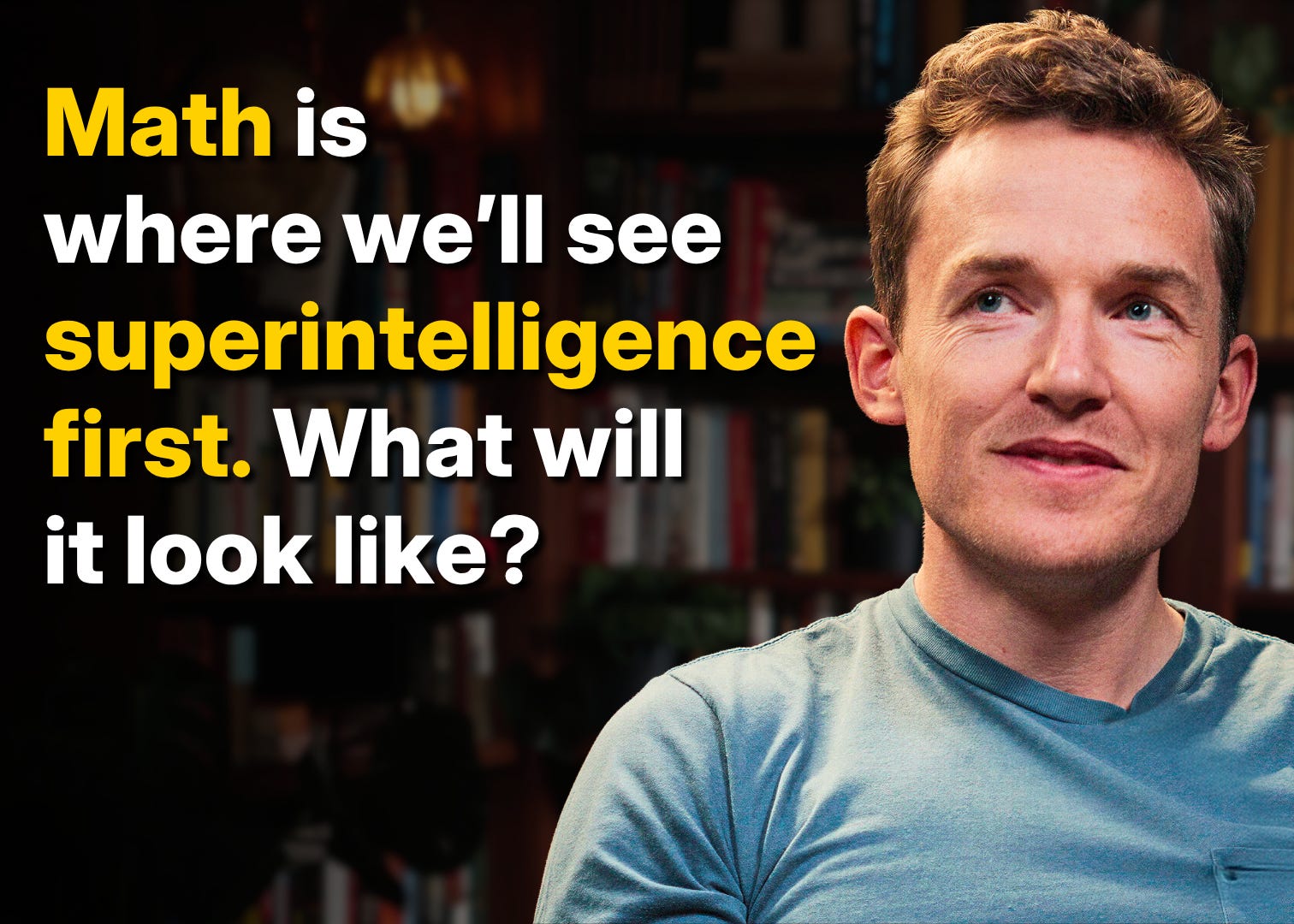
The purpose of creating a superhuman mathematician is not just to solve proofs, but to establish a system of verifiable reasoning. This formal verification capability will be essential to ensure the safety, reliability, and collaborative potential of all future AI code and superintelligence.

OpenAI's Astra model solving major open math problems highlights a critical issue: even experts cannot easily understand or verify the solutions. This forces a reliance on other AIs or formal proof systems for validation, signaling a future where human comprehension is no longer the gold standard for scientific progress.

While AI tools can empower talented students, they also enable amateurs to generate seemingly plausible but incorrect proofs. This floods professional mathematicians with requests to verify AI-assisted work from individuals who lack the foundational skills to check it themselves, creating a new form of expert burden.
Instead of supervising an AI's hidden thought process, we can demand it produces a 'certificate of reasoning'—a checkable proof—along with its output. This could include citations or sensitivity analyses, shifting verification from observing the process to checking the provided proof.

AI tools for literature searches lack the transparency required for scientific rigor. The inability to document and reproduce the AI's exact methodology presents a significant challenge for research validation, as the process cannot be audited or replicated by others.

Simply generating a mathematical proof in natural language is useless because it could be thousands of pages long and contain subtle errors. The pivotal innovation was combining AI reasoning with formal verification. This ensures the output is provably correct and usable, solving the critical problems of trust and utility for complex, AI-generated work.
