Get your free personalized podcast brief
We scan new podcasts and send you the top 5 insights daily.
Distillation functions as an organic leveling mechanism that spreads frontier capabilities to compact, accessible architectures across the industry. This technological dynamic prevents a single well-capitalized frontier lab from compounding a permanent, runaway lead. Smaller models capture high-end performance, allowing diverse organizations to deploy intelligence affordably at global scale.

Related Insights
Arthur Mensch argues that the core knowledge for training advanced AI models is limited and circulates quickly among top labs. This diffusion of knowledge prevents any single company from creating a sustainable IP-based lead, which is accelerating performance convergence and commoditization across the industry.

Contrary to fears of a monopoly, the AI market is heading toward a diverse ecosystem. The proliferation of open-weight models and specialized tooling allows companies to build and control their own differentiated AI systems rather than simply renting intelligence token-by-token from a handful of large labs.
The ability to distill the capabilities of a frontier AI model into a smaller, cheaper one is the main factor preventing an oligopoly. Even if a lab's model is continuously improving, competitors can continually distill its public-facing behaviors, ensuring that no single company can maintain an insurmountable lead.

Large, centralized AI models are vulnerable to 'distillation attacks,' where a smaller model can be trained cheaply by querying the larger one. This technical reality, combined with the moral hypocrisy of creators restricting copying after scraping the internet, strongly suggests a future dominated by decentralized, open-source models.

China is gaining an efficiency edge in AI by using "distillation"—training smaller, cheaper models from larger ones. This "train the trainer" approach is much faster and challenges the capital-intensive US strategy, highlighting how inefficient and "bloated" current Western foundational models are.

The common practice of model distillation suggests that AI capabilities will eventually be commoditized. As smaller models can cheaply mimic larger ones, differentiation will shift away from raw performance to product integration and price, likely triggering a massive price war among providers.

Fears of a single AI company achieving runaway dominance are proving unfounded, as the number of frontier models has tripled in a year. Newcomers can use techniques like synthetic data generation to effectively "drink the milkshake" of incumbents, reverse-engineering their intelligence at lower costs.

Relying solely on expensive frontier models is unsustainable. Vertical AI companies must build a portfolio of smaller, specialized models that match frontier performance on specific tasks but cost 100x less, effectively allocating intelligence where it's needed most.

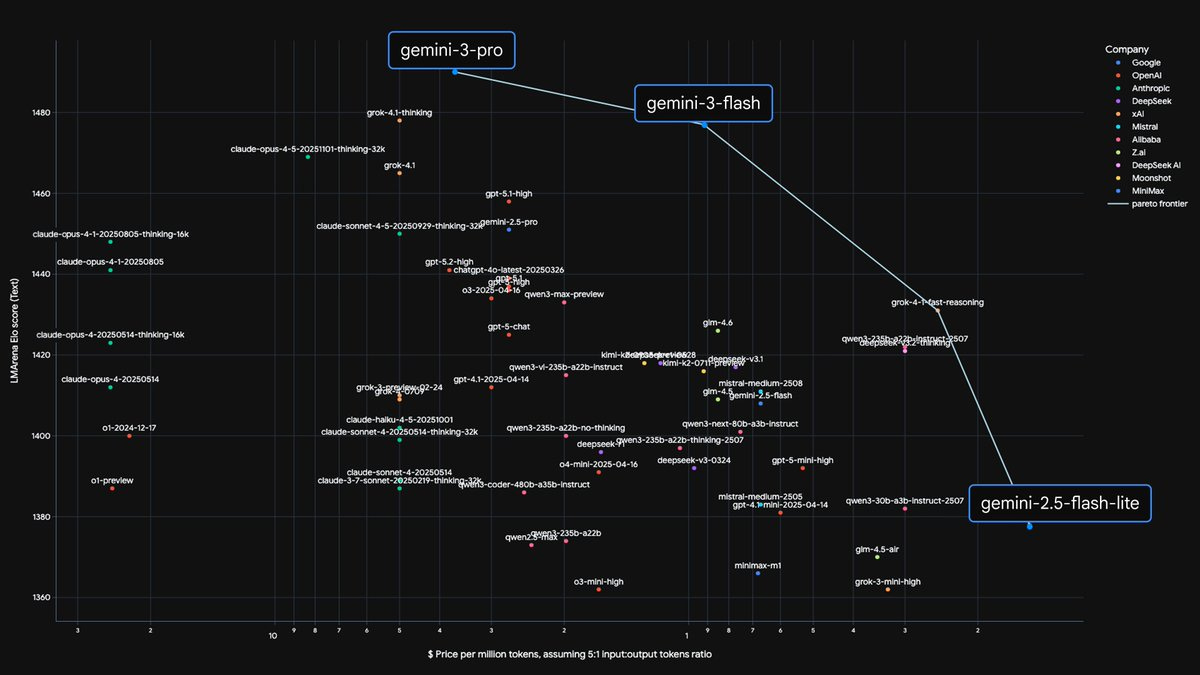
Google's strategy involves creating both cutting-edge models (Pro/Ultra) and efficient ones (Flash). The key is using distillation to transfer capabilities from large models to smaller, faster versions, allowing them to serve a wide range of use cases from complex reasoning to everyday applications.
For specialized, narrow tasks like classification, it's possible to distill the capabilities of a frontier model into a much smaller, fine-tuned model (e.g., under 1B parameters) and retain about 95% of the performance. This is a crucial strategy for managing cost and latency in production AI applications.
