Get your free personalized podcast brief
We scan new podcasts and send you the top 5 insights daily.
Google's AI for Science tool, ERA, maps complex scientific problems into tasks where an AI agent generates code to maximize a specific score. This shifts the scientist's role from coding to defining an objective function, representing a meta-level change in the research process.

Related Insights
Frontier labs like OpenAI are now focused on building autonomous AI agents capable of conducting research and running experiments. This "auto researcher" is seen as the "final boss battle" to accelerate AI development itself.

Mechanistic interpretability (Mekinterp) research has been slow due to its manual, ad-hoc nature. The guests argue that coding agents can automate the experimentation process, enabling large-scale, systematic analysis of AI models. The first science AI should automate is the science of understanding itself.
Google is moving beyond AI as a mere analysis tool. The concept of an 'AI co-scientist' envisions AI as an active partner that helps sift through information, generate novel hypotheses, and outline ways to test them. This reframes the human-AI collaboration to fundamentally accelerate the scientific method itself.

A key part of OpenAI's 'takeoff' strategy is building an automated AI researcher. This system is designed to perform the full end-to-end workflow of a human research scientist autonomously. The goal is to dramatically accelerate the cycle of AI improvement, with humans providing high-level direction and oversight.
Their 'AI Scientist' is architected as a multi-agent system. It features an orchestrator for hypotheses, a literature review agent, and specialized vision-language models for analyzing experimental data directly from lab instruments, rather than relying on one monolithic model.
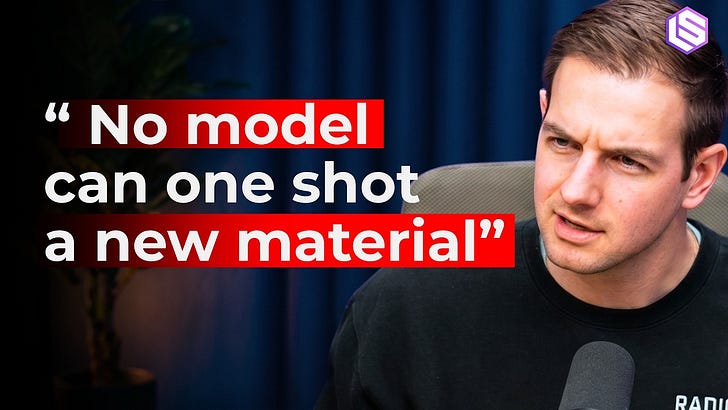
AI's true power in science isn't autonomous discovery, but process compression. It acts as an expert guide, allowing motivated individuals to navigate complex fields like drug discovery and assemble workflows that once required multiple specialized teams, blurring the line between professional research and individual effort.

The ultimate goal isn't just modeling specific systems (like protein folding), but automating the entire scientific method. This involves AI generating hypotheses, choosing experiments, analyzing results, and updating a 'world model' of a domain, creating a continuous loop of discovery.

Researchers were stuck for two years on how to measure the warming effect of jet contrails, a difficult counterfactual problem. The ERA system successfully searched through potential confounders to generate a working model, unblocking a key scientific challenge.
Silico is an agentic platform designed to accelerate empirical research like interpretability. It uses swarms of agents to break down complex problems, run experiments, synthesize information, and validate hypotheses, allowing human researchers to operate at a higher level of abstraction and focus on "big questions."

With AI generating complex formulas and proofs, the most challenging part of scientific research is no longer solving the core problem. Instead, the primary human task becomes verifying the AI-generated results and writing them up, fundamentally changing the research workflow.
