Get your free personalized podcast brief
We scan new podcasts and send you the top 5 insights daily.
Silico is an agentic platform designed to accelerate empirical research like interpretability. It uses swarms of agents to break down complex problems, run experiments, synthesize information, and validate hypotheses, allowing human researchers to operate at a higher level of abstraction and focus on "big questions."

Related Insights
The next evolution beyond a single agent like Autoresearch is a platform for agent swarms to collaborate on a single codebase. AgentHub is conceptualized as a "GitHub for agents," designed for a sprawling, multi-directional development process.

Frontier labs like OpenAI are now focused on building autonomous AI agents capable of conducting research and running experiments. This "auto researcher" is seen as the "final boss battle" to accelerate AI development itself.

Knowledge workers are using AI agents like Claude Code to create multi-layered research. The AI first generates several deep-dive reports on individual topics, then creates a meta-analysis by synthesizing those initial AI-generated reports, enabling a powerful, iterative research cycle managed locally.
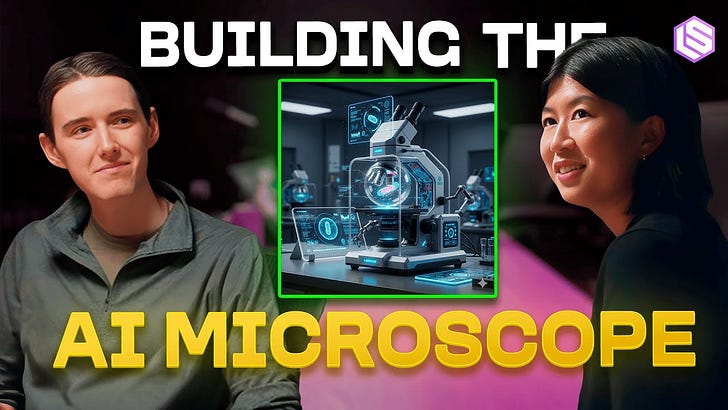
Mechanistic interpretability (Mekinterp) research has been slow due to its manual, ad-hoc nature. The guests argue that coding agents can automate the experimentation process, enabling large-scale, systematic analysis of AI models. The first science AI should automate is the science of understanding itself.
A key part of OpenAI's 'takeoff' strategy is building an automated AI researcher. This system is designed to perform the full end-to-end workflow of a human research scientist autonomously. The goal is to dramatically accelerate the cycle of AI improvement, with humans providing high-level direction and oversight.

Their 'AI Scientist' is architected as a multi-agent system. It features an orchestrator for hypotheses, a literature review agent, and specialized vision-language models for analyzing experimental data directly from lab instruments, rather than relying on one monolithic model.
An unexpected benefit of building a robust, end-to-end "Model Factory" is its suitability for AI agents. These agents are now taking over tasks within the factory, such as writing code, launching jobs, and evaluating results, creating a recursive self-improvement loop for the research process itself.

A key strategy for labs like Anthropic is automating AI research itself. By building models that can perform the tasks of AI researchers, they aim to create a feedback loop that dramatically accelerates the pace of innovation.

Grok 4.20 uses "swarm intelligence," where multiple specialized AI agents collaborate and discuss problems before providing a solution. This approach, mirroring academic concepts, is now being commercialized to tackle more complex tasks than single models can handle.

Goodfire AI defines interpretability broadly, focusing on applying research to high-stakes production scenarios like healthcare. This strategy aims to bridge the gap between theoretical understanding and the practical, real-world application of AI models.