Get your free personalized podcast brief
We scan new podcasts and send you the top 5 insights daily.
The ability to secure surety bonds for massive projects acts as a "cornered resource." It requires a strong balance sheet and track record, effectively barring smaller competitors from bidding on large-scale, lucrative contracts, creating a powerful competitive advantage.

Related Insights
LandBridge strategically acquires land to control critical infrastructure corridors, particularly for produced water moving from New Mexico to Texas. This creates "blocking positions" that force competitors to negotiate for access, solidifying the company's competitive advantage and pricing power in the region.

In the hybrid capital market, the ability to deploy capital at scale is a significant competitive advantage. While many firms can handle smaller $20-40 million deals, very few can quickly underwrite and commit to a $500+ million transaction. This scarcity of scaled players creates a less competitive, inefficient market for those who can operate at that level.

While low-capex businesses are easy to start, businesses requiring significant capital for equipment or technology create a financial barrier to entry. This reduces competition, allowing for more pricing power and long-term defensibility once you've achieved success.

Gaonkar favors businesses with complex, "systemic" moats derived from deeply integrated processes, like TSMC's manufacturing expertise. She argues these are more durable than moats based on a single advantage, comparing it to owning the process of gold extraction rather than just owning the mine.

Scale creates a powerful barrier to entry in logistics. A dominant provider with a vast network can add a new, specific service (like pallets for celery) to its existing operations far more cheaply than a new competitor could build a network for that single service, effectively locking out competition.

Investor Henry Ellenbogen favors two types of competitive advantages. First, hard-to-replicate physical assets like distribution networks, which are messy and time-consuming to build. Second, “soft” moats built on elite human systems for talent development, operational excellence (like the Danaher Business System), and sharp capital allocation. These are harder to see but just as powerful as physical scale.
![Henry Ellenbogen - Man Versus Machine - [Invest Like the Best, EP.452] thumbnail](https://megaphone.imgix.net/podcasts/498a0910-d6ea-11f0-aae4-8f837283e00f/image/9b60f0353346cd1b5cbd326c86e22287.jpg?ixlib=rails-4.3.1&max-w=3000&max-h=3000&fit=crop&auto=format,compress)
By never spending its raised venture capital, the company demonstrates extreme financial stability. This reassures large enterprise and government customers in slow-moving physical AI industries that they can commit to long-term, multi-year partnerships, creating a competitive moat.

The ability to navigate the defense procurement process is a highly specialized talent possessed by perhaps only 40 people in the US. This scarcity makes go-to-market execution, not just technology, a significant bottleneck and a powerful competitive moat for companies like Anduril.
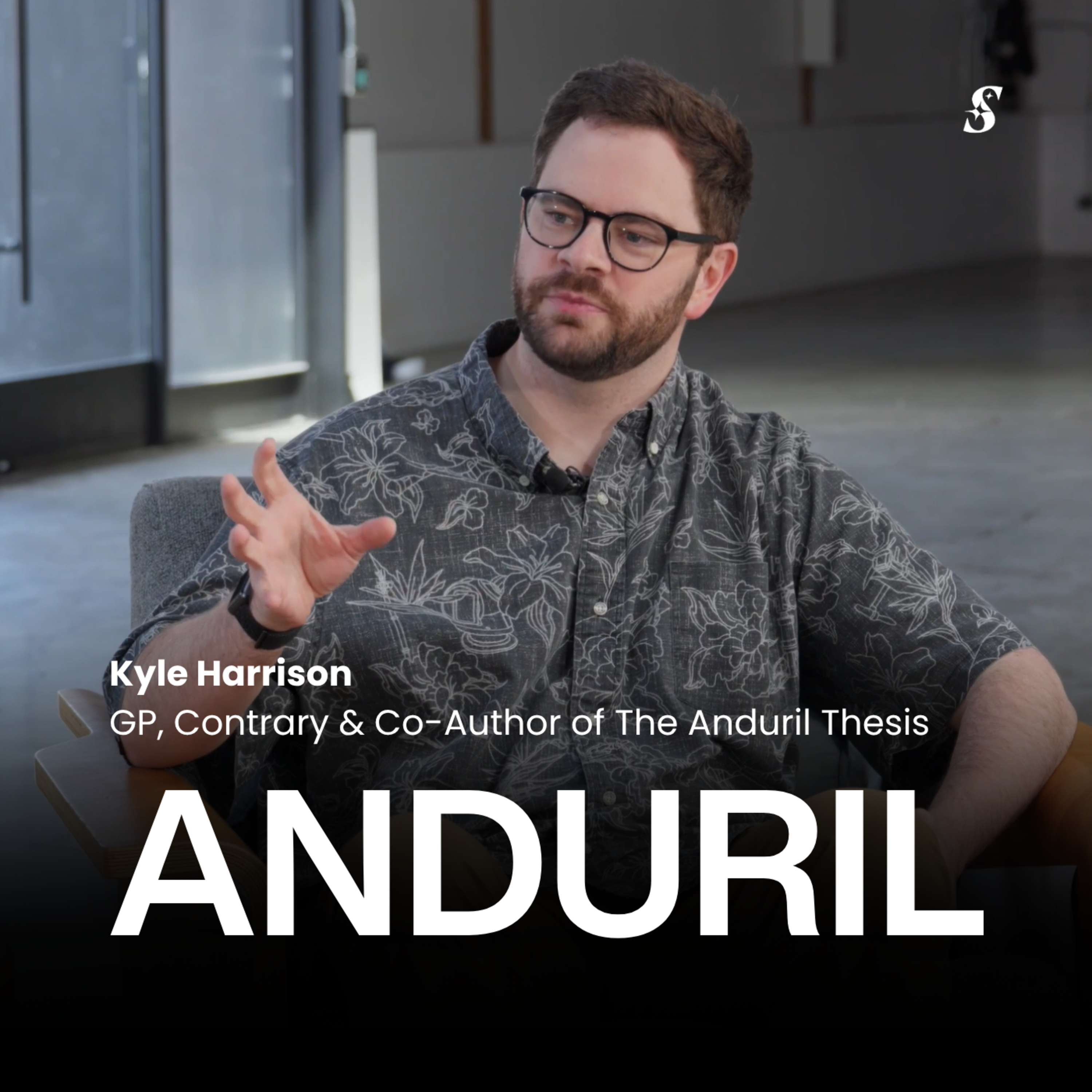
The U.S. Office of Personnel Management's outdated, paper-based retirement system highlights a major flaw in government procurement. The primary skill of incumbent vendors is navigating the contract acquisition process, creating a moat that protects them from competition despite delivering low-quality products.

Linde's competitive advantage stems from network density. Transporting industrial gases over 100 miles is uneconomical, so Linde builds on-site plants for major clients and leverages that infrastructure to serve all other nearby customers, creating defensible local monopolies or duopolies in each region.