Get your free personalized podcast brief
We scan new podcasts and send you the top 5 insights daily.
Counterintuitively, a harness built to support multiple AI models is superior to one co-designed with a specific model. A multi-model approach prevents overfitting to one model's quirks, making the system more robust and higher-performing, analogous to how a model trained on the internet beats one trained on personal data.
Related Insights
Performance gains increasingly come from the "harness"—the surrounding system of tools, data connections, and agentic workflows—not the underlying model. Stanford's "meta-harness" concept shows a 6x performance gap on the same model, suggesting the product layer is where real innovation and competitive advantage now lie.

An AI model's operating environment—its "harness"—is now the primary driver of capability. Benchmarks show the same model achieves vastly different results in different harnesses, proving that the runtime, tools, and state management are as critical as the model's internal weights for achieving results.

According to Meta's CTO, the era of one monolithic model doing everything is over. The current frontier involves using a 'harness' that intelligently routes tasks to a collection of different, specialized models based on cost, latency, and capability.
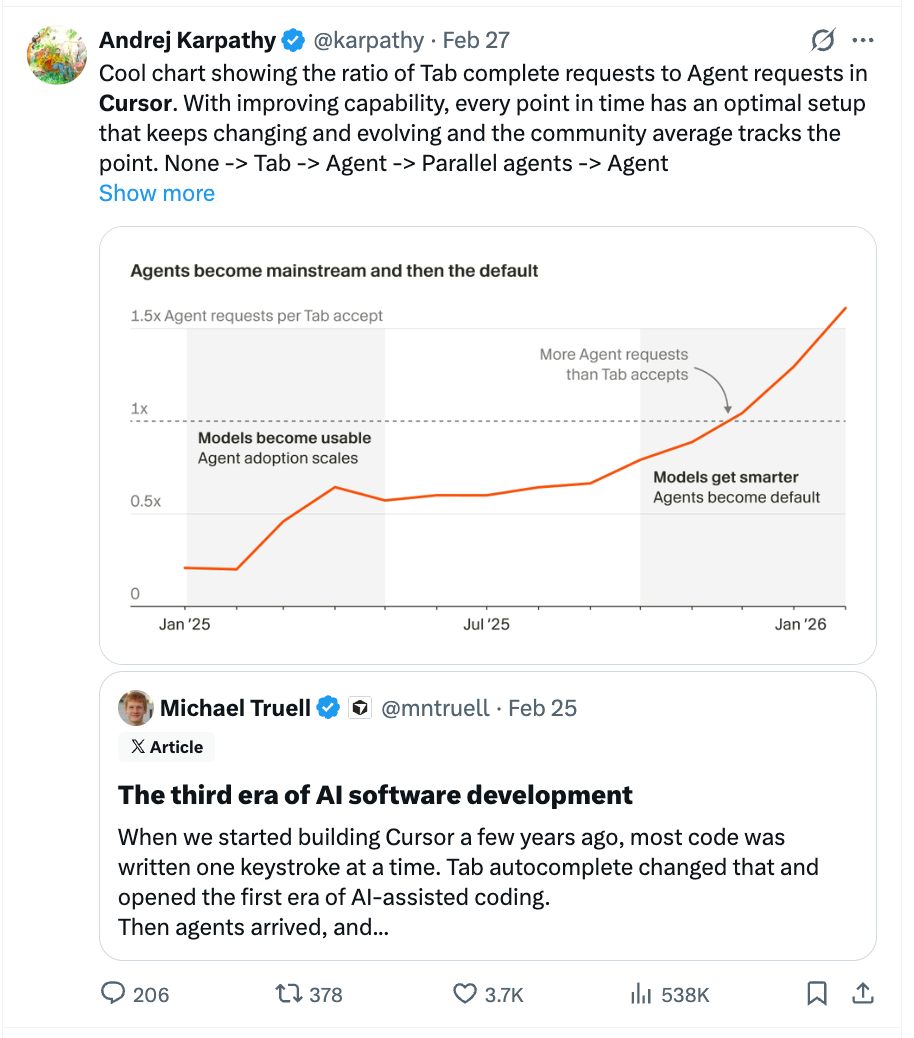
Cursor found an agentic layer combining learnings from models by different providers created a synergistic output, superior to relying on a single, unified model tier. This highlights the value of model diversity in agentic systems, as different models possess unique strengths.
Instead of relying on one powerful model for all tasks, the leading strategy is 'smart routing'—using a panel of models and directing each task to the most appropriate one. This compound architecture demonstrably beats single frontier models on both cost and performance.
Performance comes from a "harness" surrounding the AI model, which includes curated data, tools, and rich context. This harness, which can be open and multi-model, is where the hard work lies—prepping the context layer so that a model's plan can execute efficiently.
Instead of relying on a single "best" foundation model, the winning strategy will be creating "harnesses" that combine multiple models. This approach leverages the unique, exponential advantages of each lab—for instance, using Google's Gemini for multimodal tasks and Anthropic's Claude for code generation.

The Anthropic shutdown shows the danger of relying on one AI model. A robust strategy is to build a proprietary front-end "harness" that controls memory, skills, and data, while being able to dynamically route requests to various backend models.

With new foundation models launching constantly, end-users don't care about the specific model name. A durable AI application should be model-agnostic, using an intelligent agent to select the best model for a given task. This focuses the product on the user's desired outcome, not the underlying tech.
Top-tier language models are becoming commoditized in their excellence. The real differentiator in agent performance is now the 'harness'—the specific context, tools, and skills you provide. A minimalist, well-crafted harness on a good model will outperform a bloated setup on a great one.
