Get your free personalized podcast brief
We scan new podcasts and send you the top 5 insights daily.
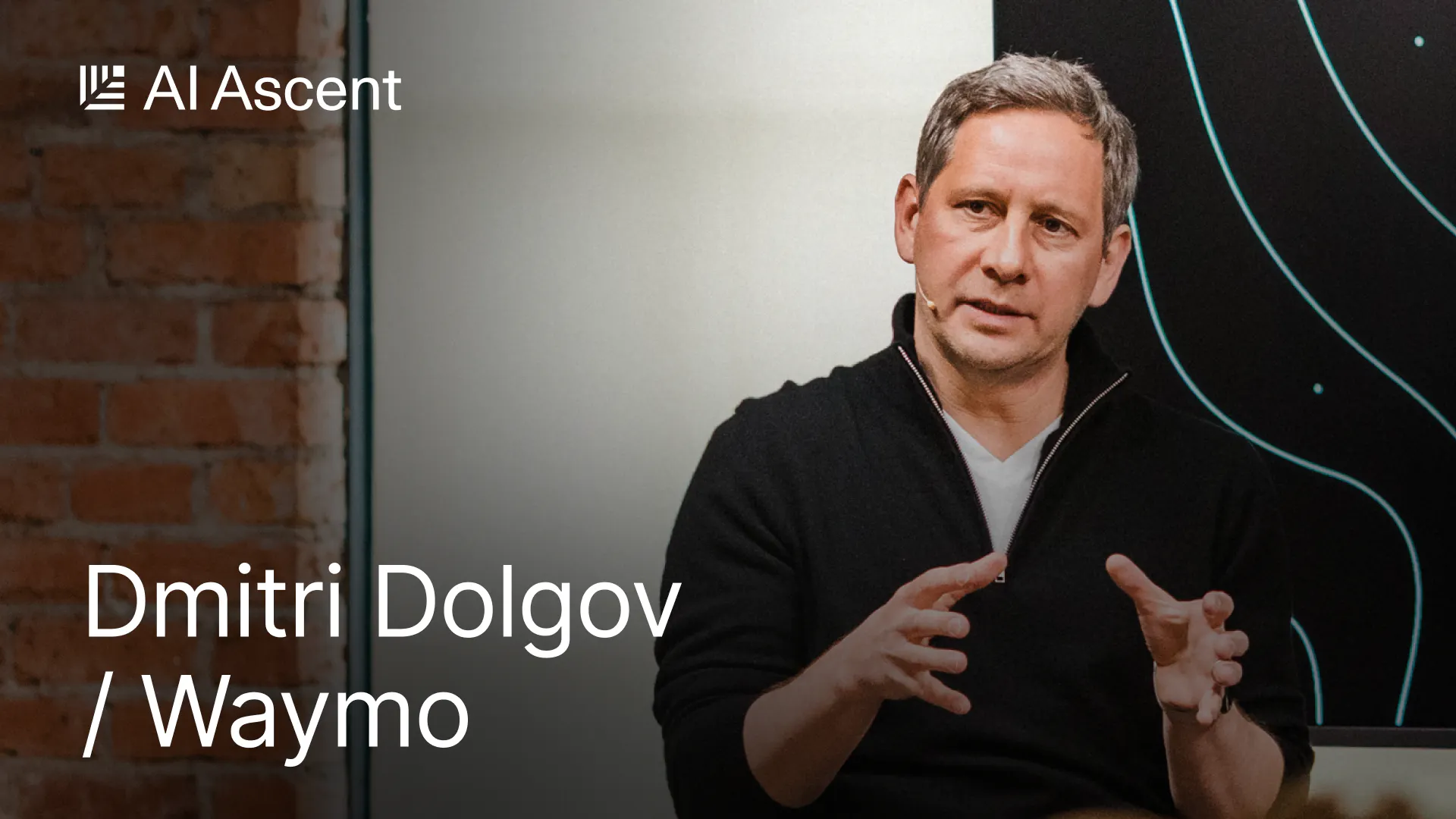
Architectures evolve through waves like ConvNets, Transformers, and VLMs. Without strong foundations in infrastructure, data, and rigorous evaluations, teams become trapped in local minima where changing stacks risks regressions. Waymo's primary capability is not current model weights, but the underlying evaluation machinery that enables engineering teams to execute major paradigm shifts without sacrificing safety or stalling deployment progress.

Related Insights
The move from Waymo's 4th to 5th generation driver was a discontinuous jump. Waymo abandoned smaller, specialized ML models for a single AI backbone trained on a massive, nationwide dataset. This generalizable stack, rather than city-specific tuning, enabled its recent rapid scaling across the US.

Unlike typical tech development that focuses on capabilities first, Waymo embeds safety as a "non-negotiable foundation" from the start. This means building safety into the model architecture and team mindset, as the approach to achieving 90% performance is fundamentally different from reaching the final "nines" of reliability.
AI models and frameworks change constantly. A deep understanding of user needs, encoded into a robust evaluation suite, is a lasting asset. This allows you to continuously iterate and improve quality, regardless of which new model or agent framework becomes popular.

The transition from Gen 4 to Gen 5 was a discontinuous jump that enabled rapid expansion. Waymo made a "big bet on AI," replacing a system of many smaller, specialized ML models with a single, generalizable AI backbone. This new architecture, trained on diverse national data, was the key to scaling beyond specific pre-mapped areas.

As powerful AI models become commoditized, the sustainable competitive advantage will shift from model superiority to architectural robustness. Building systems with independent control planes, clear policy enforcement, and auditable execution paths will be the key long-term differentiator for agentic systems.

A "vanilla" end-to-end model is insufficient for safety-critical systems. Waymo's foundation model is end-to-end but is augmented with "structured materialized intermediate representation." This allows for crucial runtime validation, richer training, and closed-loop evaluation necessary for superhuman performance at scale.
Waymo decouples major hardware and software upgrades. Its 6th generation platform introduces a new custom vehicle and a cheaper, simpler sensor stack, but runs the same proven 5th generation software. This "tick-tock" approach allows them to validate a new hardware platform while relying on a mature, generalizable software stack.
Waymo uses a foundation model to create specialized, high-capacity "teacher" models (Driver, Simulator, Critic) offline. These teachers then distill their knowledge into smaller, efficient "student" models that can run in real-time on the vehicle, balancing massive computational power with on-device constraints.
The rapid pace of AI paradigm shifts—from simple token-in/token-out models to complex agentic systems—forces a complete infrastructure rewrite every 12 to 18 months. Google's lesson for large organizations is to invest in standardized platforms to avoid having every team reinvent the wheel and fall behind.

Dolgov notes that simply open-sourcing or handing over Waymo's current driving model to another team would not enable them to build an autonomous vehicle company. Without the accompanying evaluation metrics, training recipes, simulator infrastructure, and data-driven validation pipelines, engineers cannot test, verify, or iterate on the model with sufficient confidence to deploy it safely in the physical world.