Get your free personalized podcast brief
We scan new podcasts and send you the top 5 insights daily.
Next-generation topoisomerase I payload ADCs are showing up to 50% response rates in platinum-resistant ovarian cancer without requiring high biomarker expression. Unlike mirvetuximab or trastuzumab deruxtecan, these emerging agents could broaden clinical accessibility to broader patient populations without upfront IHC biomarker stratification.

Related Insights
Real-world data shows that in platinum-sensitive ovarian cancer patients who have progressed on PARP inhibitors, subsequent platinum-based chemotherapy has a surprisingly low response rate of only 20%. This quantifies a significant opportunity for highly active ADCs to potentially replace platinum in this growing patient population.
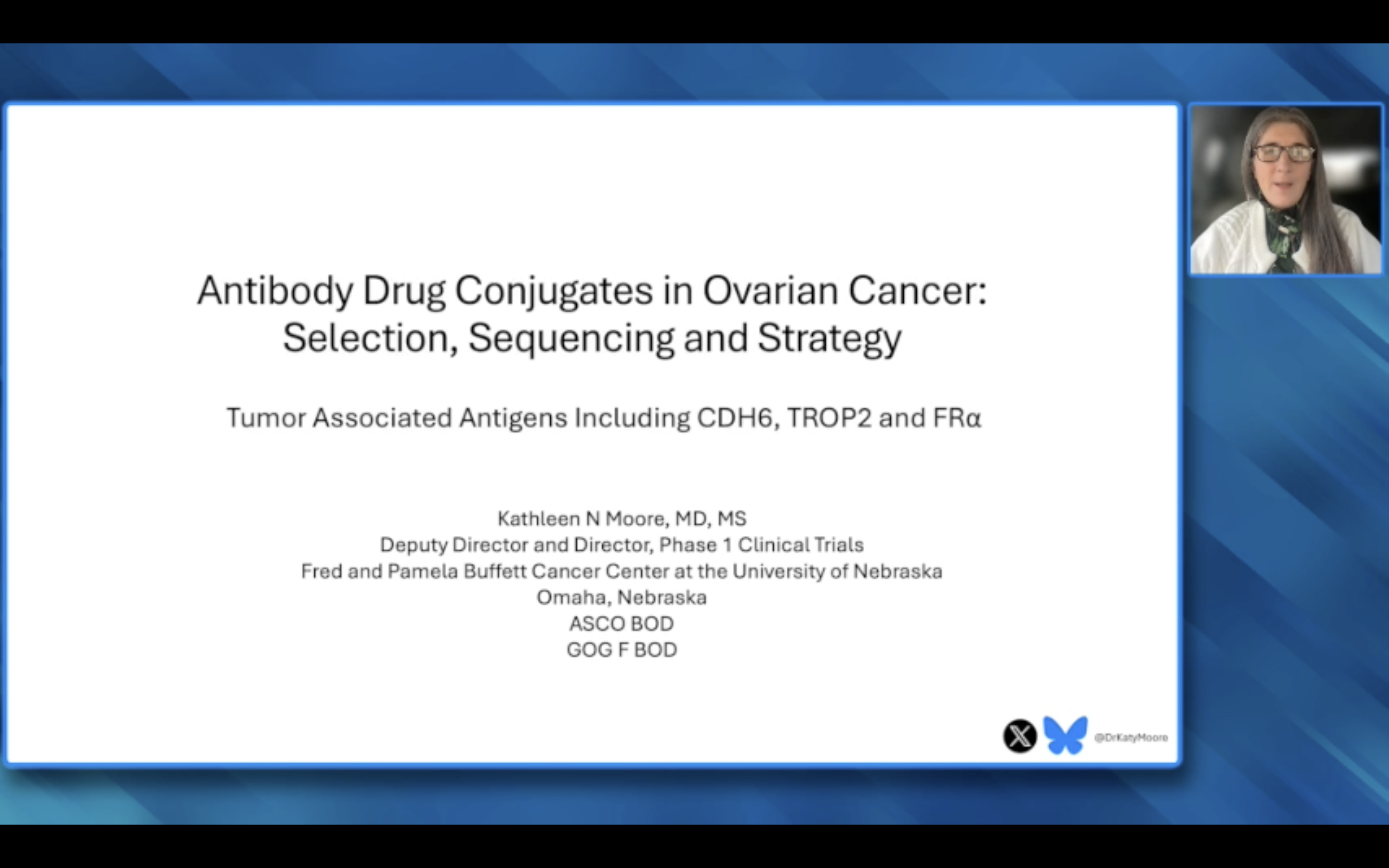
Emerging antibody-drug conjugates (ADCs) targeting folate receptor alpha, such as Sofiem and T-SAM, are demonstrating strong response rates in ovarian cancer patients with both high and low FRα expression, challenging the current high-expression requirement for approved ADCs like mirvetuximab.

Unlike early ADCs requiring high biomarker expression (e.g., mirvetuximab), next-generation agents show efficacy even in low-expressing tumors. This allows for broader, "all-comer" clinical trial inclusion criteria instead of biomarker-gated entry, potentially expanding patient access to these novel therapies.
A new wave of antibody-drug conjugates (ADCs) is transforming ovarian cancer treatment. These 'heat-seeking missiles' deliver potent chemotherapy payloads directly to tumor cells, achieving response rates from 23% to over 60% in biomarker-selected populations. This far surpasses the efficacy of conventional chemotherapy in resistant settings.

Despite concerns about cross-resistance from breast cancer data, experts would consider sequencing ADCs with the same payload (e.g., deruxtecan). The rationale is that even a diminished response rate (e.g., 30%) is still significantly better than the 15% seen with standard single-agent cytotoxics.

A surprising trend in ovarian cancer is the consistent efficacy of antibody-drug conjugates (ADCs) with a TOPA1 payload. Regardless of the specific cell surface target, these agents are achieving response rates around 50%, suggesting the payload's potency is the primary driver.

While numerous antibody-drug conjugates (ADCs) with different targets are in development for ovarian cancer, most use a topoisomerase inhibitor payload. This creates a future clinical challenge, as patients may become resistant to the payload class, limiting the effectiveness of subsequent ADCs regardless of the target.
Most new antibody-drug conjugates (ADCs) for ovarian cancer use the same topoisomerase-1 (Topo1) inhibitor payload. This similarity will likely prevent their sequential use due to cross-resistance, forcing clinicians into a "one-shot" scenario where they must choose the single best Topo1-based ADC upfront for a patient.

Historically, therapies for platinum-resistant ovarian cancer were so ineffective that the order of administration was irrelevant. With the advent of multiple active ADCs, the concept of treatment sequencing and potential cross-resistance based on payloads or targets has become a critical, and entirely new, clinical consideration for this disease.
With multiple new effective options in platinum-resistant disease (relacorilant, pembrolizumab, ADCs), the key clinical question is shifting from choosing one superior drug to determining the optimal sequence. Biomarkers can guide initial choices, but sequencing multiple regimens, including re-using weekly paclitaxel backbones, is now a viable strategy.