Get your free personalized podcast brief
We scan new podcasts and send you the top 5 insights daily.
The feeling that AI development is a "race" is unique to this tech era. According to Aetherflux founder Baiju Bhat, this urgency is fueled by geopolitical competition between the U.S. and China, who both view AI leadership as a national strategic priority, unlike previous consumer-focused tech waves.

Related Insights
Dario Amadei's call to stop selling advanced chips to China is a strategic play to control the pace of AGI development. He argues that since a global pause is impossible, restricting China's hardware access turns a geopolitical race into a more manageable competition between Western labs like Anthropic and DeepMind.

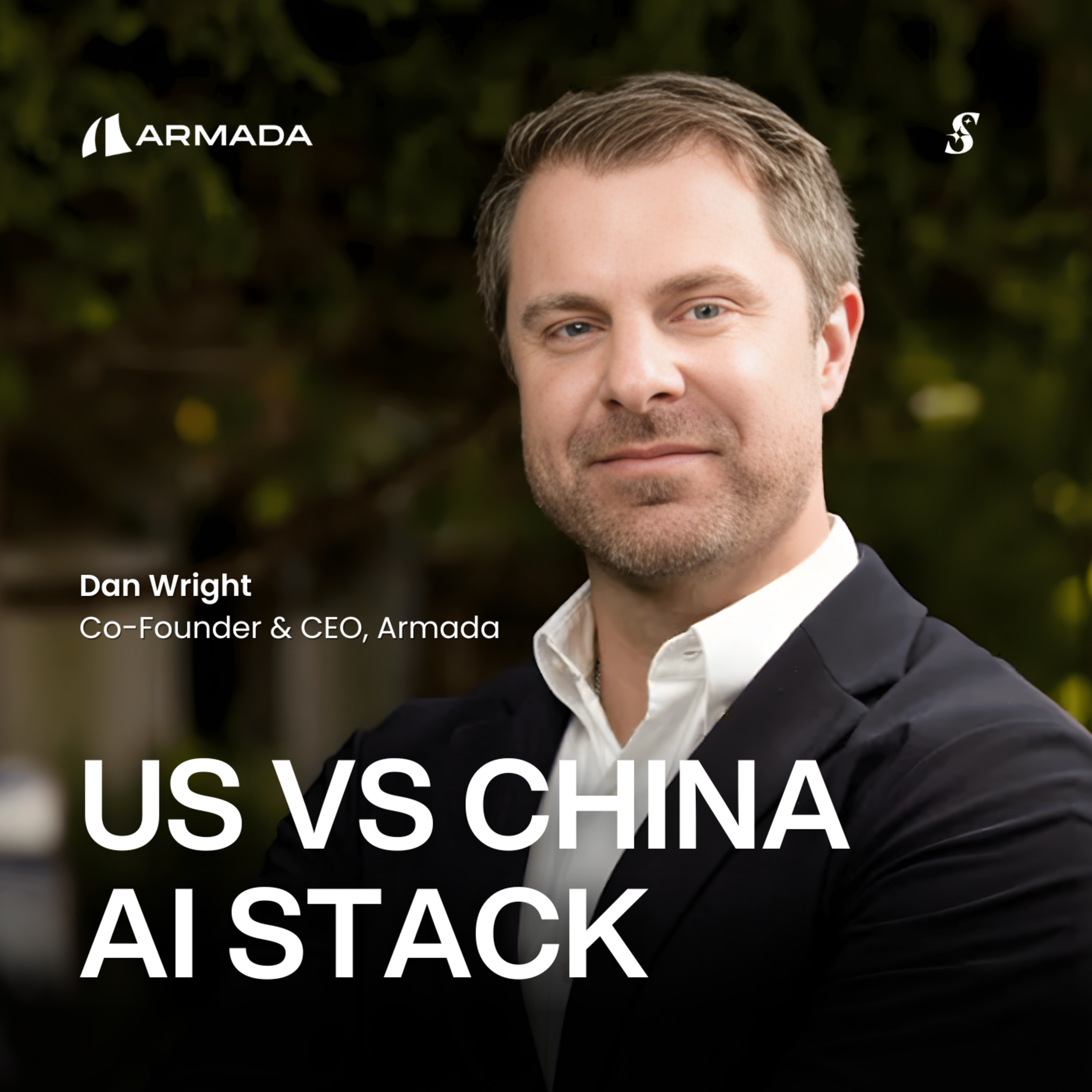
The competition in AI infrastructure is framed as a binary, geopolitical choice. The future will be dominated by either a US-led AI stack or a Chinese one. This perspective positions edge infrastructure companies as critical players in national security and technological dominance.
The US AI strategy is dominated by a race to build a foundational "god in a box" Artificial General Intelligence (AGI). In contrast, China's state-directed approach currently prioritizes practical, narrow AI applications in manufacturing, agriculture, and healthcare to drive immediate economic productivity.

The justification for accelerating AI development to beat China is logically flawed. It assumes the victor wields a controllable tool. In reality, both nations are racing to build the same uncontrollable AI, making the race itself, not the competitor, the primary existential threat.

The conversation around AI and government has evolved past regulation. Now, the immense demand for power and hardware to fuel AI development directly influences international policy, resource competition, and even provides justification for military actions, making AI a core driver of geopolitics.

The development of AI won't stop because of game theory. For competing nations like the US and China, the risk of falling behind is greater than the collective risk of developing the technology. This dynamic makes the AI race an unstoppable force, mirroring the Cold War nuclear arms race and rendering calls for a pause futile.

The idea that AI development is a winner-take-all race to AGI is a compelling story that simplifies complex realities. This narrative is strategically useful as it creates a pretext for aggressive, 'do whatever it takes' behavior, sidestepping the messier nature of real-world conflict.

Major tech companies view the AI race as a life-or-death struggle. This 'existential crisis' mindset explains their willingness to spend astronomical sums on infrastructure, prioritizing survival over short-term profitability. Their spending is a defensive moat-building exercise, not just a rational pursuit of new revenue.

The guest argues that without the massive GDP growth and efficiency gains promised by AI, the U.S. is on a path to being surpassed by China as the world hegemon by 2030. AI is not just an economic boom; it's a geopolitical necessity for maintaining America's global standing.
![Dylan Patel - Inside the Trillion-Dollar AI Buildout - [Invest Like the Best, EP.442] thumbnail](https://megaphone.imgix.net/podcasts/799253cc-9de9-11f0-8661-ab7b8e3cb4c1/image/d41d3a6f422989dc957ef10da7ad4551.jpg?ixlib=rails-4.3.1&max-w=3000&max-h=3000&fit=crop&auto=format,compress)
The US-China AI race is a 'game of inches.' While America leads in conceptual breakthroughs, China excels at rapid implementation and scaling. This dynamic reduces any American advantage to a matter of months, requiring constant, fast-paced innovation to maintain leadership.
