Get your free personalized podcast brief
We scan new podcasts and send you the top 5 insights daily.
Instead of relying on major lab APIs, Harvey created its own model by post-training an open-weight foundation (Kimi K3) on legal data. This strategy resulted in a specialized model that outperformed the base model significantly on legal benchmarks while running at less than a quarter of the cost of leading proprietary models.

Related Insights
Harvey, an early OpenAI investment, is now creating proprietary models on open-source foundations. This signals a major trend where vertical AI companies are protecting their valuable training data and avoiding dependency on platforms that could become competitors.

Companies like Intercom and Cursor are proving that fine-tuning open-weight models on specific, "last-mile" user interaction data creates cheaper, faster, and more accurate models for vertical tasks (like customer service or coding) than general-purpose frontier models from labs like OpenAI.

In data-scarce verticals like law, Harvey AI overcomes the lack of public training data by using coding models to create synthetic documents. This pipeline is so effective that even lawyers can't tell the difference, unlocking the ability to post-train specialized models.
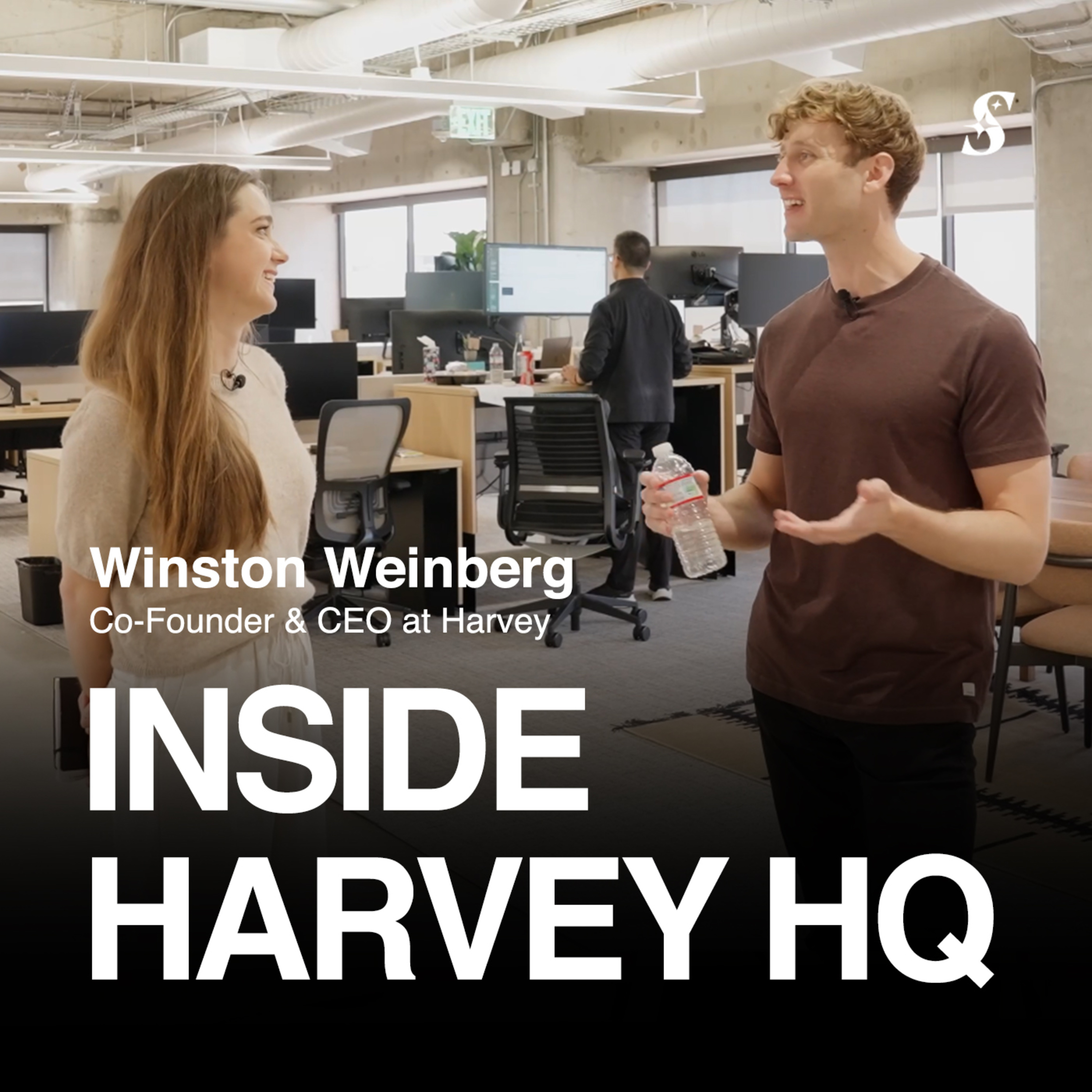
A successful strategy for AI startups is to initially leverage state-of-the-art foundation models to acquire users and data. Once sufficient high-quality, domain-specific data is collected, they can train their own specialized models to drastically cut costs and latency.
Decagon found that fine-tuning smaller, specialized open-source models led to better performance, lower latency, and reduced costs compared to using general-purpose frontier models for specific enterprise workflows. This contradicts the common "smart but expensive vs. dumb but cheap" tradeoff.

While firms can access frontier models directly, platforms like Harvey are essential because they provide a robust security layer for client data and a fine-tuned 'RAG layer' that understands legal nuances better than general models, justifying their cost in a regulated industry.

High-growth platform Lovable is developing its own specialized AI models by adapting and continuously training open-weight alternatives. This strategy allows it to create tailored solutions, increase usage on its proprietary models, and reduce dependency on major third-party AI labs.

Coding assistant startup Cursor exemplifies a new AI playbook: start with a powerful open-weight base model (like China's Kimi), then apply significant reinforcement learning compute (3-4x the base model's) to achieve superior performance in a specific vertical. This strategy avoids the massive cost of pre-training a foundation model from scratch.

By training a smaller, specialized model where company data is in the weights, firms avoid the high token costs of repeatedly feeding context to large frontier models. This makes complex, data-intensive workflows significantly cheaper and faster.

You don't need a massive, nine-figure research budget to build a top-performing AI model for a specific domain. Application-layer companies like Harvey are achieving state-of-the-art results with small teams of just seven researchers by leveraging the maturing ecosystem of post-training and evaluation tools.
