Get your free personalized podcast brief
We scan new podcasts and send you the top 5 insights daily.
Instead of manually refining prompts, a superior workflow uses a model strong in text and logic (like Claude) to generate a highly structured, "OCD-level" prompt. This output can then be fed into a specialized model (like an image generator) to achieve far more precise and desirable results, leveraging the distinct strengths of each AI.

Related Insights
For niche tasks, leverage an AI model with deep domain knowledge (like Claude for its own 'Skills' feature) to create highly specific prompts. Then, feed these optimized prompts into a powerful, generalist coding assistant (like Google's) to achieve a more accurate and robust final product.

When working with multiple AI tools (e.g., an LLM for strategy, another for code, a third for images), delegate the task of writing prompts to your main AI partner. Explain your goal, and have it generate the precise instructions for the other tools. This saves time and ensures greater precision in your communications across a complex AI stack.

Forget complex 'prompt engineering.' When a new AI model is released, find the official prompting guidelines from the creator. Feed this document into a chatbot like ChatGPT and have *it* construct the perfect prompt for you based on your reference image and goals, saving significant time and effort.

A powerful workflow involves using a generalist AI like Claude Opus for initial brainstorming and prompt creation. This refined prompt is then fed to a specialized model like Claude Code for the actual development task, leading to better and more structured results.
Instead of prompting a specialized AI tool directly, experts employ a meta-workflow. They first use a general LLM like ChatGPT or Claude to generate a detailed, context-rich 'master prompt' based on a PRD or user story, which they then paste into the specialized tool for superior results.
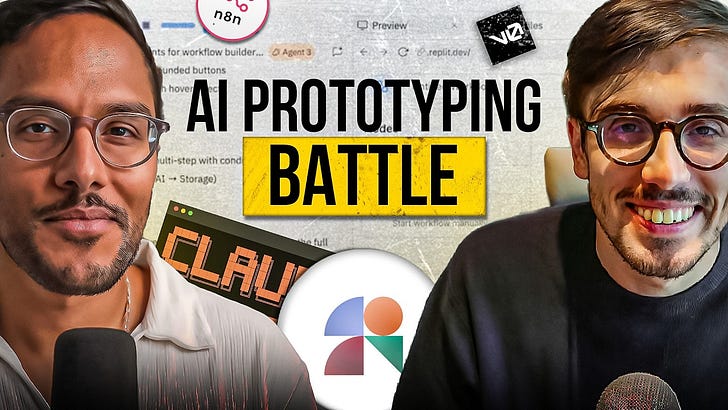
Before delegating a complex task, use a simple prompt to have a context-aware system generate a more detailed and effective prompt. This "prompt-for-a-prompt" workflow adds necessary detail and structure, significantly improving the agent's success rate and saving rework.
Achieve higher-quality results by using an AI to first generate an outline or plan. Then, refine that plan with follow-up prompts before asking for the final execution. This course-corrects early and avoids wasted time on flawed one-shot outputs, ultimately saving time.

Instead of manually crafting complex instructions, first iterate with an AI until you achieve the perfect output. Then, provide that output back to the AI and ask it to write the 'system prompt' that would have generated it. This reverse-engineering process creates reusable, high-quality instructions for consistent results.

Instead of asking one AI to do everything, use different tools for specialized tasks, like using Claude to generate structured JSON data. This 'multi-agent' approach prepares clean, high-quality context for your primary prototyping tool, resulting in a better final output.

Instead of manually crafting complex "mega prompts" or training rules for AI assistants, ask the AI to generate them for you. You can have a dialogue with the AI to refine its suggestions, dramatically speeding up the process of creating sophisticated workflows.
