Get your free personalized podcast brief
We scan new podcasts and send you the top 5 insights daily.
To push for data broker regulation, Civ AI created demos tailored to partisan fears. They showed Republicans how AI could create dossiers on gun owners and Democrats how it could target abortion providers, making the abstract threat of surveillance concrete and alarming to both sides.

Related Insights
Public resistance to AI data centers is not monolithic; it is a coalition of disparate anxieties. The left wing fears job displacement and the destruction of creative arts, while the right wing fears mass surveillance and control from coastal elites. Understanding these different motivations is crucial for addressing public concerns.

Despite hyper-partisanship, the core principles of the Biden administration's AI Bill of Rights have been adopted in proposals by red states like Oklahoma and Florida. This suggests a surprising bipartisan consensus is emerging around the need to protect citizens from specific AI harms.
Digital AI (agents) threatens roles often held by Democrats like journalists and lawyers, while physical AI (robots) impacts jobs Republicans value, such as manufacturing and military. This dichotomy creates divergent political reactions to AI, with blue states being more aggressively anti-AI.

Encode successfully fought federal preemption of state AI laws by uniting "strange bedfellows" like conservatives, parents of children harmed by AI, and artists. Rallying diverse groups with different end goals against a single, shared threat is a powerful political strategy for blocking unfavorable policy.
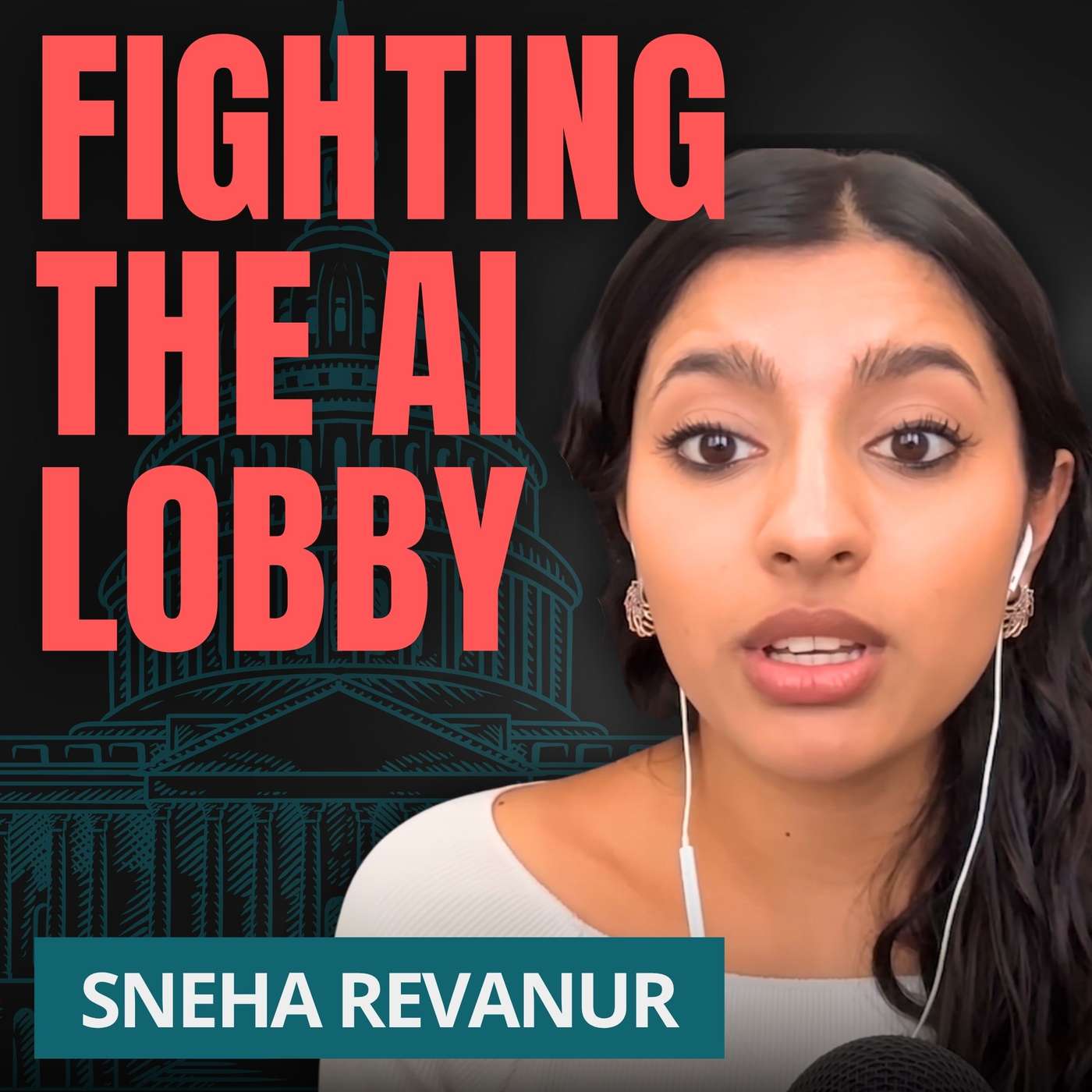
Because the general public poorly understands AI, the topic becomes a blank canvas for political manipulation. Politicians can create any perception they want—from job-stealing menace to national security threat—to shape opinion and move votes.

AI policy is not inherently partisan. Common ground exists where AI intersects with core principles from both parties, such as Republican aversion to government overreach (surveillance) and a shared concern over widespread white-collar job displacement.

Recent polling reveals a dramatic, rapid surge in opposition to data centers across all political affiliations. Lobbyists describe this swift shift in public opinion as unprecedented, making it a rare, potent bipartisan issue in election cycles.

The political battle over AI is not a standard partisan fight. Factions within both Democratic and Republican parties are forming around pro-regulation, pro-acceleration, and job-protection stances, creating complex, cross-aisle coalitions and conflicts.
The economic and societal impact of AI is forcing politicians across the aisle to collaborate. From co-sponsoring legislation on AI-driven job loss to debating state vs. federal regulation, AI is creating common ground for lawmakers who would otherwise rarely work together.

Public backlash against AI isn't a "horseshoe" phenomenon of political extremes. It's a broad consensus spanning from progressives like Ryan Grimm to establishment conservatives like Tim Miller, indicating a deep, mainstream concern about the technology's direction and lack of democratic control.
