Get your free personalized podcast brief
We scan new podcasts and send you the top 5 insights daily.
While AI platforms like Anthropic's Claude Science provide a common workbench, true differentiation for biopharma companies comes from the middle layer. This is where proprietary data, custom-built tools, and expert-guided queries create a competitive edge that the commoditized platform itself cannot provide.

Related Insights
Intelligence from frontier models is now a commodity. The real value comes from Forward Deployed Engineers (FDEs) who customize and apply this general intelligence to a company's specific, unique workflows, creating a competitive edge through superior deployment.

The key for enterprises isn't integrating general AI like ChatGPT but creating "proprietary intelligence." This involves fine-tuning smaller, custom models on their unique internal data and workflows, creating a competitive moat that off-the-shelf solutions cannot replicate.

Since LLMs are commodities, sustainable competitive advantage in AI comes from leveraging proprietary data and unique business processes that competitors cannot replicate. Companies must focus on building AI that understands their specific "secret sauce."

Many pharma companies have breakthrough AI results in isolated functions, or "pockets of excellence." However, the ultimate competitive advantage will go to the company that first connects these disparate successes into a single, integrated, enterprise-wide AI capability, thereby creating compounded value across the organization.

The next inflection point will come from clever data generation strategies optimized for AI models, not human analysis. This "black box data" approach—like pooled screening with sequencing readouts—is vastly more scalable and creates a powerful, proprietary moat for companies.

AI's potential in drug discovery is contingent on having a robust "data factory" to generate massive, high-quality biological datasets. Najat Khan emphasizes that the combination of this data infrastructure, AI, supercomputing, and human expertise is what creates a true competitive advantage, not the algorithm alone.
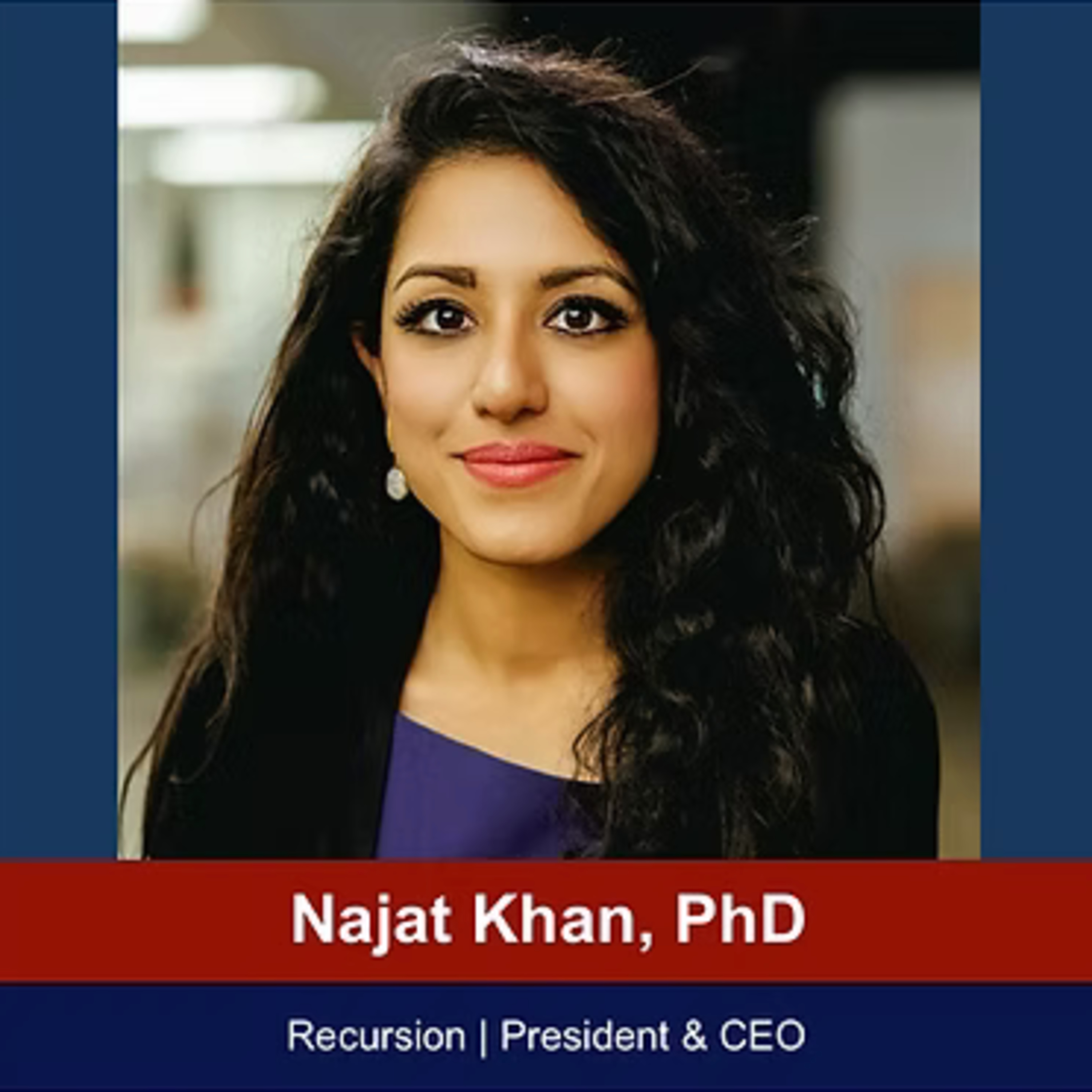
The company's core strategy is "data-first," believing the true long-term differentiator in AI drug discovery is generating unique, high-quality experimental data, not just innovating on model architecture, which they see as prone to commoditization when trained on public data.

As foundational AI models become commoditized, differentiation will come from building specialized platforms for specific business functions like sales or marketing. This involves deep integration with industry-specific data, workflows, and context, making the 'intelligence layer' the key competitive advantage.

The key advantage for AI biotech isn't the model itself, but generating massive, proprietary datasets ("science tokens") via automated labs. This novel data, which doesn't exist publicly, is crucial for training superior models and achieving true scientific intelligence.
![Alex Karnal - The Trillion-Dollar Health Revolution - [Invest Like the Best, EP.467] thumbnail](https://megaphone.imgix.net/podcasts/cbc5538c-3d2c-11f1-abeb-8fa0b9345ba8/image/7338c7270d70078f65b4911eb9cd5b0b.jpg?ixlib=rails-4.3.1&max-w=3000&max-h=3000&fit=crop&auto=format,compress)
The competitive advantage in pharma isn't the sophistication of an AI algorithm, which is often a commodity built on third-party models. The true differentiator is the quality, relevance, and end-to-end consistency of the proprietary data used to train and validate these models. Poor data invalidates even the best analytics.
